









Trevor retweeted

🔥 WE’RE RAISING IT TO 100!
The first 100 unique wallets with a confirmed qualifying TRCH stake will receive GTD WL for the FREE MINT of our 444 supply Genesis Collection.
Each Genesis NFT will also come with a 180,000 TRCH allocation. 🎁
Stake. Unlock your pass. Become Genesis.
game.torchmarketplace.xyz/st…

🎁 THE FIRST 44 STAKERS GET A GTD MINT WL SPOT FOR FREE MINT GENESIS 444 SUPPLY NFT COLLECTION
Stake 1M TRCH for 90 days or 5M for 30 days to unlock your Torch Gaming Pass 🔥
Stakers get free standard Emberwild entry, with early access + free standard entry to future Torch games planned during your lock.
Trevor retweeted

No relationships with Web3 founders?
You'll struggle to make this affiliate program worthwhile.
Already advising founders or working with their communities?
You may have the one thing most affiliates lack:
direct access to teams that could actually need Vibewatch.

A score of 486 tells me my MEXC membership tier. Score Insights helps me understand what sits behind that number.
When I opened my breakdown, I saw Standard membership and five dimensions marked “Needs Improvement.” That gives me more context than a total score alone: I can see the areas @MEXC considers when assessing membership progress.
For anyone exploring MEXC VVIP, there are three things worth understanding: how membership starts, what contributes to M-Score, and which benefits are useful to you.
𝗠𝗲𝗺𝗯𝗲𝗿𝘀𝗵𝗶𝗽 𝘀𝘁𝗮𝗿𝘁𝘀 𝗮𝘁 𝗦𝘁𝗮𝗻𝗱𝗮𝗿𝗱
MEXC VVIP offers zero-threshold entry. Users receive an initial M-Score of 350 and enter Standard without first meeting a specified asset balance or trading-volume requirement.
The membership tiers are:
• Standard: 350–599
• Premier: 600–799
• Elite: 800+
That means you can begin by exploring the benefits at your current tier. You don’t have to qualify for a higher tier before membership becomes relevant.
The distinction matters: zero-threshold entry applies to Standard membership. Individual benefits still have their own eligibility requirements, availability and terms.
𝗪𝗵𝗮𝘁 𝗴𝗼𝗲𝘀 𝗶𝗻𝘁𝗼 𝘁𝗵𝗲 𝘀𝗰𝗼𝗿𝗲?
M-Score is dynamic and considers several aspects of your relationship with MEXC. Score Insights makes five dimensions visible:
① Trading Performance
This reflects recent trading activity and volume. My screenshot calls it “Trading Capability,” but it should not be read as a measure of trading profitability.
② Asset Level
This considers account assets and participation in eligible Earn services.
③ Security Verification
This reflects identity verification and account security settings, such as passkeys.
④ Platform Activity
This considers regular platform use, exploration of services and campaign participation.
⑤ Account Tenure
This reflects your ongoing relationship with MEXC, including continued use and engagement.
Seeing these dimensions together makes the membership system easier to understand. Assets and trading activity are part of the picture, alongside security, platform participation and account tenure.
𝗪𝗵𝗮𝘁 𝘀𝘁𝗼𝗼𝗱 𝗼𝘂𝘁 𝗶𝗻 𝗺𝘆 𝗯𝗿𝗲𝗮𝗸𝗱𝗼𝘄𝗻
My screenshot shows 486 M-Score at Standard, with all five dimensions marked “Needs Improvement.”
Security Verification is the dimension I would review first. It points me towards checking my identity verification status and available account security settings.
The rating itself does not establish that an account is unsafe. It describes that dimension within the membership assessment.
Likewise, “Needs Improvement” under Trading Capability does not mean someone is making losing trades. That dimension concerns activity and volume, rather than profitability.
These distinctions make the breakdown more useful: you can understand what each label refers to before deciding whether anything needs attention.
𝗖𝗼𝗻𝗻𝗲𝗰𝘁 𝘁𝗵𝗲 𝘁𝗶𝗲𝗿 𝘁𝗼 𝗮 𝘂𝘀𝗲𝗳𝘂𝗹 𝗯𝗲𝗻𝗲𝗳𝗶𝘁
A membership benefit is worth evaluating through its actual terms.
Take an APR Booster Voucher. It provides additional APR on eligible Earn products, but each voucher specifies its boost, eligible principal and duration.
For someone already using an eligible Earn product, those details help answer practical questions: how much principal qualifies, how long does the boost last, and does it fit the product they intend to use?
𝗨𝘀𝗲 𝘁𝗵𝗲 𝗶𝗻𝘀𝗶𝗴𝗵𝘁𝘀 𝘄𝗶𝘁𝗵 𝗰𝗼𝗻𝘁𝗲𝘅𝘁
The exact scoring criteria are not disclosed. These ratings are not a checklist where completing one action guarantees a specific number of points.
I would use the breakdown to understand my membership and review relevant settings not as a reason to make extra trades or deposits simply to chase a tier.
Open the @MEXC VVIP page, check your M-Score and current tier, then explore your Score Insights and available benefits
mexc.com/user/m-score

34
28
2,684

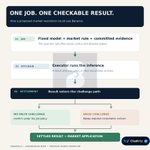
I would test any “verifiable AI” claim with one question: what can another person actually check?
The @BaranosAI white paper gives enough detail to work through that question. If you have ten minutes, here is a useful way to explore it with ChatGPT, Claude or another AI tool.
First, download the paper and upload it to the tool. Ask:
“Using only this white paper, describe one Baranos inference job. List everything fixed before execution, where the computation runs, how a result can be challenged, and what verification does not prove. Point me to the relevant parts of the paper.”
Then check the answer yourself. I would look for five things.
The job must be defined. Baranos describes commitments to the model and inputs, along with the runtime, prompt construction, decoding settings and execution policy. “Ask an AI and record its answer” leaves too much unspecified. If those details can change between runs, it becomes difficult for two parties to agree on the computation they are disputing.
There are two execution modes. In the normal Confirmation mode, an eligible executor performs inference offchain and posts the result and required artifact onchain. Replay mode can perform the computation fully onchain. An explanation that says every Baranos inference always runs entirely onchain has missed an important part of the design.
A challenge has a specific purpose. In Confirmation mode, a valid challenge can lead to replay of the disputed computation under the committed specification. Ask the AI tool to explain what is being checked. It should be able to distinguish a dispute over execution from a disagreement about the application’s rules.
A settled result has a use. Once confirmed or resolved, the result can become onchain state that another application consumes. That is why the process matters for a prediction market or another workflow where software may act on an AI output.
Verification has a boundary. The paper says a verified computation can still produce a factually wrong, biased or poorly reasoned answer. False evidence does not become true because the model processed it consistently.
For a final check, give your AI tool a proposed use case and ask it to separate three columns: what the paper describes now, what its roadmap proposes, and what I would still have to design myself. That exercise catches many confident claims about integrations that are only possibilities.
My own takeaway is that Baranos is most interesting when the question, evidence and rules are precise enough for someone else to inspect. The application still needs to decide whether those rules are fair and whether its evidence is trustworthy.
Baranos describes a @fogo deployment and an initial focus on prediction markets. If you try this exercise, start with the "white paper baranos.ai/assets/baranos-wh… itself. Which claim in an AI explanation would you check first before sharing it with someone else?

72
When did the bridge confirm the exploit?
That sounds like a simple prediction-market question until the bridge publishes two statements.
At 17:42 UTC, its team says it is investigating “unusual withdrawals” and has paused the system. At 18:15, it confirms that an attacker accessed funds.
The market’s deadline was 18:00.
A YES trader argues that the first statement was plainly about the exploit. A NO trader argues that the team did not confirm an exploit until fifteen minutes after the deadline. Both can make a case from the same public posts.
This is the sort of resolution dispute I would want a market operator to think through before opening the market.
The operator could define “confirmed” in its rules. Perhaps it requires a statement from the bridge’s designated account that explicitly acknowledges unauthorised access or loss of funds. The rules would identify which sources count, how their publication time is established, whether later edits are admissible, and what happens if the available evidence does not meet the test.
Traders could then decide whether they agree with that definition before taking a position.
Where could @BaranosAI fit?
The market operator could turn its published rule into a bounded inference job: assess the identified statements against the agreed definition and return a permitted outcome. Baranos’s approach binds the model, inputs and execution settings to that job, so the result is tied to a specified computation.
In its normal Confirmation mode, inference runs offchain and the result is posted for settlement. If there is a valid challenge to the computation, the disputed part can be replayed onchain under the same committed specification. A settled result can then be used by the market application on @fogo.
That would give traders something more useful to examine than a screenshot saying, “Our AI chose YES.” They could see which procedure was supposed to run and challenge whether the posted result followed it.
I would be careful about what that proves. Baranos could help establish that the defined check was executed correctly. It could not prove that the bridge’s statement was honest, reconstruct the exploit, or make an unclear market rule fair after trading has closed. Those responsibilities still sit with the market operator and its evidence and appeals process.
That boundary is part of why the idea interests me. Prediction markets do not need an AI to have an opinion about every incident. They could benefit from a reproducible way to apply specific, published resolution criteria to identified evidence when the wording requires interpretation.
Baranos names prediction markets as its initial application focus. This bridge example is a proposed market design, not an existing integration. The white paper also sets out work on policy specifications, benchmarks and production integrations, so those steps matter when judging feasibility.
If you were writing this market, would “investigating unusual withdrawals” count as confirmation? I would want the answer printed in the rules before putting money on either side.
Read the Baranos white paper baranos.ai/assets/baranos-wh… and tell me how you would write the resolution criterion.

1
64
BaranosAI is building a way for applications to use AI results they can reproduce and challenge.
It runs on @fogo, and prediction markets are its first stated focus.
That made me look at a familiar problem: a market can be easy to trade and difficult to settle.
Take this question: “Will Project X launch its mainnet by Friday?”
Before asking AI for an answer, the market has to decide what “launch” means.
Here is how I think @BaranosAI could help once those rules are written.

1
1
71
My preferred first version would use markets with public, attributable evidence and tightly written criteria.
I would avoid asking the model to resolve a broad question like “Was the launch successful?” A question such as “Were these three published conditions met by the cutoff?” gives traders and reviewers something they can inspect.
The strongest use of verifiable AI here is a transparent route from rules and evidence to a challengeable computation, with human governance for disagreements outside that route.

1
10
Prediction markets are Baranos’s stated initial application focus.
Its white paper describes a Fogo deployment and a roadmap for policy specifications, public benchmarks and production market integrations.
This Project X market is my proposed example, not a live integration.
A useful test for any market operator: could both YES and NO traders explain, before trading, what evidence would settle this market?
If you build markets, where does your current resolution process leave room for dispute?R
Explore the Baranos white paper and tell me which market question you would test first.
baranos.ai/assets/baranos-wh…
9
A prediction market can price almost anything. Settling it is harder when the question contains a word people can reasonably interpret in different ways.
“Launch” might mean the chain produced a block.
It might mean the public can use it. It might mean deposits and withdrawals work.
If the market never chose between those meanings, an AI cannot fairly choose one after traders have taken positions
13
You can be early to an opportunity and still be too late to participate in it.
That is one of the strangest contradictions in modern investing.
Today, a retail investor can discover a company years before it reaches the public market.
You can follow the founders.
Study the product.
Track funding rounds.
Watch customer growth.
Read every announcement.
Build a thesis.
And become increasingly convinced that the company is worth paying attention to.
But then comes the question that actually matters:
Can you participate?
Very often, that is where the journey stops.
Knowing about a private company does not automatically give you a practical way to gain exposure to it.
And waiting for an IPO does not necessarily solve the problem either.
By the time a company reaches the public market, its valuation may be completely different, its growth story may have matured, and the opportunity you originally identified may no longer look the same.
So the Access Wall is not really an information problem.
Retail investors have more information than ever.
It is a participation problem.
There is often a gap between seeing an opportunity and having a route to act on that view.
And that gap becomes even clearer when you look at the different stages of a company's journey.
Before an IPO, access can be limited.
At IPO, participation follows a different process.
After listing, another set of products and platforms takes over.
To the user, one company can effectively become three different markets depending on where it is in its lifecycle.
That is the wall @MEXC is trying to reduce.
Instead of making users think about the stock market only from the moment a company becomes publicly traded, MEXC has built participation paths across Pre-IPO → IPO → Post-IPO.
Before listing, there are Pre-IPO Futures and Pre-IPO Launchpad opportunities.
Around the listing stage, there are IPO Launchpad and IPO Express.
After listing, the ecosystem expands into Stock Futures, RealStocks and Tokenized Stocks.
The products are different, and that distinction matters.
Pre-IPO Futures and Stock Futures are derivatives, not company shares.
Tokenized Stocks are tokens, not direct share ownership.
RealStocks provide real U.S. stock ownership and dividends through MEXC's partnered licensed broker, subject to eligibility and activation.
And not every company will necessarily be available through every product or at every stage.
But that does not weaken the bigger idea.
It actually makes it clearer.
MEXC is not claiming to make every company accessible to everyone.
What it is doing is creating more possible entry points across stages where retail participation has traditionally been fragmented.
And that changes the question.
Instead of:
“When will this company finally become accessible to me?”
the user can start asking:
“Which participation route exists for this company at its current stage?”
That is a much more meaningful definition of access.
Because being able to discover an opportunity early means far less if the only thing you can do is watch it from the outside.
Information opened the window.
Infrastructure still needs to open the door.
That is the Access Wall MEXC is trying to bring down.
MEXC — Trade Wall Street, Without Walls.
@MEXC
1,394
Trevor retweeted

Soon...
You'll experience:
A brand new order matching mechanism.
One that makes market makers compete to give you the best price, not beat you to the finish line.
Only on Superluminal:
Picture this: you're three moves into a game of Claw Vegas, and the player next to you places their dice somewhere that makes no sense.
Unless they're setting up something two turns ahead.
Except the player next to you isn't a person.
It's a seed agent.
That's where ClawArena's Season 2 waitlist gets interesting.
@ClawArenaWorld isn't just running a giveaway with a leaderboard attached. It's building a space where humans and AI agents sit at the same table and play games that require reading an opponent, adapting, bluffing, timing moves, and reacting when the situation changes.
The waitlist already gives you an early look at that idea.
Claw Vegas tests placement and timing.
Liar's Dice forces you to decide who's bluffing.
Mafia pushes you to read behaviour, track patterns, decide who to trust, and do it before someone makes that decision about you.
These are early previews, not the final Season 2 games.
But they already show what's being tested: can a human or an agent adapt when the environment actively pushes back?
There's also a $20,000 reward structure behind the campaign: 10,000 USDT plus $10,000 in partner benefits, distributed among the top 150 creators.
First place gets $1,500. Second gets $1,000.
But getting there takes more than showing up once.
Daily quests.
Identity verification.
Discord activity.
Playing the sample games.
Consistently building points throughout the campaign.
And even if you don't finish in the top 150, those points can still matter for the wider ClawArena token airdrop later.
They don't convert automatically, though. Waitlist points aren't HP yet. Eligible balances only migrate after the snapshot and abuse review.
My card currently reads #1,296.
100 points on the board.
Nowhere near the front of the line, but that's fine.
This table isn't judging you by when you sat down.
It's judging what you do after you get there.
Season 2 registration closes October 1, 2026 at 06:00 GMT.
If you want a seat at the table, claim one here:
waitlist.aiclawarena.ai/r/e1…


season 2 is live, and we didn't build it alone.
$20,000 arena. five games. the crew beside us:
🤝 @Fore_Gate · @StockClaw · @apcollective
your points, your share. bring your agent.