

From a world that carried meaning to a self that must—tracing how different traditions locate reality.
London
Joined January 2019
- Tweets5.2K
- Following2.2K
- Followers3.2K
- Likes259K




Pinned Tweet
1/5
Who first said Laozi became the Buddha?
In 166 CE, the Han official Xiang Kai (襄楷) recorded it as hearsay: "Some say Laozi entered the lands of the barbarians and became the Buddha."
He reported the idea. Where it began, we don't know. 🧵👇

1/7
Ancient China's most famous fake miracle.
Emperor Wu of Han (汉武帝) wanted to glimpse the dead. One man claimed he could make it happen and won wealth, honours and the rank of general.
His downfall began with a message hidden inside a cow's stomach. 🧵

7/7
Sima Qian records the outcome:
「于是诛文成将军而隐之。」
"Thus General Wen Cheng was executed, and the matter was concealed."
One of ancient China's most famous miracle workers was exposed by the oldest forensic evidence of all: his own handwriting.
1
8
29
Speed isn't the only measure of a good riding horse. Smoothness, steadiness and the relationship between horse and rider matter just as much.


1/3
In the Shang and early Zhou dynasties, human victims—including captives and attendants—were sometimes buried with the dead.
By the Warring States period, wooden figurines had become increasingly common in Chu tombs, serving as substitutes for the living. 🧵

ALT Funerary Figure
3/3
Not everyone approved. The Mencius records Confucius condemning those who first made tomb figures (始作俑者), because they resembled living people too closely.
The phrase survives today as a Chinese idiom for the person who starts a bad precedent.
5/5
Pilgrims & translators brought detailed knowledge of the Buddha centuries earlier, yet the claim lingered: precedence, not evidence.
In 1281, the Yuan emperor Kublai condemned the tradition & ordered controversial Daoist texts destroyed.
Exchange gave way to competition.
1
16
141
1/8
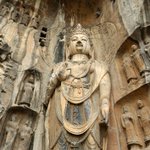
If the story of Buddhism's spread and transformation in northern China could be told through three places, they would be Dunhuang, Pingcheng, and Luoyang. 🧵
7/8
Together, these three places tell a remarkable story:
Dunhuang witnessed Buddhism travelling into China.
Pingcheng witnessed its flourishing under imperial patronage.
Luoyang witnessed its further transformation through Chinese artistic and cultural traditions.