




Pinned Tweet
Most companies are experimenting with AI. Few can show measurable ROI.
One of the main issues is the lack of operating evidence: a clear view of how operations actually run and where AI can create value.
𝐋𝐚𝐦𝐩𝐢’𝐬 𝐀𝐈 𝐓𝐫𝐚𝐧𝐬𝐟𝐨𝐫𝐦𝐚𝐭𝐢𝐨𝐧-𝐚𝐬-𝐚-𝐒𝐞𝐫𝐯𝐢𝐜𝐞 𝐜𝐥𝐨𝐬𝐞𝐬 𝐭𝐡𝐚𝐭 𝐠𝐚𝐩.
Within days, @lampi_ai analyzes authorized context across relevant company data to map how the business operates.
It builds digital twins and turns signals into actionable intelligence:
→ An operating digital twin showing how operations run
→ A customer twin identifying revenue opportunities
→ ROI prioritization showing the highest-impact AI opportunities
Each opportunity is assessed by return, feasibility, data readiness, and time to value.
The strongest opportunities are converted into governed AI agents and deployed inside existing workflows.
Every agent operates within defined permissions, approval paths, and ownership rules, with human oversight, traceability, and value measurement built in.
Find the value. Deploy the agents.
For more: lampi.ai/ai-operating-partne…


Clément Herr retweeted

First time I've seen this in an NDA - a section governing how you can use AI when evaluating the deal.
Basically - you may not upload this to the non-enterprise version of Claude/Chat and let it train on our CIM


Clément Herr retweeted

Two AI companies have added more revenue this year than all of public software combined
More charts in State of Markets II: a16z.news/p/state-of-markets…


Introducing our State of Markets pt 2, along with a companion podcast where we unpack the data and discuss what comes next.
Tech is the everything cycle.
Supply: putting the buildout in context, just passed railroads as % of GDP. The wisdom of Elon is real: the factory (or the datacenter!) is the product.
Demand: diffusion is so, so early. Median AI vendor spending in the top 1% of companies is 8x that of the top 10%. Only about 30% of S&P 500 companies report a quantified AI impact, which means there’s a substantial opportunity in connecting models to a company's data and workflows. Diffusion into companies is one of the main themes of the next 5 years.
We’re entering the agent work period. Only a few million users today, but applicable to billions of internet users with massive surplus created. META/GOOG monetize US users at $200+ per year today. Agent opportunity is much higher.
Mega-trends the next 5 years: Consumer agents, Robotics, Autonomy, AI x bio, Personal health, Diffusion into enterprise, New era of American Dynamism.
Much more in our SoM report here - a16z.news/p/state-of-markets…
@a16z @sarahdingwang @aleximm @santiago__rdz


Google is so back. Gemini 4 Argon looks impressive.
The huge gap on legal agentic work stands out: 19.6% on Harvey’s Legal Agent Benchmark vs 5.4% for GPT-6 Astra, 6.7% for Claude Fable 5.1 and 3.8% for Opus 5.5.
Introductory pricing is $2/M input + $10/M output, then $4/$20, still 2.5x cheaper than Astra/Fable.
Pretty wild performance for the price.

Lots of discussion out there about our next model(!), so I wanted to give an early look as soon as possible. Introducing Gemini 4 Argon!
It shows frontier performance in complex workflows, cyber defense and software engineering. Teams are using it extensively at Google, from coding to quantum computing, great feedback.
Here’s a look at the benchmarks:

Clément Herr retweeted

Today, with over 100 industry partners, we introduced the NVIDIA Open Agent Safety Platform, bringing together OpenShell and Sentry.
Artificial intelligence is extraordinary technology that will advance discovery, productivity, security, health, and prosperity for generations to come.
But its full promise can only be realized when people have confidence that AI is being built to be safe and deployed with wisdom and responsibility.
This is bigger than a single product. It's the beginning of an open ecosystem to build the trust layer for safe agent systems.
Together, we are building the foundation of the AI economy.
Trust and innovation are not in conflict. Safety is how trust is earned. We must build not only the most capable AI, but the most trusted AI, so that this extraordinary technology can realize its enormous promise for the world. nvda.ws/4hcoq7m


𝐎𝐏𝐔𝐒 𝟓.𝟓 𝐁𝐄𝐍𝐂𝐇𝐌𝐀𝐑𝐊 𝐉𝐔𝐒𝐓 𝐃𝐑𝐎𝐏𝐏𝐄𝐃.
The coding numbers are strong, but the knowledge work benchmarks are what matter most to me.
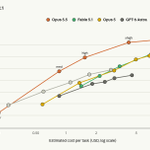
On GDPval-AA v2.1, Opus 5.5 scores 1846, ahead of Fable 5.1, Opus 5, and Astra.
At lower effort, Opus 5.5 seems to produce:
- fewer false positives in review tasks
- better structured financial answers
- more industry-standard slides
- more relevant citations
- better handling of hidden assumptions
- less tendency to stop at the first plausible answer
That looks promising for serious knowledge work in enterprise AI.
Testing it.

Clément Herr retweeted

Looks like today may be a record day for token volume % of open models on Vercel AI Gateway:
🟦 Open 78.4% 🟨 Closed 21.6%
While spend 💲 usually tells a different story, #3 and #4 today are Moonshot AI & DeepSeek. Adding Z.ai, their combined spend surpasses OpenAI (#2).
(Do note that's the spend for inference of the model across providers (mostly in the US), not revenue going directly to the open weight labs.)

Clément Herr retweeted

JUST IN: Anthropic is considering releasing a new AI model to counter OpenAI’s GPT-6 Astra momentum, just days after CEO Dario Amodei called for the industry to “slow the pace” of AI development. — Reuters
I’m convinced that Jev, or the next "System One model", will play a big role in AI orchestration.
When building an agent harness, you quickly realize that a lot of the work around the LLM is not open-ended reasoning, but rather bounded decision-making: supervising workers, detecting issues, routing tasks, evaluating progress, selecting tool calls, filtering context, triggering retries, escalating, etc.
Jev will not replace frontier LLMs. It will sit around them.
- #Jev: fast, deterministic decisions.
- Frontier #LLMs: expensive, intelligence work.
That’s the interesting split
With all the hype around #Jev, we wanted to test it.
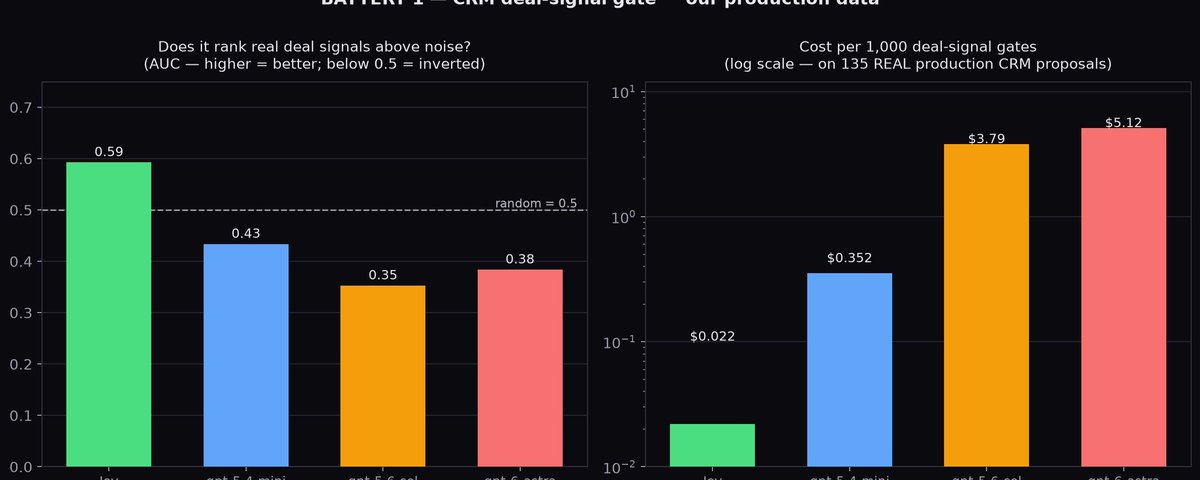
We tested it againt gpt-5.4-mini, gpt-5.6-sol, and gpt-6-astra across few use cases: detecting real deal signals, routing user requests, selecting the right tools, deciding what to remember (memory), and workflow discovery.
We know that LLMs are an expensive way to make deterministic choices. The question is wheather Jev might change this economic.
First, the cost gap was brutal: 𝐉𝐞𝐯 𝐢𝐬 𝟏𝟔𝐱 𝐜𝐡𝐞𝐚𝐩𝐞𝐫 𝐭𝐡𝐚𝐧 𝐦𝐢𝐧𝐢, 𝐚𝐛𝐨𝐮𝐭 𝟏𝟕𝟎𝐱 𝐜𝐡𝐞𝐚𝐩𝐞𝐫 𝐭𝐡𝐚𝐧 𝐬𝐨𝐥, 𝐚𝐧𝐝 𝐚𝐛𝐨𝐮𝐭 𝟐𝟑𝟎𝐱 𝐜𝐡𝐞𝐚𝐩𝐞𝐫 𝐭𝐡𝐚𝐧 𝐚𝐬𝐭𝐫𝐚.
But the result was more interesting than “Jev is cheaper.”
Across our tests, Jev performed particularly well on narrow, high-volume gates: deal-signal detection and workflow discovery, while GPT-5.4-mini was stronger at tool routing, and the larger models performed better on complex memory judgments.
The key takeaway: 𝐉𝐞𝐯 𝐥𝐨𝐨𝐤𝐬 𝐥𝐢𝐤𝐞 𝐚 𝐠𝐚𝐭𝐞𝐤𝐞𝐞𝐩𝐞𝐫, 𝐧𝐨𝐭 𝐚 𝐠𝐞𝐧𝐞𝐫𝐚𝐥𝐢𝐬𝐭.
Instead of asking one expensive LLM to make every decision, you can use a cheap, calibrated model to filter the massive volume of simple decisions, and reserve the expensive reasoning models for the cases that actually require them.
Cheap gate → rich reasoning → action.
We are definitely going to keep testing this approach.

Many private equity firms want to adopt #AI. Far fewer have a clear strategy for turning it into measurable ROI.
That is why our approach at @lampi_ai has always been use-case first.
We identify specific tasks, understand the existing deal-team workflow, and focus implementation where AI agent can make a concrete difference.
In this article, we share what that looks like in practice through use cases we have implemented with PE firms — from back-office tasks to deal screening, due diligence, and portfolio value creation.


Clément Herr retweeted

This is exactly how our automation already runs in production:
Typed workflow specs.
Deterministic validators.
Confidence thresholds.
Review gates.
Code owns the loop.
The llm judges the evidence.


Clément Herr retweeted

Last month I wrote about how we can build a positive and safe future for everyone: meta.com/thefutureisforevery…
Every lab has the responsibility and incentive to move at the pace required to train its models safely, and the ability to take its own actions to ensure that happens.
The reality is:
- People won't want to use agents that are misaligned with them and that don't do what they ask, so labs have a strong natural incentive to make their models more aligned.
There is a lot of debate about slowing progress on capabilities until alignment catches up. My view is that trust and alignment are quickly becoming the most important capabilities that will differentiate agents and models. Any lab that doesn't focus on alignment will fall behind.
- Labs face significant liability if their models cause harm, so they have a strong incentive to prevent this as well.
Meta delayed shipping Muse for several months to focus on safety and security. We didn't call for everyone else to do this before we would. We just did it as part of our day-to-day work because it was clearly the right thing for people and for us. I'm proud of the security foundations we've built.
- Engaging independent evaluators and advisors is industry best practice. MSL already does this today in several areas because it helps produce better work. Other labs can just do this too. In general, it would be helpful for there to be a larger and more diverse ecosystem of evaluators.
- Committing the significant majority of compute towards serving people rather than racing towards recursive self-improvement is one of the best ways to ensure we develop this technology safely. Meta has made this commitment and other labs can do this as well.
I believe the key to building a positive future for everyone is maintaining the right balance of power. This is within our power to do.
Call this morning with the AI lead of a 50+ person investment firm.
Me: “Where are you on AI adoption?”
Them: “Pretty good. We bought Claude licenses for everyone.”
But: No metric. No shared skills. No workflow. No clear ROI. No shared use cases.
Buying licenses is not AI adoption.
Real adoption starts when AI is used in recurring work, reviewed by the team, improved over time, and measured against the way the work was done before.
There are three layers:
𝟏. 𝐀𝐜𝐜𝐞𝐬𝐬: seats purchased and teams enabled.
𝟐. 𝐀𝐝𝐨𝐩𝐭𝐢𝐨𝐧: active users, workflows run, and outputs accepted after review.
𝟑. 𝐈𝐦𝐩𝐚𝐜𝐭: what changed before vs after: fewer manual steps, fewer review loops, faster turnaround, fewer errors, or more work handled with the same team.
Most companies stop at layer one.
Some reach layer two.
Only layer three tells you whether AI actually changed the operating model.