

Estimates what an infrastructure change does to cost, latency, errors, and resilience before you ship it. For infrastructure teams and AI agents.
Joined June 2026
- Tweets91
- Following12
- Followers9
- Likes35






Pinned Tweet
Install the Cloud World Model GitHub App on one repo with Terraform, OpenTofu, Helm or Kubernetes. Every PR gets an estimate of what the change does to cost, latency and errors before you merge. Want a fresh run? Just comment:
/cwm simulate
github.com/apps/cloud-world-…

2
36,884
Egress quietly becomes one of the biggest lines on a small cloud bill.
In our September 2026 pricing snapshot, tripling traffic (100→300 RPS) raised one small web stack's modeled cost ~48% on AWS, ~54% on GCP and ~12% on DigitalOcean, all from egress.
5 ways to cut it, with dated list prices:
cloudworldmodel.ai/blog/clou…

What happens to your AWS stack if traffic triples?
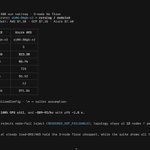
We pointed an MCP client at Cloud World Model, simulated ALB + 2× m5.large + db.r5.large MySQL, and went from 200 to 600 RPS:
p99 87 → 422 ms
errors 0 → 10%, all app CPU
MySQL CPU flat at ~18%
modeled cost $0.76 → $1.42/hr
Real tool calls, honest limits:
dev.to/canvascloudai

The 33 cloud prices we track stayed flat in September.
But tripling traffic from 100 to 300 RPS raised modeled costs:
AWS: 48%
GCP: 54%
DigitalOcean: 12%
Same fixed infrastructure. All modeled egress.
Model the traffic before you deploy.
cloudworldmodel.ai/blog/clou…

Simulate the cloud without the cloud.
Before your AI agent changes infrastructure, let it test the design. Push traffic. Break a zone. Compare modeled cost, latency, and errors.
MCP + REST. Nothing real provisioned.
cloudworldmodel.ai

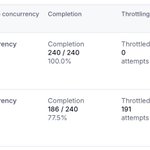
More parallel calls don’t always finish a bulk cloud update faster.
In this modeled 240-operation scenario, concurrency 1 completed 240/240 with no throttling. At concurrency 4, only 186/240 completed, with 191 throttled attempts.
We’re exploring these tradeoffs in Cloud World Model’s Provider API Limits scenario.

We stopped relying on documentation to tell us how accurate our cloud simulator was.
We deployed a real AWS stack, sent traffic through it, and monitored the results in CloudWatch.
Result: approximately 0% CRUD errors. Overall accuracy: approximately 97.4%.
Evidence and limits: cloudworldmodel.ai/blog/owne…
#AWS #CloudComputing

Terraform tells you what will change.
It doesn’t tell you the hourly bill, the P95, or what happens when the DB pool saturates.
Cloud World Model simulates that before you deploy.
AWS, GCP, Azure, OCI + DigitalOcean.
Cost. Latency. CPU. Errors. Chaos. Resilience.
And we surface what the model doesn’t know.
Because if a cost is unmodeled, an RL agent treats it as free. That’s a failure mode, not a feature.
MCP + x402. No cloud account required.
cloudworldmodel.ai
OpenCost can now tell you what your AI inference actually cost.
What if you could simulate the economics before deploying?
We ran a 70B LLM at 50 RPS through Cloud World Model across EKS, GKE & AKS - then simulated a 3× traffic spike.


Your GPU bill keeps climbing while models serve billions of tokens, but per-token cost has been a black box. OpenCost 1.121.0 fixes that.
cncf.io/blog/2026/08/05/open…
#CloudNative #AI #OpenCost

The interesting part: CWM surfaced ~$7–13/hr in idle GPU cost from the HA capacity floor.
At 3× traffic, all three clouds scaled to 12 nodes, hit 100% GPU utilization and pushed p95 latency to ~1.8s.
OpenCost measures what happened. @CloudWorldModel simulates what could happen.
1
25
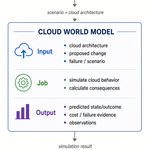
What happens when you change a cloud environment before you change the real thing?
Cloud World Model simulates it.
State → Action → Next state → Metrics → Recommendation
We just published a look inside a simulation step, including the rule engine, ML model, referee/blending, failure effects, and autoscaling.
Other tools look at what your environment is.
Cloud World Model models what it becomes.
cloudworldmodel.ai/blog/clou…

What does all this mean for Cloud World Model?

Nvidia CEO, Jensen Huang:
"We're going from a billion people using computers to 100 billion agents using them."
This is the biggest shift since the internet, and the gap between the people watching and the people who actually get it is massive.
Learn to build agentic systems that improve themselves, or spend the next decade catching up.
Watch it, then read the full roadmap on agents, loops and graphs below.


Cloud World Model is now listed on @AiToolsObserver.
Cloud World Model helps engineers simulate cloud architectures, validate AI agents, and test infrastructure decisions before deploying a single resource.
Thanks to the AI Tools Observer team for featuring us!
aitoolsobserver.com/ai-tool/…

Agent sandboxes are great for safe code execution.
But they don’t solve the harder infrastructure questions:
• Will this architecture scale?
• What happens if a region fails?
• How much will it cost?
• Which design is actually better?
That’s where cloud world models come in.
They let AI simulate cloud architectures before deployment - reducing cost, risk, and trial-and-error.
Sandboxes tell you if the code works.
World models tell you if the architecture works.
We need both.
#AI #CloudComputing #CloudArchitecture #AgenticAI #Infrastructure #DevOps
🤖 Made with AI

Cloud World Model now supports x402 payments in USDC on both Base and Solana mainnet.
AI agents can pay per cloud simulation from either network—no subscriptions, no prepaid credits.
Built with @PayAINetwork.
#x402 #Solana #Base #AIAgents #CloudComputing
🤖 Made with AI

What happens during a real cloud outage?
We just added real-world incident scenarios to Cloud World Model so you can simulate them for learning not production.
🎥 This video walks through the AWS Regional Outage (July 24, 2026).
We’ve also added the CloudFront Edge Outage and several other real-world scenarios.
Simulate the cloud without the cloud.
cloudworldmodel.ai
#AWS #CloudComputing #SRE
Shipped a streaming MCP server for cloud simulation - no install: cloudworldmodel.ai/mcp
Paste into Cursor, Windsurf, or Claude Desktop. No key needed for demo mode.
Also on Smithery: smithery.ai/servers/canvascl…