

I’m obsessed with finding amazing companies and compounding alongside them over the long term.
2050
Joined November 2022
- Tweets5.3K
- Following151
- Followers1.1K
- Likes21.6K








(2/4) I look for tectonic plates moving beneath the surface.
This is probably the most important part of how I think about investing.
I’m not primarily looking for companies that execute perfectly today.
I’m looking for enormous structural changes that unfold over many years.
Changes that can create opportunities far bigger than most people currently imagine.
With Eos, it’s the transformation of how we generate, store, and use energy.
I believe we’re still very early in that transformation.
And these changes don’t happen in straight lines.
Companies struggle. Timelines slip. Expectations get crushed. Investors lose patience.
But the tectonic plates keep moving.
That’s where I try to focus my attention.
Of course, being right about the direction of an industry doesn’t automatically mean you’ve picked the right company.
You can be completely right about the future and still lose your investment.
That’s a risk I take very seriously.
4. I deliberately accept extreme risk.
I’m not looking for safe investments with predictable returns.
I’m interested in opportunities that could potentially deliver 100x returns.
And those opportunities almost never come without enormous uncertainty.
If everything were already proven, profitable, predictable, and widely understood, much of the opportunity would probably already be reflected in the valuation.
That doesn’t mean every risky investment is attractive. Risk alone creates no value.
It means I’m willing to accept uncertainty that many other investors understandably aren’t.
And I’m fully aware that I can lose a substantial amount of money by being wrong.
That’s part of the equation, not something I ignore.
(3/4) Progress, promises, and time.
5. Progress matters more to me than promises.
Management’s credibility can be restored.
Not through another impressive presentation, ambitious guidance, or exciting announcement.
But by consistently doing what they say they’re going to do. Quarter after quarter.
Until then, I’ll remain skeptical of their promises.
But I also refuse to ignore the progress happening in the actual business.
Those two things can coexist.
Eos can have unreliable management AND be making meaningful operational progress.
The question is whether that progress is enough.
And whether it happens fast enough.
6. Time is part of my investment thesis.
Some people recently asked me whether they should sell $EOSE now and buy back lower. I’m the wrong person to ask that question.
I understand the temptation.
But I don’t know where the stock will trade next week or next month. And I don’t pretend to.
What I do know is that constantly trying to predict short-term price movements can distract you from the very reason you invested in the first place.
I would rather spend my energy understanding where a business could be in five or ten years than trying to predict what the market will do tomorrow.
That doesn’t mean holding forever, ignoring new information, or refusing to admit mistakes.
It means giving the underlying thesis time to develop instead of allowing every price movement to rewrite it.
Time is not automatically your friend. A business can run out of money long before its opportunity materializes.
But when the underlying thesis remains intact, time can be incredibly valuable.
7. What would actually prove me wrong?
This is the question I keep coming back to with Eos.
I have very little doubt about the long-term need for energy storage, the market opportunity, or the potential of the technology.
I also see real progress in manufacturing.
But none of that guarantees Eos will succeed.
The biggest question for me is whether they can reach sustainable profitability before they run out of financial runway.
And if they need more capital, what will that cost existing shareholders?
Because you can be right about the market, right about the product, and right about the long-term opportunity, yet still lose money on the investment.
That’s the risk I take most seriously.
And it’s something I continuously evaluate.
(4/4) So why am I still relatively calm?
Not because I trust management.
Not because I know the stock has bottomed.
Not because I believe Eos is guaranteed to succeed.
I’m calm because I understand what I’m betting on, why I’m taking the risk, and what could go wrong.
I’ve learned that discomfort, uncertainty, and even serious doubts about management don’t necessarily invalidate an investment thesis.
Sometimes they reveal genuine problems. Sometimes they create extraordinary opportunities.
The difficult part is learning to distinguish between the two.
And that’s why I keep coming back to the actual progress of the business.
Despite all my criticism of management, I believe Eos is in a stronger operational position today than it has ever been.
The stock price tells a very different story.
Maybe the market sees risks that I’m underestimating. Maybe it’s simply unwilling to accept the uncertainty. Or maybe there’s a genuine disconnect between the price and the underlying business.
I don’t know.
And I don’t need to pretend that I do.
I don’t need to be certain about the outcome to believe the opportunity is worth the risk.
That’s the essence of how I approach investing.
I don’t expect everyone to share my conviction or my appetite for risk.
But I do think it’s worth questioning how much of our investment decisions are driven by what is actually happening in a business, and how much by the emotions created by its stock price.
Because ultimately, the goal isn’t to feel confident every day.
It’s to understand what you own, why you own it, and what would make you change your mind.
$EOSE | How I think about investing when confidence is disappearing. (1/4)🧵
I’ve been getting quite a few questions lately about $EOSE.
People are frustrated, worried, losing confidence, or wondering whether they should sell now and buy back lower.
I understand why.
The stock is trading around $1.65, management keeps disappointing investors, and despite the progress the company is making, the market seems completely unimpressed.
So I thought it might be useful to share how I think about investing.
Not to convince anyone to buy, sell, or hold $EOSE. But because I think the way we deal with uncertainty, risk, and time has an enormous influence on our investment decisions.
1. The stock price is not the business.
A falling stock price doesn’t automatically mean the business is deteriorating. Just as a rising stock price doesn’t necessarily mean things are going well.
I try to separate those two things.
When I look at Eos today, I see a company that has made enormous progress compared to where it was a few years ago.
Manufacturing capabilities, production capacity, actual deliveries, revenue. The progress is real.
And there’s something else worth considering.
This isn’t just happening to $EOSE.
I follow a lot of tickers, and a surprisingly large number of them are trading at or near their 52-week lows.
That doesn’t automatically mean they’re all undervalued. But it does make me question how much of what we’re seeing is specific to Eos and how much reflects broader market sentiment.
Because when a stock falls, it’s tempting to look at the company and assume something must be fundamentally wrong.
Sometimes that’s true. Sometimes the market is simply repricing risk across an entire group of companies.
Understanding the difference matters.
Does all this mean Eos is worth more than its current market cap? That’s a separate question.
But I don’t let the stock price tell me what to think about the business.
2. I have serious doubts about management.
Let’s be clear about that.
For years, management has repeatedly failed to deliver on its own expectations.
They keep changing the numbers and metrics they emphasize, seemingly choosing whichever comparison looks best that particular quarter.
And once again, we’re watching them gradually walk back guidance.
I find that genuinely astonishing. You would think they’d have learned from previous mistakes by now.
Sometimes I wonder whether they’re simply terrible at anticipating setbacks or whether they don’t fully understand the challenges they’re facing.
Maybe those aren’t even two different things.
So no, I don’t blindly trust management.
But over the past decades , I’ve learned something important.
My confidence in management and my confidence in the underlying opportunity are two very different things.
They don’t always move in the same direction.
I can have serious doubts about management while simultaneously recognizing enormous progress in the business.
That doesn’t make management irrelevant. Especially not when execution and financial runway are so critical.
But it does mean I refuse to let my frustration with management blind me to what’s actually happening.


🔋Tony🔋 retweeted
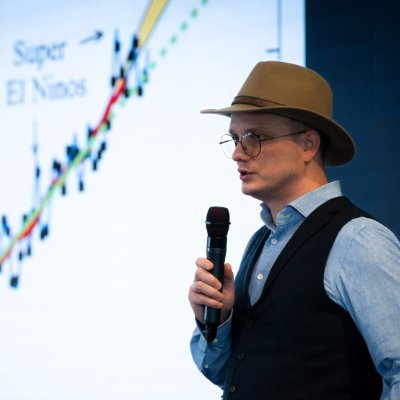
🚨 BREAKING Y-AXIS 🌊🌡📈
Record warm waters in the main El Niño region reached >30°C for the first time in the @noaa Sea Surface Temperature dataset.
We've ain't seen nothing yet of the impacts this will have around the world.


The El Nino is off the charts. Can people see the real issue and accept the implications? We may be getting closer. See the Bigger Problem – mailchi.mp/caa/super-duper-e…
Also available on Substack:
jimehansen.substack.com/p/su…


🔋Tony🔋 retweeted
Une alerte météorologique "extrême", pour reprendre le terme du message FR-Alert reçu sur les téléphones pour toute la population, est en cours dans le Gard et l'Hérault.
Les dernières prévisions sont terrifiantes entre 300 à 400mm de pluie en plaine et en villes. La population est invitée à se confiner chez elle.

I feel this needs to be said every couple weeks! The short term mindset dominates this platform. As long term investors we need to keep the right mindset! $EOSE
Something I keep noticing on X, not just with $EOSE but across almost every investment I follow.
People dig deep. They research obsessively, share findings, cross-reference numbers, debate every data point. I genuinely appreciate that. I learn from it. The community finds things I would miss.
But two patterns emerge almost every time, and both quietly undermine the entire effort.
First: when you focus this hard on details, the details themselves become your thesis. Every piece of information becomes load-bearing. When pieces are missing, which they always are, the whole structure feels unstable. You start filling gaps with assumptions. Those assumptions create anxiety. And then the question is no longer "is the direction right?" but "which of the things I believe is actually still true?"
Second: detail-focused investors inevitably bake a timeline into their thesis. Because the details suggest one. Joe says Q2, so Q2 becomes part of the model. When Q2 becomes Q3, it is not just a delay. It is a crack in the foundation. The thesis was built on those details and the details moved. Most of the frustration on X traces back to this. Not to the actual state of the business, but to expectations that were always derived from a level of precision the situation never warranted.
The alternative is to start not with details but with tectonic plates. The large, slow, undeniable forces reshaping the world. And to ask one question: is everything still moving in that direction?
For EOSE, those plates are obvious if you zoom out far enough.
Everything is going electric. Transport. Industry. Heating. All of it. AI is growing at a pace that genuinely surprises even the people building it. Power is the bottleneck. The grids across the western world are not remotely capable of handling what is coming. And the dominant current solution, short-duration lithium, does not solve this problem. It manages it. There is a fundamental mismatch between what the world needs and what currently exists at scale.
Call it what it is: a shift that has been in motion for years and is now undeniable to almost everyone.
The second plate: there is no good, scalable solution yet. Eos is not finished either. But every time you check, they are closer. DawnOS brought round-trip efficiency from the 30s into the 70s. Indensity is not just an improvement, it is a product designed for the TAM that actually matters at scale. Line 2 is about to go live carrying every lesson from Line 1. Frontier Power USA is directly addressing the financing and insurance problem that has blocked this entire sector, not just Eos. These are not incremental updates. These are structural bottlenecks being removed one by one.
Most people try to assemble a puzzle without seeing the picture on the box. They need every piece to understand what they are looking at. When pieces are missing, the whole thing stalls. But when the tectonic plates are clearly moving in one direction, the details always find their place. Anyone who has watched long cycles knows this. The plates move, the details follow.
None of this is fast. It cannot be fast. If you expected faster, the honest question is whether your expectations were calibrated correctly, not whether execution is slow.
And then there is Cerberus. They had a 5 to 10x return available and walked away from it. Twice they extended their lockup instead of exiting. They are now building FPUSA as a long-term infrastructure platform. You do not extend lockups twice if you are chasing a quick exit. You do it when you believe the destination is worth the wait. Behavior is data. And that data is loud.
The concern I hear most often is that there is too little guidance on the next 1 to 2 years. That Eos is not making it easy. And that is fair. They are not making it easy. But consider what is actually being asked here. A small-cap American manufacturer is solving a problem that trillion-dollar companies have not solved. In a sector where technology, financing, insurance, permitting, and execution all have to work at the same time. Hard is the point. Easy investments do not produce asymmetric returns.
Zoom out. The picture is still there.
Went through the new Indensity white paper. Honestly the most convincing thing Eos has put out in a while. $EOSE
What stood out to me is the stacking. Lithium systems stay flat mostly because of fire code. You need spacing, suppression, separation. Z3 doesn't burn, and Eos finally designed a product around that instead of just mentioning it on slides.
That also moves them toward a different kind of customer. Think data centers, city substations, military sites. When you only have a small lot to work with, how much you can fit on it starts to matter a lot. I think zinc has a much better shot there than competing with lithium on cheap open land.
I also liked that each Core runs its own battery string. In a six-level setup one failure takes out less than 1.5% of the system. Given the reliability issues Eos has had, that's a smart design choice.
I did the math on the 4,000 homes claim and it checks out. A quarter acre at 500 MWh/acre is 125 MWh, which comes to about 31 kWh per home per day. Close to the US average.
One thing to watch out for. Figure 1 says "10x", but that's compared to Eos' own first product from 2018. Compared to lithium, the paper claims about 2x. Still good, but I expect people to mix those two up.
A few things I missed in the paper. The 250 MWh in one week is still a target, not something they've done yet. There's nothing on cost per kWh or what this does to margins, and the frame adds hardware. But that's expected in a white paper. Round-trip efficiency isn't mentioned at all. The lithium comparison is against unnamed systems. And getting a permit for a 48 ft battery structure in a suburb seems a lot harder than the paper makes it sound.
Also no customer names. No orders, no pilots. Obviously.
So I like where this is going, but it's still a paper. It's time to make big install happen with real customers attached, and when we see what it does to gross margin. That second part is where Eos has disappointed before.

Energy storage needs to go where power demand is growing fastest. Data centers, urban substations, military installations, and commercial campuses all present new constraints on space, labor, deployment, and infrastructure. The assumptions built into conventional systems don’t transfer easily to these environments.
That’s the challenge behind Eos Indensity™.
Our latest white paper explores how Eos reimagined energy storage architecture from the ground up, moving beyond the traditional “big box” BESS model toward a modular, stackable, high-density system designed around the real-world constraints of space, speed, constructability, reliability, and resilience.
The paper breaks down three generations of compounding insight that led to what the Indensity architecture delivers: a complete plant-level energy storage solution for places it hasn’t been practical before.
Read the full white paper: eose.com/insight/eos-indensi…

Nothing to see here. 😔


🔋Tony🔋 retweeted

$EOSE
Every incremental increase in felt delivs QoQ and YoY has led to step changes in revs & improvements in margins… 🔑
In a higher rate backdrop there’s gonna be even more scrutiny for capital allocators and bad investment get weeded out…
As we enter the back end of 26& next year.. I expect the quality of Eos investors to improve…
Given the bottleneck with electrons, continued adoption of open source & exploding token usage
Grid flexibility + BTM solutions will become more mainstream
There’s a strong correlation between quality of investors & valuations.. maybe hence the story telling role..
Lastly, seeing bigger bulk orders and a improved supply chain will lead to better pricing, continued margin improvement, and will harden out the mfg operation going on in TH
Good signs. Now keep growing that backlog 👍

$EOSE 🚨 FELT DELIVERED 🚨
56,039 KG of felt was delivered to EOS on Saturday 09/19/2026.
@FreemyerGreg
@philroberts


🔋Tony🔋 retweeted

Any pursuit of superintelligence has to be grounded in the core principle that if the AI we build is not helping humanity and under human control, it's not worth pursuing.
We also need to accelerate and spread the benefits of AI, such that they are diffused broadly across countries, communities, and companies. This requires a frontier ecosystem in which both closed and open-source models can thrive.
And for firms, it’s imperative that they retain full control over their unique and tacit knowledge. Every organization should be able to build its own continuous learning loop/hill climbing machine, without becoming dependent on any one model provider, and have the ability to embed its own knowledge into models and weights they control.
So, in this context, we welcome the research, focus, and deliberate pacing needed to get alignment right as the design goal. We also welcome ideas like "embedded evaluators" and the broader efforts to develop the mechanisms to make this more than just talk.
The key is that this cannot be controlled by a handful of entities, but must have broad representation across the ecosystem, countries, and fields, including academia.
This is the approach we are taking: broad access and choice at every layer of the AI stack; enterprise control of learning loops and models; and the “Code of Conduct” that underlies our own first party MAI models that we’ll publish tomorrow for public consultation.