

Research Group for Multilayer Modeling and Analysis of Complex Systems: from cells to societies. Led by @manlius84 at @DFAunipd @unipadova
Padova, Veneto
Joined December 2017
- Tweets883
- Following398
- Followers2.2K
- Likes948





🚨 New #ComplexityThoughts🧪 is out, Issue #55
Lot of #NeuroSky and #HumanBehavior
Feat. @sees_lab and many others
📝 Post: open.substack.com/pub/manliu…
🎧 Spotify: creators.spotify.com/pod/sho…
🎧 Apple: podcasts.apple.com/us/podcas…
👀 RSS: manlius.substack.com/feed

Kudos to the team, who worked tirelessly to build a robust study, as well as to the reviewers and the editor for the constructive peer review process.
For more info about the density matrix literature, check the thread curated by @manlius84
end/
xitter.cf/manlius84/status/13269…
unavailable
Our paper adds to a long list of papers showing how StatPhys and ML can be used together to tackle very hard problems in #NetworkScience
It's cool that behind such methods there is our density matrix framework: I can't foresee how many applications are still to be found
13/
These features make the NFC a new technique to investigate how network function works across scales, providing a complementary multiscale perspective to structural techniques such as LRG.
NFC is not a RG method: it doesn’t iteratively rescale or focus on fixed points.
12/
By dropping fast modes above a given scale, LRG effectively renormalizes networks while capturing the backbone of slow information dynamics
NFC prioritizes functional similarity over topological constraints: nodes w/ similar functional roles are grouped even if disconnected
11/

Recently, a RG technique has been developed to exploit our density matrix framework: it is called the Laplacian RG.
In LRG, nodes are grouped based on slow diffusion modes (low eigenvalues of the Laplacian), ensuring that information flow is preserved at a specific scale
10/
Super-nodes are effective coarse-grained units that play similar roles in network function, not necessarily in direct connectivity, at variance w/ standard RG methods
Our purpose is different and NFC provides the most reliable results when compared w/ structural methods
9/
Super-nodes preserve the full information dynamics, retaining the diversity of diffusion pathways & signal speed across the network.
NFC identifies redundant structures in information flow and merges nodes even if they are not directly connected but perform similar roles.
8/

This is the largest difference with renormalization group techniques for networks, which instead are focused on structural scale invariance by means of specific ad-hoc rules.
We sacrifice a bit interpretability to achieve an unexpectedly good results.
7/


It's not possible to achieve this in analytical form, so we asked a machine to learn what should be done.
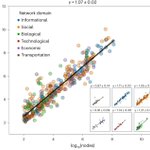
Our Network Flow Compression (NFC) works like a charm and does its job by preserving information flow properties across all scales, rather than focusing on structure only.
6/
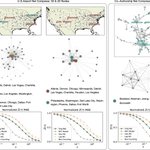
Back to the original problem. By ensuring the partition function remains nearly unchanged across scales, we guarantee that key macroscopic flow properties (entropy/free energy) are preserved even after compression (coarse-graining).
That's where StatPhys ends and ML starts
5/

Providing a grounded definition for von Neumann entropy, we can use it in StatPhys and information-theoretic problems. Recently, we have used to define a variational approach for open systems, able to predict the emergence of sparsity in networks.
4/
nature.com/articles/s41567-0…

The density matrix describes an ensemble of events unfolding on a quenched network, according to a given dynamics. For this reason it is suitable to describe complex information dynamics for multiscale analysis:
journals.aps.org/pre/abstrac…
journals.aps.org/pre/abstrac…
3/
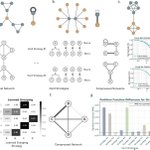
Problem: assume a process on a network with N nodes.
How should we group nodes into n<N super-nodes while preserving the overall diversity of pathways & flow speed? NFC solves this by learning node groupings by means of our density matrix framework
2/
journals.aps.org/prx/abstrac…

🚨 Excited for the latest paper from the lab, led by Zhang & Arsham
Can we coarse-grain a #ComplexNetwork while preserving macroscopic network flows? Surprisingly, the answer is positive, and we have shown it by means of StatPhys + Machine Learning 🧵1/
nature.com/articles/s41467-0…

CoMuNe Lab retweeted

Postdoc position in Lyon with a stay in Berkeley in my group
euraxess.ec.europa.eu/jobs/3…
A few weeks remaining and a few seats available for our amazing school.
Possible surprises to be announced soon... 🏃!

The call for the very special 10th edition of the Mediterranean School of Complex Networks is out!
This year, it will take place in Ortigia, a beautiful small island in Syracuse, Italy.
The lineup of lecturers is outstanding!
All info in the website: mediterraneanschoolcomplex.n…

Do you work on collective behavior emerging from complex biological systems? Or simply would like to know more?
An amazing summer school in an amazing Venice, with an outstanding lineup of speakers:
👉 almadalcoschool.github.io/
Deadline to apply in Feb 2025, 🏃♂️!

🚨 News! #ComplexityThoughts is now also on Apple Podcasts!
Now we have several ways to enjoy reading and listening to it:
🎧 Apple: podcasts.apple.com/us/podcas…
🎧 Spotify: creators.spotify.com/pod/sho…
👀 RSS: manlius.substack.com/feed

🚨 New #ComplexityThoughts is out, Issue #49 🧪 🌐 🧠 🦠
As usual, here the links:
📝 Post: manlius.substack.com/p/compl…
🎧 Podcast: creators.spotify.com/pod/sho…
👀 RSS: manlius.substack.com/feed
👉 Like it? Join us! It's free.