

Rebuilding how GTM founders and products achieve message-marketing/product-marketing fit = The Grandma Test Guy = CMO @Quivacomics = Core Team @TheCompassDAO
Send Me A DM @
Joined December 2020
- Tweets9.6K
- Following395
- Followers1.1K
- Likes15K


Pinned Tweet
To think that I discovered the Grandma Test by accident continues to amaze me to this date.
I was on the phone with my grandma when I saw a project's pitch deck land in my inbox.
Standard thing. I review and design pitch decks all the time, but this time, I did something different.
I read the first slide out loud to her. Her response? "Akpan Akaniyene (in our native dialect), I have no idea what that means."
Not "tell me more." Not "that sounds interesting." Just a complete, honest confusion from an old woman.
That's when it hit me. If my own grandma couldn't understand a single slide, how was a stranger supposed to in 30 seconds? They wouldn't
So I ran an experiment.
I started reading every Web3 homepage, pitch deck, and product description out loud to people who live outside the crypto world. Friends. Family. Random people willing to listen.
When I'm done reading, I would ask them, "What do you think this project actually does?"
The pattern was undeniable every single time. The comprehension score circled around 2, 3, or maybe 4 out of 10, making over 95% of Web3 product messaging way off for normal people.
Truthfully, I wasn’t looking at bad products. I was looking at brilliant products built by brilliant people, but the words were just so broken.
Founders were writing for themselves. They wrote for the 5% of crypto-natives who already spoke the language. They polished their sentences to sound smart and clever, but not even to be understood.
And that confusion was quietly eating away and costing them everything:
😭 Ads sent people to a website they couldn’t understand or take action on in three seconds. So they left.
😭 Investor meetings ended with “we’ll pass,” not because the product failed but because the founder's story didn’t land fast enough.
😭 Launch momentum was killed because people couldn’t repeat what the thing did at one go.
😭 Months of budgeting and planning are disappearing into explaining instead of growing.
I eventually wrote down what I’d been doing on impulse. I turned it into a simple system.
I called it The Grandma Test.
Because that's exactly what it is:
If your grandma can't understand what you do and why she should care, your messaging isn't ready.
Over the past 9 months, I've used The Grandma Test on 8+ Web3 projects. DeFi protocols, infrastructure tools, creator dApps.
Every single one had the same problem: brilliant tech, broken words.
And every single one improved after applying the framework.
Confusion costs you. However, clarity pays you back every single day.
I'm the Grandma Test Guy. And I'm here because Web3 deserves a better messaging structure.

I tell you, waiting months for long-term retention numbers to prove your value is a very slow, expensive way to learn.
Just find a way to talk to users every day who've already felt the real payoff.
Their reaction tells you early whether your product is a nice-to-have or something they truly need.
2
Ask the people who actually use your product one honest question:
"How would you feel if you could no longer use this product tomorrow?"
If the answer isn't genuine disappointment, you don't have deep dependence yet, no matter how polished your pitch sounds.
Strive for that deep dependence goal.
12
Dear Founders and Marketers,
Your gut can be a great compass until you get too close to the map.
You know every detail of why you built the product. A first-time visitor has zero to none of that context.
They judge you by what lands on the page, not what lives inside your head. Fix your messaging.
6
Retention and NPS (Net Promoter Score) are very useful metrics, but like I said, they often act like a rearview mirror.
By the time those numbers tell you something is off, you might have spent months attracting the wrong crowd or pushing a story that you feel clicked but never did.
Look for earlier proof that people actually depend on what you built.
10
Product-market fit keeps your current users loyal. Message-market fit gets new people to lean in.
If you spend time prioritising product-market fit over message-market fit, I assure you you're just polishing product usage while leaving your front door poorly labelled.
Great founders fix what they build and how clearly they explain it. Let that sink in.
13
Don't always shrug it away when it happens like it's nothing, because it is actually something.
Lost deals often wave a red flag long before your product's retention charts ever dip.
When prospects don't book or disappear after seeing your deck, ask a simple question:
Did our words make the payoff obvious enough for them to care right away?
Because it's actually supposed to.
1
When you're a founder who relies so much on founder-led sales, you begin to get so used to explaining things live and reading the room.
But depending on that for a long period of time, it will start to make you wonder why cold visitors leave your site confused every time without taking the next step.
That is the negative experience of a founder who didn't work on message-market fit together with product-market fit.
And that brings us to what I'm about to tell you right now.
If someone needs a 30-minute call directly to you as the founder just to understand what your product actually does, your message is not pulling its weight at all.
1
15
A curious user who signs up and ghosts you a week later is not real demand in my books.
Real product-market fit is the user who pays, sticks around, and would actually feel the loss if you shut down tomorrow.
Message-market fit is what helps them spot that value before they ever bounce.
7
If your current users love what you built, but new prospects keep going quiet after a demo...
You probably don't have a product problem.
You have a translation problem.
Your live pitch makes it click, but your website and deck are not carrying that same clarity when you're not in the room.
Use the Grandma Test to fix it
1
10
Product-market fit is whether people keep coming back and miss you if you're gone.
Message-market fit is whether a stranger gets why you matter at their very first glance.
You can build something users love, yet stay invisible if your homepage forces them to do all the heavy lifting plus thinking to figure out if you're good for them or not.
5
You want to know something?
There's quiet danger in the gap between how your team explains your product and how your customers describe the value they actually care about.
When those two stories don't match, your growth starts stalling long before you notice it on a chart.
8
M∆JØR™ | The Grandma Test Guy retweeted

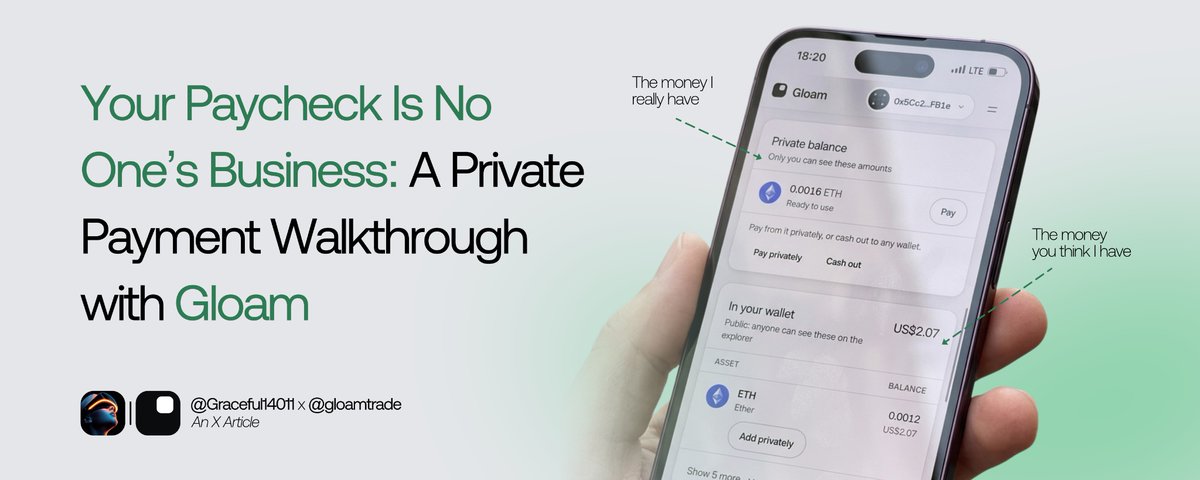
A conversation about on-chain privacy got me thinking.
How much of our financial activity should really be public?
I decided to explore @gloamtrade and document my experience.
Read the full article 👇
Now, I’m not saying that user feedback scores or retention charts are bad in GTM.
They actually do a great job.
The problem is that they only tell you what happened after the dust has already settled.
What I've seen is that, right now, most teams lean heavily on three things: retention charts, recommendation scores, and pure gut instinct.
Let's take a deep look at retention first.
You seeing your user numbers stop dropping and finally level off is a great sign proveing that people are getting real value from what you built.
Recommendation scores are helpful too, they can show you if people actually like your product enough to tell a friend about it.
Both of these metrics work, and you should track them.
However, the catch is that they are both rearview mirrors.
By the time those numbers show up on your screen, the story for your project is already written.
And the truth is, if you just sit around waiting for these charts to move, you can easily spend months talking to the wrong users or pitching the wrong message, burning through your marketing runway and delaying real revenue while you wait for a signal that arrives too late.
1
2
35
Did you know that by the time your numbers start telling you something is wrong with your product-market fit, the market has often been warning you for weeks?
You see those moments when you notice fewer users sticking around, when bringing in new customers gets more expensive, and when sales take longer to close.
By then, the market has often been moving away from your product for some time, and winning back lost ground takes much more effort.
But the first signs show up long before your numbers change.
Look at the deals you're losing. Listen to the questions prospects keep asking.
Pay attention to the difference between how your team explains the product and how your customers describe the value they would genuinely miss.
That gap tells you something important.
Your team might believe the product solves one problem, while the people you're trying to reach see something completely different.
And those conversations are often an earlier signal of trouble than your growth dashboard.
1
23
Your analytics dashboard is always the last to know when something is broken.
By the time churn spikes or sales slow down, the market has been trying to warn you for weeks.
Look at your lost deals instead; they tell the real story much earlier.
1
7
What if I tell you that real market differentiation starts the exact day you sound like a real human instead of a marketing template?
It's very simple.
When you deliberately avoid the standard industry jargon and say what you actually mean, you instantly stop blending in and start standing out.
4
Your homepage using the exact same buzzwords or industry term as every competitor in your space means only one thing;
you’re trapped in a commodity race.
When everything built in a industry is looking identical, the only thing left to fight over is price.
And the only way to stand out by simply telling the truth.
10
The temptation to build a homepage for your project, that appeals to "everyone" is a very big trap you need to steer clear of.
When you try to speak to all markets at once, your message gets watered down until it moves zero people.
What you need to do is just pick the group with the sharpest pain and speak directly to them, especially in your hero section.
2
25
Nobody talks about how exhausting it is to keep pushing when nothing seems to change 💔🥹
Happy International Men's Day to all men trying to make it big out there
Early on, while starting your project or whatever it is you're building, your biggest superpower is focus.
It would do you so much good if you choose the audience with the clearest urgent pain and own that particular conversation completely.
When you narrow your focus, your growth stops leaking energy to everything and anything.
10