

Crowther Lab studies global ecosystems, generating knowledge to protect #biodiversity & address #ClimateChange
Zurich, Switzerland
Joined August 2017
- Tweets6.9K
- Following3.1K
- Followers12.1K
- Likes6.1K



Pinned Tweet
Out today in @ScienceMagazine: Over half of the world’s forests have become more fragmented since 2000, threatening biodiversity and climate stability.
science.org/doi/10.1126/scie…
#Biodiversity #Conservation #ClimateCrisis
@YibiaoZ @ConstiZo @TWCrowther
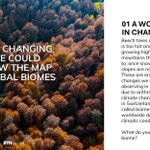
🌍 Climate change is reshaping the planet! By 2080, 17% of land could see major biome shifts: tundra shrinks by 47%, boreal forests push north, deserts & savannas expand by 23%. 🌱 How plants will respond depends on their ability to adapt and move.
doi.org/10.1038/s41598-025-1…


Our new papers show that over half of the world’s forests have become more fragmented since 2000. This weakens carbon sinks: forest edges store 16% less biomass, equal to 36 Pg carbon lost globally
@ScienceMagazine: science.org/doi/10.1126/scie…
@NatureEcoEvo: nature.com/articles/s41559-0…

More than half of the world’s forests have become more fragmented since 2000.
Our new @ScienceMagazine study is featured in @mongabay — showing the risks of fragmentation and the power of protection.
📰Mongabay: news.mongabay.com/2025/09/mo…
📄Paper: science.org/doi/epdf/10.1126…

Between 2000 and 2020, 51–67% of global forests became more fragmented. In the tropics, where biodiversity and carbon storage are highest, the rate was even higher at 58–80%. This silent erosion of ecological integrity poses a major risk to ecosystems worldwide.
The loss of forest area is devastating. But the loss of connectivity — the fabric that holds forests together — is just as dangerous. This study highlights both the urgency of halting fragmentation and the promise of effective conservation and restoration.
Huge thanks to all co-authors for making this possible, and a special shout-out to @YibiaoZ, who led this research as part of his PhD thesis. 👏
@ConstiZo @TWCrowther @haozhi_ma @LidongMo @LalasiaM @Pablo_Negret @ThLauber @Zhaofei2022 @domrebindaine
More than half of the world’s forests have become more fragmented since 2000.
Out today in @ScienceMagazine:
science.org/doi/10.1126/scie…
#Biodiversity #Conservation #ClimateCrisis
The loss of global forests is a direct threat to our climate, biodiversity and human wellbeing. But there’s another hidden threat: fragmentation — the breaking of forests into smaller, isolated patches.
Crowther Lab retweeted

So excited that this amazing study led by the indomitable @YibiaoZ is out in @ScienceMagazine. We must start looking at forest fragmentation from a more ecological perspective to protect biodiversity and conserve ecosystem functionality 🌳🍃

Out today in @ScienceMagazine: Over half of the world’s forests have become more fragmented since 2000, threatening biodiversity and climate stability.
science.org/doi/10.1126/scie…
#Biodiversity #Conservation #ClimateCrisis
@YibiaoZ @ConstiZo @TWCrowther
Crowther Lab retweeted
Out today in @ScienceMagazine: Over half of the world’s forests have become more fragmented since 2000, threatening biodiversity and climate stability.
science.org/doi/10.1126/scie…
#Biodiversity #Conservation #ClimateCrisis
@YibiaoZ @ConstiZo @TWCrowther
Crowther Lab retweeted

In this episode, I'm joined by ecologist @TWCrowther to discuss the critical importance of biodiversity as an intricate web of life that supports all other living beings, not just through the sheer number of species, but because of the complexity of interactions within ecosystems.
thegreatsimplification.com/e…
🌍 Understanding global ecosystem resilience is vital for effective conservation and climate policy.
Our newly published review in @GlobalChangeBio investigates the most widely used indicators of resilience based on Earth Observation data.

🔥 Ecosystems that recover slowly are often more drought-resistant.
🌡️ Reliable resilience assessments are crucial for informing policy decisions and guide conservation efforts worldwide.

👉 Read the full study: onlinelibrary.wiley.com/doi/…
👏 This work is a collaborative effort by Katharina Runge, @LalasiaM , @MiguelBerdugo1, MarleeTucker, @TWCrowther, Camille Fournier de Lauriere, and @Guirado_e
#ecology #resilience #science #sciencelover #naturalscience #environment
