

Independent. By Design. Trustyfy: https://teapawt.org/t.co/myeP8AJxnC Trustyfy B2B: https://teapawt.org/t.co/9Xy39ATPv6 Tokenee: https://teapawt.org/t.co/aBGiS4xv6L
Online
Joined February 2012
- Tweets19.3K
- Following776
- Followers3.2K
- Likes30.7K


Pinned Tweet
We do frequent demos on how you can solve money transfer related issues. Request via DM.
1️⃣ Simpler Cross-Border Payments
2️⃣ Shared Control Over Business Funds
3️⃣ Put Your Crypto to Work
4️⃣ Clearer Team Access
5️⃣ Less Financial Admin
6️⃣ Support That Knows Your Business
#web3 #independence #Banking


i-LevelUP retweeted

Visa said on its latest earnings call that its stablecoin-linked card programs have passed 225, up more than 70% in a year. They cover about 5 million cards in over 50 countries, and transaction volume is up more than 150%.
At the till, nothing looks different. The provider typically converts the balance into regular currency, so the merchant is paid as usual.
The card is just the part you tap. Where the money sits before that is a separate choice, and it's easy to overlook

Ethereum's flagship developer conference is in Mumbai this week. Fitting place: India received more than $137 billion from workers abroad in 2024, more than any other country.
That's a perfect use case Trustyfy is build for:
money that crosses borders as easily as the people who earn it.
Cost of cross border transfer is a few cents only
Real-time transfer
$15 for a lifetime account often pays off with the first transfer
Start free today. Link in Bio.


Paraguay's Largest bank has frozen 3 million accounts.
This is why we are building.
This is why you should review your risks.
This is why you should setup alternative payment rails.
This is why you should be in control.
This is why Independent By Design becomes a real unfair advantage.
If you want to know more.
DM.

🚨PARAGUAY’S BIGGEST BANK FREEZES 3 MILLION ACCOUNTS OVERNIGHT, THIS IS WHY BITCOIN EXISTS!
Paraguay’s central bank seized Ueno Bank after its solvency collapsed. The app, cards, and transfers were instantly shut off for roughly 3 million people, about 60% of the country’s adults.
People are in the streets because their own money is locked behind a single institution that can be turned off with one decision.
bitcoin:native in self-custody has no central off switch. No one can freeze it, seize it, or lock you out.
i-LevelUP retweeted
KYC isn't the opposite of self-custody.
A card or bank account means a regulated company handles your money, so it must know who you are. Your wallet keys don't change hands.
In Trustyfy, the card and bank account come via regulated partners, with KYC. Your wallets stay yours.

i-LevelUP retweeted
Ethereum's flagship developer conference is in Mumbai this week. Fitting place: India received more than $137 billion from workers abroad in 2024, more than any other country.
That's the use case to build for: money that crosses borders as easily as the people who earn it.

i-LevelUP retweeted
The most convincing scam alert comes from the real app.
Last month, attackers took over the service a wallet maker used to send push notifications. Users got an alert from the official app saying their portfolio had been synced to a new device. The link led to a copy of the company's site, with a countdown, asking for their recovery words. About $2.56M was taken from roughly 70 wallets, the company said.
Three habits that protect you from this kind of attack:
1. Never act from an alert. Open the app yourself.
2. No real security check asks for your recovery phrase.
3. When an alert feels urgent, slow down. Urgency is the tactic.

i-LevelUP retweeted
On Monday, SEC staff added three entries to the agency's crypto FAQ. One draws a line worth knowing: a system that works is not the same as a system nobody controls.
The guidance describes a central party as one that can act unilaterally, for example by limiting access, modifying code, reversing transactions or revoking access. A system can be fully usable and still have one.
It is staff guidance with no legal force, and it concerns how tokens are classified, not how you hold them. But the habit travels: ask what a product does, then ask who can switch it off.
i-LevelUP retweeted
Your phone isn't your wallet. It's a key to it.
In a self-custody wallet, the money lives on the blockchain. The phone just holds a way in. If it's lost or stolen, your recovery phrase is how you get back in on a new device.
Do these now, while nothing's wrong:
1. Back up the recovery phrase on paper and keep it somewhere safe.
2. Lock the phone with more than a four-digit code.
3. Turn on the app's own lock, if it has one.
4. Know how to freeze your cards from another device.
Losing a phone should cost you a phone. Not your money.


My thesis after this week:
The next phase of crypto adoption will look nothing like the last one.
Last cycle: tokens, communities, narratives.
Next cycle: payments, compliance, settlement, reporting.
Stablecoins → the money layer
Tokenization → the asset layer
Institutional capital → the liquidity layer
What's still missing is the user layer: products people and SMEs can use every day.
That's where I'm focusing.
Which layer do you think is furthest behind?

An observation from this week:
Almost every complaint I read about crypto cards and neobanks follows the same pattern.
Account frozen. Review "within 7 business days". Weeks pass. No explanation.
The real risk isn't volatility. It's depending on a single provider.
My rule: never keep your only access to money in one place.
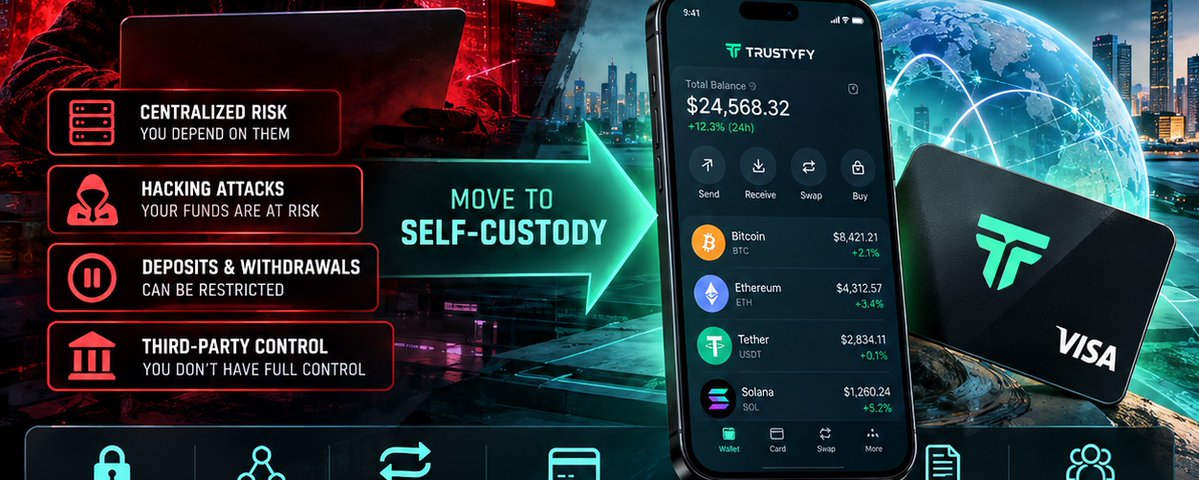
That's why I use Trustyfy: a self-custody wallet plus fiat accounts and cards in one setup, with the keys staying with me.
tinyurl.com/Try-Trustyfy (Ad)
Not financial advice.
Everyday is zeroday.
The TOP 10 Biggest Crypto Hacks In History.
Make sure you stay safe.
Community Article:
teapawt.org/CryptoScout24/status/2…


Institutions don't move on-chain because of hype.
They move when three boxes are ticked:
1. Regulatory clarity they can defend to a board
2. Custody and settlement they can audit
3. Liquidity they can exit
Look at the steps that actually happened, like tokenized treasury funds and spot ETFs. Each ticked those boxes first.
The lesson for builders:
Stop pitching "decentralization" to institutions.
Pitch lower settlement risk, lower operating cost and 24/7 markets.
That's the language capital speaks.
LIST OF EXCHANGES HACKED / COMPROMISED TODAY
- BINANCE - 3.5 BILLION
- BYBIT - 1 BILLION
- BITGET - 1 BILLION
- SWYFTX - 10 MILLION
Stay safe out there.

Its time to get into self-custody with ALL your assets.
move everything from central exchanges !
⚠️ This is financial advice.
if you want to get a secure wallet, link in bio
🚨BREAKING: BINANCE HOT WALLET APPEARS TO BE DRAINED FOR ~$2.53B!
On-chain data shows a large outflow from a Binance hot wallet (Binance 14) involving roughly $2.53 billion across 60+ tokens on Ethereum, including a major ETH transfer.
The transaction that moved the funds was initiated by an address funded via Tornado Cash, with the assets sent to a fresh EOA.
The report remains unconfirmed.
Tokenizing an asset is the easy part.
Making it useful is the hard part.
A tokenized bond or fund share only matters if it can:
→ sit in a wallet people already use
→ settle against a stablecoin
→ pass compliance checks automatically
→ show up correctly in reporting and tax
That's why RWA adoption looks slow from the outside.
The token isn't the bottleneck. The plumbing around it is.
Whoever builds that plumbing captures most of the value.
