

Crypto Setups Founder | DeFi educator | Eye on Icon - Podcast Co-host
Joined October 2011
- Tweets3.4K
- Following1.3K
- Followers1.8K
- Likes6.1K







CryptoSetups 🪩 retweeted

EP 1: Migration – Finding Hope in a New Realm
I’ve personally launched a small side project in collaboration with VIIM Studios in Korea. Nothing huge. Just a fun experiment combining A.I. and storytelling.
@gosodax team is obviously obsessed with crypto. But here’s a fun fact: a lot of us are also big anime fans. So I thought… why not mix the two?
As the title suggests, the theme of this first episode is $SODA Token Migration. The 'New Realm' is @SonicLabs, of course! Can you spot other metaphors in the vid?
If you enjoy this kind of content, please Like, Share, and Follow. I’d also love to hear your ideas for future episodes — drop your thoughts in the comments!
Sodie has just arrived in the New Realm — a dazzling, neon-lit world where night and light blur together. Lost and disoriented, she stumbles a mysterious vending machine called SODAX. Hesitant, she inserts a foreign coin called ICX, unsure if it will be accepted. The moment the machine whirs to life, everything changes. Shadows give way to light, uncertainty transforms into wonder, and a new possibility emerges.
This encounter marks the beginning of Sodie’s journey as a ‘Solver’ — a rare courier capable of traversing realms and keeping humanity connected.
CryptoSetups 🪩 retweeted

Took a break from money markets to tackle the exchange upgrade & widgets.
Now we’re back with the signed-out state, which includes a calculator to remove the guesswork before you take action.
Still lots to do, but finally happy with the core experience.
balanced.network/preview/mar…

CryptoSetups 🪩 retweeted

Can't miss Drinks with Raoul tomorrow at 6p ET
I'll be giving away 1000 $USDC to one lucky winner!
To enter:
1. Join the @RealVision waitlist (link below)
2. Drop a screenshot with the email confirmation & mention 2 friends in the comment (NO bots!)
3. Like & RT this post


CryptoSetups 🪩 retweeted

Sonic Sync ft @gosodax teapawt.org/i/broadcasts/1rmxPyAlr…


CryptoSetups 🪩 retweeted

The Balanced trade experience just levelled up.
You can now see the USD value of your swap, supply, or transfer upfront, so you can complete your transactions with confidence.
Try it out from app.balanced.network/trade.
CryptoSetups 🪩 retweeted

Andre absolutely ratio’ing Brian Armstrong?
I’m thinking he’s so back.
Full 2-hour podcast dropping imminently on @therollupco — his first pod in several years 🫡
This quoted post is unavailable.
CryptoSetups 🪩 retweeted

Ethereum's future is increasingly pointing towards
- Appchains
- Based Rollups
@Spire_Labs asks: What if every L1 smart contract is also a based-rollup appchain?
The L1 scales like an L2, but everything stays on the L1
Rollups become Ethereum again


CryptoSetups 🪩 retweeted
The endgame is clear:
An ecosystem of interconnected chains, with the gas and cross-chain complexities abstracted away from the end user, with thousands of applications used by millions daily.
Every new user on a rollup, appchain, L2 is a net benefit to Ethereum and crypto as a whole.

From a world of fragmented L1s with limited scale, no interoperability, fractured security, and partial decentralization
To hosting infinite chains, each one faster than the fastest possible L1, with interoperability, and cumulative security
Ethereum's rollup-centric roadmap is so successful, it's destined to be taken for granted by NPCs
CryptoSetups 🪩 retweeted

No. Adding some context (and data) changes the story regarding flows to Solana from other chains👇
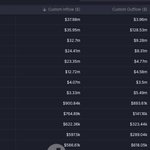
Over the last month, @base is #1 in terms of net flows ($463m). @solana is #2 with $197m of net flows. @SuiNetwork #3 with $120m.
If we zoom out to Year-to-Date, @arbitrum ($2.4b), @optimsimFND ($2.2b), and base ($1.6b) lead all chains.
But the only thing that really matters for Solana is pulling TVL from Ethereum (and the L2s).
Why?
That's where all the value sits today.
Is it happening?
Not really.
Here's the data (via @artemis__xyz)
1. YTD, Solana has lost TVL to Base, OP, and Arbitrum (albeit small numbers, about $55m)
2. Solana has seen $2.36b inflows from Ethereum L1 YTD, with over $1b flowing back to ETH (42%).
*2.7% of Ethereum's TVL went to Solana YTD, modest figures*
3. Ethereum has seen $6b of net outflows YTD, but 83% of it went to L2s (stayed in the ecosystem, where it can continue to drive value to the L1).
In total, 82% of the value that left Ethereum YTD found its way back to the L1.
----
TL;DR: Solana is pulling some TVL from Ethereum, but it's quite modest. 42% of value that went to Solana from Ethereum made its way back to Ethereum this year.
Most of the value that leaves Ethereum makes its way back to the most secure and decentralized L1.
And most of the value that has left has gone to L2s (stayed in the ecosystem).
Data: powered by @artemis__xyz


CryptoSetups 🪩 retweeted

Ethereum is the sum of the L1 and all of the L2's built on top of it.
Scaling Ethereum blockspace is also scaling ETH the asset as a commodity money.
While not all blockspace is created equal, we should work to scale all of it as much as possible.
CryptoSetups 🪩 retweeted

Vitalik dropped 6 detailed articles about the Ethereum roadmap
Here's our condensed ELI5 cheat sheet 👇
========================================
@VitalikButerin's latest articles have been part of a series, "Possible futures of the Ethereum protocol," with each post diving deep into a major pillar of Ethereum's roadmap:
🔀 Part 1: The Merge
📈 Part 2: The Surge
🔥 Part 3: The Scourge
✨ Part 4: The Verge
📤 Part 5: The Purge
🎉 Part 6: The Splurge
These are some of the most foundational writings on Ethereum we've seen in its entire history; that said, there's also a lot of info to take in here...
Before or even as you dive into these posts, you may find it helpful to have a bird's eye view of what each major upgrade is focused on to better grasp Vitalik's technical writings on the Ethereum roadmap.
🔀 The Merge
The Merge, completed in 2022, marked Ethereum's transition from Proof-of-Work (PoW) to Proof-of-Stake (PoS), cutting energy consumption by 99% and enhancing network security through staking. However, according to Vitalik Buterin, upgrades related to The Merge are ongoing.
The goal moving forward is to speed up transaction confirmations, reducing the wait time to as low as 4 seconds. Vitalik shared that another goal related to The Merge will be to lower the staking requirement from 32 ETH to just 1 ETH, allowing more people to participate and help secure the network.
By speeding up confirmations and making staking easier for everyone, Ethereum will become even more decentralized without compromising its security.
📈 The Surge
The Surge is all about making Ethereum faster and more scalable, aiming for over 100,000 transactions per second (TPS). This will be done by optimizing Layer 2s and improving data storage techniques.
A big part of The Surge was EIP-4844, introduced in the Dencun upgrade earlier in 2024, which added “blobs"— new blockspace for storing L2 data.
Next, PeerDAS, expected in the Pectra upgrade in 2025, will enhance how Ethereum manages these blobs, boosting network bandwidth while keeping costs low. Data compression will also help by making transactions smaller, which will further improve the efficiency of rollups.
These upgrades will make Ethereum much more scalable while keeping it decentralized and secure.
🔥 The Scourge
The Scourge tackles a major challenge: centralization risks in Ethereum’s staking and block creation processes.
Right now, building blocks — the process of choosing which transactions go through — favor big players who use advanced algorithms to earn more money. This can lead to transaction delays or manipulation, which isn't good for Ethereum’s decentralization goals.
To fix this, Ethereum plans to split the block-building job into smaller, more manageable parts. One proposal, called inclusion lists, would allow smaller validators to ensure that certain transactions get included in a block, reducing the power of big block builders.
Additionally, ongoing research into encrypted mempools aims to improve security by hiding transaction details until they’re confirmed. A mempool is a waiting area for transactions before they’re added to a block. Currently, anyone can view these pending transactions, which allows block builders to reorder them for profit (a practice known as MEV, or Maximal Extractable Value). By encrypting mempools, transaction details would be concealed until confirmed, reducing opportunities for manipulation.
In addition, Ethereum is looking at ways to reduce the rewards for staking to prevent too much of the network’s wealth from concentrating in the hands of a few large validators. These combined efforts aim to keep Ethereum decentralized and protect users from exploitation.
✨ The Verge
The Verge focuses on making Ethereum easier and cheaper to run, especially for people running their own nodes.
Currently, running a node requires storing hundreds of gigabytes of data, which can be a barrier for many users. The Verge aims to change this by introducing "stateless clients" that don’t need to store all that data. Instead, they’ll rely on cryptographic proofs (either Verkle trees or STARKs) to verify the blockchain.
Stateless clients mean that even a phone or a basic laptop could fully verify Ethereum. This would greatly expand who can help run and secure the network, making it more decentralized. In the long run, Ethereum aims to use cryptographic proofs to verify entire blocks so that even low-power devices can quickly confirm that everything on the blockchain is correct.
The Verge also looks at making Ethereum quantum-resistant by possibly replacing Verkle trees with a more future-proof alternative, ensuring the network can withstand emerging technologies like quantum computing.
📤 The Purge
The Purge looks to make Ethereum leaner and less complex over time.
As blockchains grow, they tend to accumulate more and more data, which every node must store, making it harder for new nodes to join the network. The Purge tackles this problem by reducing the need for nodes to keep all historical data and unused protocol features.
One goal of the Purge is history expiry, where older data — such as transactions and accounts — are stored in a distributed way, similar to how torrent networks work. Instead of every node storing every past transaction, each node would only keep a part of this history, with other nodes storing other parts. This way, Ethereum stays secure and decentralized, but nodes don’t need massive storage to join the network.
Another part of the Purge is state expiry, which addresses the growth of “state data” like account balances and contract storage. This involves automatically removing or archiving unused data over time, making it easier to manage Ethereum’s long-term storage needs.
Moreover, the Purge will be aimed at cleaning up old, rarely-used network features, simplifying the code to keep Ethereum efficient and accessible.
🎉 The Splurge
The Splurge is Ethereum’s “finishing touches” phase, focused on various improvements that don’t fit neatly into other categories but are crucial for enhancing Ethereum’s user experience and technical robustness.
One of the Splurge’s main goals is optimizing the Ethereum Virtual Machine (EVM), Ethereum’s core computational engine, to make it faster and more secure. This includes adding features like account abstraction, which allows users to create flexible, user-friendly accounts with advanced security options. The Splurge also works on improving transaction fee mechanics to keep costs stable and fair, even as network demand fluctuates.
Additionally, the Splurge continues exploring advanced cryptographic techniques that could make Ethereum more resilient to future technological shifts, such as quantum computing. These upgrades aim to future-proof Ethereum, ensuring it remains a reliable platform for decentralized applications in the long run.
🔮 Zooming out
These six major upgrade phases are the pillars of Ethereum's evolution as a meticulously architected, multi-layered system that balances innovation with practicality. These phases aren't isolated but intertwined, with each upgrade balancing immediate needs and future-proofing the network.
Through this layered approach, Ethereum is aligning itself to serve as an excellent foundation for global-scale applications and interactions — the kinds we've all come to expect online, plus ones we’ve yet to even imagine. Along the way, the network's intentional design will ensure that Ethereum remains adaptable, inclusive, and resilient.
Authors: @davewardonline & @wmpeaster ✍️

CryptoSetups 🪩 retweeted

🔒 Security reminder.
Revoking authorization for unused or untrusted dApps is a best practice for maintaining wallet security and ensuring only trusted applications have access to your funds.
Here's how you easily do it in Hana 👇
support.hanawallet.io/en/art…

CryptoSetups 🪩 retweeted
An underestimated downstream effect of “tying L2s together” as Sassal says is the transition towards positive sum games between L2s:
Here’s what I mean…
Tribalism between rollups dwindles because the UX goes from rollup A to rollup B, to just "using Ethereum" from the end user flow.
A new user into any L2 or appchain becomes a net positive effect for the entire space, especially as we see more shared sequencing / coordinated block building and ZK proof aggregation comes online, which enable users to hop from any L2 easily within clusters (and between clusters).
This, paired with a chain abstracted account/wallet, means users live onchain in an app-centric way, not a chain-centric way.
We still see Optimism vs. Arbitrum competition, same with ZK Sync vs. Polygon and the list goes on.
In my opinion, the rollup landscape will become less competitive on the chain level as the communities are trying to grow the bigger pie, rather than fight for a finite amount of users. This means less liquidity games, less shorter term thinking, and more infinite sum thinking by L2s.
L2s are social and cultural extensions of Ethereum. With the unification of the UX also comes the re-unification of the community.
This is what excites me about the scaling roadmap.

CryptoSetups 🪩 retweeted

So @ethereum and it's L2 have more than 50% of the stablecoin volume? Ethereum is winning but it doesn't seem so in CT.
Base rollups (decentralized via the L1) + real time ZK proving (the industry is very close to be able to prove Ethereum real time) + preconfirmations (being able to confirm transactions to users in less than a second independently of block time) + easy interop between L2s (multiple teams are working on this) + account abstraction is in it's way to make Ethereum the best blockchain by far for normies.
Every blockchain will have L2s. It's impossible to onboard billions of users to an L1. The computation power of only one machine can't handle the amount of users that will use blockchains.
Ethereum has dozens of L2s with hundreds of infra engineers and super well funded. Ethereum is doing great progress but we need to improve how we explain things in twitter.
Ethereum. Cheap, fast, decentralized and secure.

For the first time ever, @base led all chains for total stablecoin transfer volume in a single day.
On October 26th, Base processed 18.1B+ in stablecoin transaction volume (99.9% was in USDC) accounting for over 30% of all stablecoin transaction volume that day.

CryptoSetups 🪩 retweeted

Possible futures of the Ethereum protocol, part 6: The Splurge
vitalik.eth.limo/general/202…
CryptoSetups 🪩 retweeted

We released Spaces last week, and have already been shipping updates based on your feedback. Here’s what’s improved:
1. Free users can now upload 5 files per Space
2. Enhanced custom instructions: Spaces AI assistant now applies them consistently across all threads
3. More detailed Space overview cards, with indicator telling you which AI model is in use
4. Support for Markdown files

CryptoSetups 🪩 retweeted

It's about time mainstream media and financial pundits start having a real, objective debate about the store-of-value properties between $BTC and $ETH. Both cryptocurrencies have unique features that deserve thoughtful discussion, especially as investors look for reliable assets in a constantly changing market.
First off, leaving out the "structural selling" linked to Bitcoin's Proof-of-Work (PoW) mining isn't doing investors any favors. Miners have big operational and capital costs: they buy specialized mining hardware, run industrial mining facilities, hire staff, and consume massive amounts of electricity. Since they get paid in $BTC, they have to keep selling to cover their expenses. At a $BTC price of $60,000 and a daily issuance of 450 BTC, miners sell on average close to $27M worth of BTC daily, which is more than $800M entering the market every month. This constant selling can hold back the asset's price growth. Plus, as $BTC's price goes up, more miners jump in, raising operational costs and increasing the selling pressure. Investors really need to understand how this works.
On the flip side, Ethereum got rid of mining when it switched to Proof-of-Stake (PoS) in September 2022. This move cut out the structural selling that comes with mining costs. Instead of miners, Ethereum now relies on validators who stake their $ETH to secure the network. This not only reduces selling pressure but also offers native yield for long-term holders, aligning everyone's incentives with the network's health and the asset's value.
Moreover, $ETH clearly dominates in terms of network revenue, which is critical for sustaining a non-inflationary issuance schedule over the long run. Ethereum holds the #1 position with ~$7.3M in fees generated over the last 24 hours, ~$32M over the past 7 days, and a significant ~$2.6bn over the past year. In comparison, $BTC ranks fourth, trailing significantly behind Ethereum with just ~$912K in fees for the last 24 hours, ~$5M in the past 7 days, and ~$1.3B over the last year. This demonstrates Ethereum's superior revenue-generating capabilities, largely driven by its versatile smart contract functionality and higher activity levels, whereas Bitcoin, focused on being a store of value, generates far less in transaction fees.
Ethereum's shift to PoS also slashed its energy use, tackling ESG concerns about electricity consumption. Its energy usage dropped over 99.9%, now consuming less than 0.05% of what Bitcoin's network uses. This huge reduction makes Ethereum a much greener option, which is increasingly important to ESG-conscious investors.
Back to Bitcoin, it's important to realize that just because there's a 21 million hard cap coded in, it doesn't guarantee it can be kept without possibly compromising the network's security. That cap is something agreed upon and upheld by network consensus, but there's nothing in the code ensuring transaction fees will be enough to pay for mining without affecting immutability and censorship resistance. Investors need to be aware of these conditions to make informed choices.
Financial analysts like @EricBalchunas and @JSeyff have a responsibility to let investors know about these details. They should point out that Bitcoin's network is still about 99% subsidized by new coin issuance. In contrast, Ethereum has made a net surplus of revenue over the past two years, thanks to its fee-burning mechanism and staking rewards. Plus, Ethereum has already proven it can resist government interference, like when it withstood a censorship attempt from OFAC, debunking the myth that the government can shut down Ethereum whenever they want. This shows how robust and decentralized the Ethereum network really is.
The idea that "$BTC's supply is fixed and $ETH's is variable" is misleading. While Bitcoin's supply cap suggests unconditional scarcity, it doesn't take into account the economic realities of network security and miner incentives, including the structural selling we talked about. Ethereum's supply is dynamic by design, adjusting issuance based on network activity and the fees stakers earn. This system keeps the network secure while aligning incentives for participants. It's a smart and elegant design that shows a more adaptable approach to monetary policy in the blockchain world.
Regarding the concern that developers or centralized parties can arbitrarily change issuance: Any changes to the issuance of either $BTC or $ETH have to go through the same network consensus process. Developers can't just make changes on their own; there needs to be overwhelming agreement for any modification to happen. In Ethereum's case, every update to its monetary policy has led to reduced issuance, showing a commitment to scarcity over time. Network participants are becoming increasingly aligned with monetary policy "ossification" and have become hesitant to accept new changes, even those that could further reduce issuance. For example, when Ethereum developers recently suggested lowering issuance again, the community pushed back until it was clear that the reduction was necessary and wouldn't hurt network decentralization.
In summary, Proof-of-Stake has allowed Ethereum to eliminate most structural selling (except for deferred selling due to taxes), create native yield for long-term holders, and tackle ESG concerns about energy consumption - all without compromising its censorship resistance, as evidenced by the failed OFAC censorship attempt. These advancements position Ethereum not just as a strong and forward-thinking network, but as a global financial platform capable of hosting a wide range of decentralized applications and services. Think of Bitcoin as a single application, digital gold, while Ethereum is like an entire operating system that not only supports various applications but also excels at the very function Bitcoin was designed for.
Given all this, you could argue that $ETH is objectively and verifiably a better store of value, even if it's not always marketed that way. It's important for investors and analysts to move past oversimplified narratives and dig deeper into the complexities of these cryptocurrencies. Understanding the nuances of Bitcoin and Ethereum's monetary policies, consensus mechanisms, and real-world resilience is key to making smart investment decisions in the fast-changing crypto landscape.
Let's get this conversation started. Tag your favorite mainstream media outlets and analysts to bring more attention to this important discussion.
CryptoSetups 🪩 retweeted

Unlock your DeFi experience with @HanaWallet!
Connect to @SoroswapFinance 🪐 and explore swaps on @StellarOrg. Get your tokens instantly and without KYC.
Let’s keep building together at @BuildOnStellar
