

One morning in 2050, humanoid robots and humans stand at a crossroads. About humanoid robots: products,use cases, business ,HRI 📮[email protected]
2050
Joined January 2023
- Tweets5.4K
- Following395
- Followers40.7K
- Likes5.9K




Pinned Tweet
Humanoid Robots
As intelligent automation systems, they are embedded within existing upstream and downstream processes, complementing and enhancing the capabilities of full-chain automation, such as production lines and warehouses.
As auxiliary assistants, collaborating with humans and participating in human-led work and life, humanoid robots are learning and evolving from their masters, evolving from passive to active.
As remote agents: Humans control robots through AR/VR and brain-computer interfaces, while humanoid robots act on their behalf, handling extreme tasks and meeting the human's needs.
As complete agents: Humans empower the robots(AI), understanding their intentions, patterns, and preferences, autonomously planning and executing tasks, and establishing a symbiotic relationship with them.
As human-machine symbionts: Humanoid robots' hands, legs, and other parts of the human body enhance the human being.
As a replica of the human, embedding human memories, knowledge, experience, ego, and superego,a digital copy,within the human body,a kind of superhuman and real-world immortality.

CyberRobo retweeted
Generative Bionics and AMD are building a Physical AI data factory
Generative Bionics is partnering with AMD to build a 5,000㎡ Physical AI Data Factory in Italy. The first facility is scheduled to begin operations in Q4 2027.
The goal is to connect real-world robot operations, data collection, digital twin simulation, and model training in one pipeline.
GENE.01 humanoid robots will collect multimodal data while performing industrial tasks. Digital twins will expand the range of training scenarios, while AMD provides the computing infrastructure for data processing, World Action Model training, and large-scale simulation. Trained models will then be tested on physical robots.
---
behind this move...
NVIDIA has been building a broad Physical AI ecosystem spanning robotics development, simulation, foundation models, and edge computing through Isaac, Cosmos, GR00T, and Jetson.
AMD needs more real-world projects to demonstrate that its computing platform can support the entire robotics development pipeline.
This partnership also gives AMD a foothold in two markets: data center computing for model training and simulation, and onboard computing for AI inference and real-time robot control.
Every new round of data processing, model iteration, and robot deployment could generate additional demand for computing power.
A demo of non-preprogrammed tasks is coming in a month or two.
In other words, by the end of December at the latest, everyone will be able to see Optimus v3.
---
Tesla’s Q3 earnings call--
Optimus early production has started on the high-volume line in Fremont. Tesla says these are the first production-quality bots and that the process is ready for a commercial product.
The ramp is expected to be slow and bumpy. Target is 20,000 a week by the end of 2027.
Design is still changing, especially the hands. AI5 chip integration is planned around April 2027. External deliveries around the end of next year, industrial first.
Like a young child, Optimus learns, makes mistakes, and grows through a process of self-play…
---
(Optimus also incorporates Piaget’s theory of lifelong development.)

Elon Musk hilariously explains why Optimus has to learn like a toddler, by playing, making mistakes and getting better over time 😂
“In order for Optimus to get the training data we need, we actually need to make a lot of Optimi. So we need to make, I think, on the order of 10,000 or 20,000 bots and then have them do self-play. We're building up an Optimus academy where Optimus can practice doing a very wide range of tasks
And then we can use that data in a flywheel to make it better and better at these various tasks, a big difference with Optimus versus the cars
Is we don't have this vast fleet of cars from which we can gather training data. So with Optimus, we have to bootstrap it by making the robots and having them do self-play, which is really how a human learns to navigate the world
You can see this when you have a toddler and they grow up and they initially are wobbly and they don't know how to do things, and eventually they, they learn to wipe their own ass, which is a big milestone, because anyone who's had kids knows
And then they learn to read and do all sorts of things and be able to do these things. And they learn this by playing
And we actually need Optimus to play at scale in order to have it be really good at tasks in the real world”

CyberRobo retweeted
Imagine AMRs moving parts through a factory while humanoid robots handle components or tend machines.
In a shared workspace, a robot needs to make sense of more than what’s in front of it. It has to connect what it sees now with what it saw a moment ago, and account for what has moved.
For #RopediaSuperWeek, @ropedia_ai’s S-Agent 2.0 explores this through visual understanding, precise measurements, and persistent scene memory. It scored 66.5 on MMSI-Bench and 82.3 on ReVSI, outperforming existing agentic systems across all five spatial reasoning benchmarks evaluated.


CyberRobo retweeted
Samsung is testing a humanoid designed for 24/7 operations.
The bipedal robot is being trained for navigation and material handling at Samsung’s R&D center in Seoul, with staff and partners monitoring its operation in shifts. (see a bit in the referenced video.) Samsung is considering a CES 2027 showcase...
Keeping robots working around the clock means minimizing downtime.
Boston Dynamics’ Atlas and UBTECH’s Walker S2 use autonomous battery swapping, with the process taking around three minutes. Agility’s Digit uses fast charging, Figure 03 supports wireless charging, and Tesla has demonstrated Optimus autonomously docking to recharge. Each approach aims to maximize productive hours.
Samsung is also advancing its robotics AI. Its Metro-WM world model uses previously observed states to guide robot planning.
In specific long-horizon task tests, it improved success rates by up to 37.33 percentage points and made planning up to 10.9 times faster.
and it is also developing dexterous hands for tasks such as grasping, assembling and connecting flexible wires. These remain research advances, with no confirmation that they are already integrated into the humanoid under testing.
Samsung has a major advantage in its existing industrial footprint across semiconductors, displays and home appliances.
It can test humanoids in its own factories, collect real-world operational data, use that experience to improve its models, and expand into more tasks and deployment scenarios.
Generative Bionics and AMD are building a Physical AI data factory
Generative Bionics is partnering with AMD to build a 5,000㎡ Physical AI Data Factory in Italy. The first facility is scheduled to begin operations in Q4 2027.
The goal is to connect real-world robot operations, data collection, digital twin simulation, and model training in one pipeline.
GENE.01 humanoid robots will collect multimodal data while performing industrial tasks. Digital twins will expand the range of training scenarios, while AMD provides the computing infrastructure for data processing, World Action Model training, and large-scale simulation. Trained models will then be tested on physical robots.
---
behind this move...
NVIDIA has been building a broad Physical AI ecosystem spanning robotics development, simulation, foundation models, and edge computing through Isaac, Cosmos, GR00T, and Jetson.
AMD needs more real-world projects to demonstrate that its computing platform can support the entire robotics development pipeline.
This partnership also gives AMD a foothold in two markets: data center computing for model training and simulation, and onboard computing for AI inference and real-time robot control.
Every new round of data processing, model iteration, and robot deployment could generate additional demand for computing power.
GENE 01

Italian Humanoid Learned to Walk--Heading Straight to the Shipyard
Six months after its CES 2026 concept reveal with AMD, Generative Bionics’ Gene.01 is now walking, sensing, interacting, grasping objects and a fully functional platform with multimodal skin.
The next step might be practical training in a factory.
Earlier,the company is partnering with Fincantieri to build an optimized GENE-series humanoid welder for shipyards. Designed for true collaboration, not replacement--handling dangerous, repetitive welding in tight hulls while using advanced vision for real-time quality control. Human workers stay safer and focused on skilled tasks.
Real-world testing planned at Sestri Ponente shipyard by end of 2026 as part of a 4-year roadmap
Samsung is testing a humanoid designed for 24/7 operations.
The bipedal robot is being trained for navigation and material handling at Samsung’s R&D center in Seoul, with staff and partners monitoring its operation in shifts. (see a bit in the referenced video.) Samsung is considering a CES 2027 showcase...
Keeping robots working around the clock means minimizing downtime.
Boston Dynamics’ Atlas and UBTECH’s Walker S2 use autonomous battery swapping, with the process taking around three minutes. Agility’s Digit uses fast charging, Figure 03 supports wireless charging, and Tesla has demonstrated Optimus autonomously docking to recharge. Each approach aims to maximize productive hours.
Samsung is also advancing its robotics AI. Its Metro-WM world model uses previously observed states to guide robot planning.
In specific long-horizon task tests, it improved success rates by up to 37.33 percentage points and made planning up to 10.9 times faster.
and it is also developing dexterous hands for tasks such as grasping, assembling and connecting flexible wires. These remain research advances, with no confirmation that they are already integrated into the humanoid under testing.
Samsung has a major advantage in its existing industrial footprint across semiconductors, displays and home appliances.
It can test humanoids in its own factories, collect real-world operational data, use that experience to improve its models, and expand into more tasks and deployment scenarios.
Samsung began developing robots quite early, but its investment in physical AI came relatively late.
At last month’s Samsung AI Forum 2026, Kris Hauser, head of Samsung’s RX Robot Lab, introduced a three-layer foundation model architecture for robots.(it's also the source of the video above)
youtube.com/watch?v=Velq-bBf…

Imagine AMRs moving parts through a factory while humanoid robots handle components or tend machines.
In a shared workspace, a robot needs to make sense of more than what’s in front of it. It has to connect what it sees now with what it saw a moment ago, and account for what has moved.
For #RopediaSuperWeek, @ropedia_ai’s S-Agent 2.0 explores this through visual understanding, precise measurements, and persistent scene memory. It scored 66.5 on MMSI-Bench and 82.3 on ReVSI, outperforming existing agentic systems across all five spatial reasoning benchmarks evaluated.
Unitree H2 is like superhero
Fending off an intruder armed with a knife
Lifting a car to rescue someone trapped underneath
Pushing a pedestrian out of the path of an oncoming vehicle
…
In a chaotic and complex real world,
Humanoid robots are needed to protect humanity…

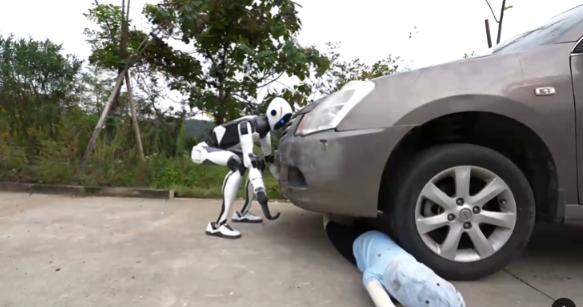
Humanoid robots have already surpassed the physiological limits of humans…(Look at the World Humanoid Robot Games 2026)
Yet, it is precisely this limit that can save lives.
It would come as no surprise to see the H2 guard mode--deployed for duty on our roads in the future.
In the event of a traffic accident, it could potentially provide rescue assistance much faster.
Millions of hours of human experience data are being collected. But how do we turn all that raw footage into something models can actually learn from?
NVIDIA just open-sourced Flora, a gold-mining tool for Physical AI. It automatically generates timestamped captions, process evaluations, and reward signals from robot data.
Interestingly,the cost difference is very striking-- $0.72/hour vs. $88/hour for the GPT-6 Astra API. Processing 1 million hours would cost $720,000 with Flora, compared with $88 million using Astra.
NVIDIA says its production system processes 200,000 hours of data per day on 512 GB300 GPUs.

We built a robotics data engine with Astra-level performance at 125x lower cost. And we are open-sourcing the weights today! Introducing Flora, a suite of open models to parse the physical world and turn raw footage into rich training signals.
Flora already powers our in-house data engine, labeling 200K hours of videos a day on 500 GPUs. We created it to scale the frontier for robot learning. Now you own the weights too.
Flora gives you:
- High-quality, timestamped captions to curate and filter human egocentric and robot data;
- Dense progress rewards for quality control and RL post-training;
- Rubrics scoring for real-world benchmarking
Try it today, links in thread:
A very cute Z-legged home humanoid.
NYC-based Tuesday Labs’ Voxel is designed for everyday household tasks--tidying up, finding lost items, fetching things, and watering plants…
I love the design choices. The bright orange makes it feel warm and approachable. It has no head, with its emotional interface built into its belly. Audio and visual interaction give it another way to communicate with people, without a conventional face.
and,it has two 7-DoF arms, simple grippers, stereo RGB cameras, distinctive zig-zag legs, and an Adaptive Operating System.
Voxel Series-1 is expected to start shipping in 2028, with reservations open for a fully refundable $200 deposit.

This is really cool
an open-source tactile manipulation dataset for humanoid robots
Real-robot tactile data is scarce.
Sharpa has released SharpaDex v1.0 on Hugging Face: 28,993 real-robot teleoperated demonstrations across 59 bimanual manipulation tasks, totaling around 300 hours.
The dataset combines visual observations, robot states, actions, and tactile data from all 10 fingertips, including force/torque signals and tactile videos.
Humanoids get smarter by interacting with the physical world. touch matters.
