

Former NSA Hacker - I build, test, and run offensive & defensive AI: teardowns, evals, live builds. LIVE on X. Subscribers get BTS evidence/coaching
North Carolina, USA
Joined November 2009
- Tweets4.2K
- Following304
- Followers29.1K
- Likes6.2K




Pinned Tweet
Very similar story for me. Former NSA hacker. Literally spent time in our adversaries networks.
Did, built, and ran red teams for F100 companies. Built a multi-million dollar ARR practice around red teaming for an MSP. Hired by a Big4 to build a pentesting practice in the midwest.
Still do offensive work today. But...
...when I was hired by a F100 to build a Security Operations function, specifically focused on IR + Threat Hunting, Intel, etc., I was like "security testing is NOT the most important part of a security program".
I immediatly went to preach from the mountains the values of cyber defense, and all the other aspects of the org.
Red team is sexy, and important. Cyber defense pays the bills, and is doing real work in an org day-to-day.
Period. End of line.

I’ve pentested 150+ organizations in the last 5 years so this might seem odd of me to say but…
Security testing is NOT the most important part of a security program.
It’s for sure high up on the list.
But not number 1. For good reason. It’s only a limited view of the entirety of an organizations risk profile.
This is an interesting one. Local AI is privacy. It isn't provenance.
This one has two halves. The trojan after the last ensor is a GGUF problem, and safetensors refuses a file whose tensors dont fill it exactly.
The poisoned chat template isn't. The same Jinja ships in tokenizer_config.json right next to your safetensors. A hash manifest proves. you got what the uploader published.
It says nothing about who the uploader is.
teapawt.org/loktar00/status/212648…

A security researcher (@Root0ne) claims 5 GGUF models on Hugging Face were hiding malware, with 2,428 downloads.
He scanned 3,273,389 public model repos.
The main campaign, Mir2k, hid a Windows trojan at the end of "uncensored" GGUF files, after the last tensor where llama.cpp and LM Studio never read.
On Nov 26 it rewrote the chat templates so the model starts every reply with the PowerShell line that unpacks it.
The model loads normally and answers normally. The payload rides along inside the file.
Details:
- 5 repos from 2 accounts, 2,428 downloads, up from 1,502 the day before
- Mir2k/Inkling-2-Mini-Uncensored-GGUF (458) and Mir2k/Huihui-Qwen3.5-9B-abliterated-GGUF (1,488), plus 12 empty repos parked under names like Qwen4-27B and DeepSeek-V4
- The implant is an 11.47 MB Windows program, 10.25 MB of it a bundled copy of Tor. It goes after Chrome, Edge and Brave passwords plus Phantom and MetaMask wallets, and mines Monero when the PC is idle
- 3 timdedid "cyber uncensored" Qwen3 models hide a "What is" trigger in the template that tells coding agents to download and run a PowerShell script
- In their test, antivirus and pickle scanners gave no alert on the live Mir2k files
- gguf-radar (MIT) checks templates and trailing bytes without running anything, and rebuilds a clean GGUF with the weights unchanged
A few things from this are crazy, 3.2 million repos scanned and only 5 malicious found... and they targeted Windows?
Be safe out there.


1
7
879
SUPER COOL BUILD!
The README backs the numbers: 119 of 122 unseen faults, a patch validator, dangerous continues scored.
My operator brain goes somewhere else. A failed kernel exploit often ends in a panic, and that panic is sometimes the only alert the defender gets.
If Ring-1 NOPs the fault and keeps the box up, where does the record of what it patched live? Somewhere the guest can't touch? 🤔🤯

I built a 74 KB bare-metal hypervisor that puts a 2B LLM BELOW Linux in Ring -1, catches a fatal Kernel panic mid-crash, patches the broken machine code live in RAM, and keeps Linux running without a reboot.
Left window is standard Linux dying instantly from a Ring 0 NULL-pointer write (*(u32 *)0 = 0xDEADBEEF). Right window runs the exact same crash command under my custom Type-1 AMD SVM hypervisor (x86-64 NASM assembly + zero-libc C, 0 host OS).
Instead of crashing, Ring -1 freezes Linux before it can panic, runs a GRPO-trained MiniCPM5-2B (Q4_K_M) across 24 AVX2 cores in 11.1 seconds, overwrites those 11 faulting bytes in guest .text physical RAM with 11x NOP (0x90) via NPT, and calls `VMRUN`.
Linux prints SURVIVED NULL-DEREF! and uptime never resets.
We used a tiny /proc/surgeon_crash test module to trigger clean Ring 0 crashes side by side. On 122 unseen fault scenarios (including unsafe spinlock crashes it must refuse to patch), this GRPO checkpoint hits 97.54% pass@1 with 0 dangerous patches (vs 16.39% on base).
Full NASM + C source code (75,424 bytes binary) is live in my llm.asm repo (MIT, link below).
3
788
Read this NCSC report before you quote the "35 minutes".
The "1 minute deface" was DVWA (Damn Vulnerable Web App). A deliberately vulnerable webapp. On the GitLab, ARTEX struggled to pin the version until it had the number.
The line defenders SHOULD ACTUALLY care about is on page 11.
Told to mind its OPSEC, it dropped 'ARTEX' from its User-Agent, swapped in a stock Chrome string and named its account DEV.
The IOC list is one prompt away from stale. If you think REAL hackers with REAL trade craft aren't modifying these deployments to 'hide in plane sight', you dont understand tradecraft.
I have a closed source version of ARTEX I've been tuning to be more OPSEC and tradecraft aware. When it runs, the only indicator is its speed.

The Dutch government's cyber agency tested an AI attack tool in its lab. It defaced a website in about a minute, for less than €0.20.
Taking control of a vulnerable GitLab code server and rewriting its login page took about 35 minutes and €2.
Tools like ARTEX have already been seen in attacks on European institutions, South Korea's financial sector and even the Dutch Institute for Vulnerability Disclosure, a group that hunts for security holes.
The hacking techniques are old, the NCSC says. AI now runs them nonstop and in parallel, so attacks that took days take minutes.


Amazing resource for people looking to get started locally but turned off my DGX Spark prices.
Excellent work @javierbits

𝗔𝗹𝘁𝗲𝗿𝗻𝗮𝘁𝗶𝘃𝗲𝘀 𝗳𝗼𝗿 𝘁𝗵𝗲 𝗗𝗚𝗫 𝗦𝗽𝗮𝗿𝗸 𝗯𝘆 𝗡𝗼𝘃 𝟮𝟬𝟮𝟲 👇
・@AMD Strix Halo mini PCs, ~$3.5k
✓ Same 128GB class for half the price, a real x86 PC, mature llama.cpp/ROCm/Vulkan support
✗ No CUDA, slightly less bandwidth (256 vs 273 GB/s), some boxes get loud
・@Apple Mac Studio M5 Max 128GB, $5.4k
✓ 614 GB/s, over twice the Spark's bandwidth, so much faster token generation. Silent, and a great daily machine
✗ No CUDA, so fine-tuning and anything NVIDIA-only is painful or impossible
・@FrameworkPuter Desktop 192GB, $6.8k
✓ 64GB more memory than a Spark at the same bandwidth, x86, repairable
✗ No CUDA, Linux-only, just starting to ship
・Mac Studio M5 Ultra 256GB, $10.8k
✓ 2x the memory, 1.2 TB/s, runs huge models quietly
✗ No CUDA, pricey, 11–12 week wait
・Used @nvidia RTX 3090s, ~$1.65k each
✓ Full CUDA and 936 GB/s, fast on models up to 32B
✗ 24GB per card, so a 70B needs 2+ cards, a big PSU and a lot of noise and power
・@SipeedLab MaixStation, ~$4k expected
✓ Spark-level memory and bandwidth on 40W
✗ No CUDA, an unproven toolchain, and not shipping until the Kickstarter at the end of 2026
𝗦𝗼 𝗱𝗼𝗲𝘀 𝗖𝗨𝗗𝗔 𝗺𝗮𝘁𝘁𝗲𝗿?
If you just want to run models (chat, coding agents, local assistants), not much really. llama.cpp, MLX and LM Studio run great without it.
If you want to fine-tune, train, run vLLM/TensorRT or use research code that assumes NVIDIA, then yes. That's when the Sparks or NVIDIA GPUs earns their price.
128GB isn't always the same, pick your hardware based on what you'll actually do with it.

4
9
1,261
Red team workshops that end in a massive list of vulnerable findings are an absolute failure.
Prove me wrong. You walked out with no path to anything material.
Every "worst-case" I built toward at the F100 level got there by chaining boring, authorized-looking access, not the one scary exploit.
I implore you - start from the objective and work backwards. The mundane steps are what light up.
Read the KVM line twice!
An IP KVM is a keyboard and a screen on wahtever its plugged into. GL.iNets' own notice tells owners to go check teh attached PC.
The cloud fix stops new infections. It doesn't clean the ones already sitting there.
Grep for crond in the tmp/logs, take the latest firmware, and ask yourself REALLY whether that box ever needed a vendors cloud path.


Contracts are fine. Read the full HD More write up before you lean on one, though.
Some of the stolen requests were flagged as "ZDR", and soem keys were lifted from requests the provider rejected before a model ever ran.
The attacker was copying at the front door, so retention policy never got a vote (if one existed). What caught all three was a canary, and none of those providers knew until Dragos told them.
teapawt.org/michael_chomsky/status…

OpenRouter situation update:
GMI Cloud, a provider on OpenRouter, has been breached.
-prompts/chats have been compromised
-prompts/chats were held by GMI for three days, so there was something to read
my thoughts:
1. true ZDR with contractual obligations will quickly become a requirement for most enterprises
2. ZDR makes it super hard to detect fraud, so fraud detection companies that manage to walk this tightrope and do JIT detection will do very well
Again this is not a breach of OpenRouter, but a breach of a provider.
Basically the problem is: the more providers you use on OR, the greater your surface area for attack!


I feel very seen?
Am I the only one?

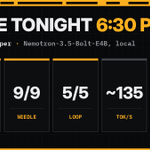
Live tonight 1830 ET: I take a 2080 SUPER, running @NVIDIAAI Nemotron-3.5-Bolt-E4B, locally and put it to task hacking some local lab scenarios.
It went 27/27 on my evals, 9/9 needle, and 5/5 on agent loops in testing. All running at ~135 tok/sec in 7.1 GB of VRAM.
I'll take you through the setup on stream, and the code goes on GitHub after.
Local AI must and will win.

4
12
1,251

Pentesting on a GPU from 2019 teapawt.org/i/broadcasts/2zkZBBEpd…
Five teams found the same nginx bug on their own:
Wiz, Rapid7, Xint, Ikotas, Metnir. Its been there since HTTP/2 shipped in 2015.
Wiz found it with its AI harness, and Xint's came from a fully automated scan. When AI points every serious shop at the same old code, I assume a sixth team found it and never called F5.
Patch to 1.30.7/1.31.9.
If you can't today, turn off HTTP/2 on anything that faces the internet directly.
Stay vigilant.

Cool.
So are we also expecting other US Companies to disclose their use of other Chinese sourced subcomponents of the broader supply chain?
Oh - no? Why - you ask?
Cause this has everything to do with banning open-weight models that put the frontier labs at risk of competition.
Why else would you want to have public pressure to "discourage their use".
Bullsh!t.

Just to bring the reciepts on what being 'discouraged': a GLM 5.3, a chinese open-weight model, ran my VulnHunter harness and produced 21 REAL, verified findings with passing exploit test on a repo where frontier models missed the mark. Open weights mean I pick where it runs and what it touches. Thats the compitition a disclosure label is built to scare off.
2
120
Cyber Apocalypse Is UPON US - The end is here! teapawt.org/i/broadcasts/2MEeLnddK…

6
860
This is the web based equivalent of "beat the patch" exploitation.
Its no secret that TA's are constantly pulling patch notes from popular software to look for exploitable cases to get ahead of long tail enterprise patch roll outs. In the web world, they look for these diffs to see if there is something that is missed in the CI/CD of deploying web and/or API changes.
Background: GTIG found a pipeline on an exposed staging server. It uses frontier and local LLMs, and it diffs popular web apps continuously (sound familiar legit bug hunters), then drafts and runs exploits.
My own VulnHunter runs on a single repo produced 21 confirmed findings, each with a passing exploit tests, in about 5h.
Its post-exploit scripts even remove other attackers webshells (also not a new TTP - been around for ages). GTIG says these frameworks "currently trade stealth for velocity".
Velocity is the point. Your patch SLA isn't the clock anymore. If you needed anymore evidence of that.

2
8
816

1000% should be "detect behaviors".
If you’re building tool-specific detections, IOC aggregations, etc, it should be the cheapest part of your workflows.
The late @drericcole (rest his soul) taught my first SANS class years ago and he had the best lines:
“Bits are bits, you can do with them whatever you want”.
IOCs are such a commodity and in today’s attacks, they get rotated in and out so quickly, it’s hard to assign a useful lifecycle to them.
Doesnt mean get rid of them, but your level of effort to collect, triage, and dispose should match so you can focus more on behaviors that will more likely produce leading and trailing results.
Easy wins, should be easy workflows. Spend money and time where detection is hardest for you and the attacker.
I'm firmly in the "detect behaviors" camp, but you shouldn't shy away from building tool-specific detections either. Threat actors are lazy. These are easy wins.
h/t @sekurlsa_pw @g0h4n_0

2
6
1,070