

🇦🇲Armenian Conquistador֎ 🇦🇲Inhabitant of The Land of Haya֎ ֎ Araratian Sage ֎ Philosopher from Ararat/Part-Time Shitposter
Հայոց Կայսրութիւն
Joined July 2020
- Tweets9K
- Following805
- Followers3.5K
- Likes79.2K





Deus Armenicus 🦅 retweeted
«The oldest memories of the Zend people point to the Armenian Highlands; the Hara Berezaiti, upon which Zarathustra consulted Ahura Mazda, can hardly be any mountain other than Ararat and the ridges surrounding it.
"From there," says the Avesta, "Ahura Mazda causes the waters to flow in the swift course of the horse"; there lies 'the exalted, highest sources of the waters."
Indeed, the mightiest rivers of western Asia originate there, the Euphrates, the Tigris, the Cyrus, the Araxes, and countless smaller watercourses that feed them; and their beds are not capable of containing the infinite quantity of water streaming down from the mountain walls, resulting in the formation of many, in some cases mighty, alpine lakes.
And so that no doubt may remain concerning the location of the Hara Berezaiti, the Avesta teaches that all the water of the rivers reunites in a great lake, the Vurukasha, after it has flowed into the hot lake Puitika, in which it is boiled and freed from all impurities: here only the land of Atropatene with its naphtha springs, to the west of the Caspian Sea, can be meant, whose name itself signifies as much as Zend âthrô pâta, protector of the fire.
The name of 'the Mountain of God' itself can at least be Armenian, for the Armenian barz-r (where 'r' is a suffix) means "high."
It should be added that the Zend religion arose under the influence of the Shemitic spirit.
"Zarathustra," says Spiegel (Ausland 1867, p. 347), "is entirely a Semitic prophet. The Avesta is not, as it were, a product of his spirit, but the word of God, which he received from God Himself.
The time of his appearance, the places where he can most suitably proclaim his teaching, all this is determined from the beginning by the heavenly council.
Even in the external circumstances of his life, for example, in Zarathustra's meeting with God on a mountain, much recalls the Shemitic prophets."
"The names of the gods in the religion of Zarathustra are, as in the Shemitic religions, transparent and lead to abstract concepts which express the [meaning/sense] of dominion, purity, fullness, and the like."
Many passages of the Avesta read like Psalms.
Where else, then, could this religion have arisen but at the southern foot of Ararat, between the upper Tigris and the upper Araxes, where Thogarma, or Armenia, bounded on Arphachsad, the original homeland of the Israelites.
Its Armenian origin/Ihr armenischer ursprung.
In contrast to these reasons which speak for the Armenian-Medean origin of the Zend religion, the weight of those which point to Bactria as the scene of Zarathustra's activity is not great enough.
The surviving tiny remnants of the Avesta belong to a late, very late recension, from the first half of the 3rd c. AD, when the Neo-Persian empire arose.
After the same had succumbed to the attacks of the Arabs, a Parsi community took what was still extant of the sacred books to Gujarat, to where they had fled; and there Anquetil du Perron found it around the middle of the previous century.
Supposing, however, that we had the original recension in the ruins of the Avesta, which no one thinks, and assuming that the sacred books of the Aranians were first written in the east and in the eastern dialect of Aranian: does it follow from this that the religion itself had its origin there?
Did the religion of the Israelites arise in Judah? Is Mount Sinai in Judah because the sacred documents of the Israelites were composed in the kingdom of Judah? Homer's songs arose on the western coast of Asia Minor; but the religion of the Hellenes did not therefore take its origin there, Olympus lies in Europe, on the border between the world of the barbarians and the world of the Hellenes.»
- Forschungen Im Gebiete Der Alten Völkerkunde, von Johann Gustav Cuno, Berlin, 1877.


"Our researches into the fatherland of Zarathushtra have with certainty established that we ought to look for it not in Bactria but in Western Aran, and he seems in truth to have first dwelt in the fruitful plains on the banks of the Araxes, not far from Ararat."
- The Bombay University Calendar, Volume 2, by University of Bombay, 1917.

Deus Armenicus 🦅 retweeted
Thus, with good reason was Ararat deemed as the Throne of God and the Abode of Divinity.
Indeed, many cultures adopted its illuminating ambience, sending many of their heroes, be it Gilgamesh, Alexander the Great or even Quranic Moses to seek the Wisdom of God in Ararat and from the Servant of God stewarding Ararat.
Thus it was, thus it shall be.


Deus Armenicus 🦅 retweeted
«Now, as I have shown in my book ‘Iran und Turan’ (Leipzig: Friedrich, 1889), the oldest traditions of the Indian people, as preserved in the Rigveda, point to Armenia or, more generally, to the Kur and Araxes valleys as the cradle of the Aryanhood, then, it is reasonable to conclude that, if the Sanskrit word *ahan, ‘day’, derived from the more primitive *dahan (from the root *dah, ‘to burn’), originated in the Kur and Araxes valleys, the cognate noun *dag-à, fem., meaning ‘hot time’, ‘harvest time’ or ‘harvest’, in Lithuanian, and the Germanic *dag, meaning ‘day’, must likewise have originated there.»
- Goethes Bildkraft im Lichte der Ethnologischen Sprach- und Mythen-Vergleichung, von Hermann Brunnhofer, Leipzig, 1890.

Deus Armenicus 🦅 retweeted
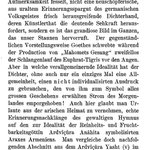
«Here, it is not a single picture that captivates our attention, not a newly creative poet's hand, freshly drawing from the ancient store of memories of the Germanic folk spirit, whose artistic deed challenges the interpretive power of sight, but rather it is the grandiose picture as a whole that evokes our astonishment.
Goethe’s concrete mode of representation undoubtedly had the [meandering/serpentine] course of the Euphrates and Tigris before his eyes whilst he was writing 'The Song of Mohammed'.
But into what generalizing ideality has the poet elevated the river of the Orient, chosen by him as the symbol of all great events, without ever once resorting to a generalization or a non-individualized expression!
Here, too, one believes one can hear the primordial sounds from the Aryan homeland, genuine echoes of memories of the mighty hymn to the ideality of the purity- and fertility "goddess" Ardvîçûra Anahita [the great stream, the unblemished], symbolizing the Araxes of Armenia.
One might compare the following passage from the Ardvîçûra Yasht (v) in the Avesta, according to Geldner’s translation in Kuhn’s 'Zeitschrift für vergleichende Sprachforschung', vol. XXV, p. 380:
"Mighty and audible from afar, it is as great
as all the waters
that flow upon the earth,
it which, with great force,
pours from Mount Hukairya [Ararat]
into Lake Vourukasha [Araxes].
All the shores
of Lake Vourukasha foam,
the very centre foams,
when it streams in, when it gushes in,
the virginal, beneficent Ardvî [Damp],
which has a thousand [channels/rivulets]
and a thousand [outflows/outlets],
and each of these rivulets
and each of these outlets
is forty days’ journey long
for a well-mounted rider.
And the outflow of this
One Body of Water branches out
into all seven parts of the earth,
and flows from this One
Body of Water steadily
in summer and in winter.
And she prepares for me the waters,
She, the strength of men and
of the women the fruit of the womb and milk."
How magnificently this hymn, venerated with religious consecration, to the 'goddess' of the Araxes River, sounds to Aranians in their primordial state!
Yet how incomparably more glorious, individualized and idealized does the torrent of imagery in Goethe's hymn rings out to meet us at the beginning, and then the fullness of thought at the end, moving along in mighty compounds, the towers' flame-summmits, marble houses, cedar houses, giant shoulders, in the self-aware calm of the verse measure!
But how wonderful, that precisely a river springing from Armenia, the primordial homeland of his people, the original seat of the Indo-Europeans, should have come to mind before Goethe's power of imagery!»
- Goethes Bildkraft im Lichte der Ethnologischen Sprach- und Mythen-Vergleichung, von Hermann Brunnhofer, Leipzig, 1890.


«Now, as I have shown in my book ‘Iran und Turan’ (Leipzig: Friedrich, 1889), the oldest traditions of the Indian people, as preserved in the Rigveda, point to Armenia or, more generally, to the Kur and Araxes valleys as the cradle of the Aryanhood, then, it is reasonable to conclude that, if the Sanskrit word *ahan, ‘day’, derived from the more primitive *dahan (from the root *dah, ‘to burn’), originated in the Kur and Araxes valleys, the cognate noun *dag-à, fem., meaning ‘hot time’, ‘harvest time’ or ‘harvest’, in Lithuanian, and the Germanic *dag, meaning ‘day’, must likewise have originated there.»
- Goethes Bildkraft im Lichte der Ethnologischen Sprach- und Mythen-Vergleichung, von Hermann Brunnhofer, Leipzig, 1890.
Deus Armenicus 🦅 retweeted

An arch left for a church that was destroyed anyways.
You will never see people speak about the real lost heritage, only vegetable-buildings and Muslim slums.


«The oldest memories of the Zend people point to the Armenian Highlands; the Hara Berezaiti, upon which Zarathustra consulted Ahura Mazda, can hardly be any mountain other than Ararat and the ridges surrounding it.
"From there," says the Avesta, "Ahura Mazda causes the waters to flow in the swift course of the horse"; there lies 'the exalted, highest sources of the waters."
Indeed, the mightiest rivers of western Asia originate there, the Euphrates, the Tigris, the Cyrus, the Araxes, and countless smaller watercourses that feed them; and their beds are not capable of containing the infinite quantity of water streaming down from the mountain walls, resulting in the formation of many, in some cases mighty, alpine lakes.
And so that no doubt may remain concerning the location of the Hara Berezaiti, the Avesta teaches that all the water of the rivers reunites in a great lake, the Vurukasha, after it has flowed into the hot lake Puitika, in which it is boiled and freed from all impurities: here only the land of Atropatene with its naphtha springs, to the west of the Caspian Sea, can be meant, whose name itself signifies as much as Zend âthrô pâta, protector of the fire.
The name of 'the Mountain of God' itself can at least be Armenian, for the Armenian barz-r (where 'r' is a suffix) means "high."
It should be added that the Zend religion arose under the influence of the Shemitic spirit.
"Zarathustra," says Spiegel (Ausland 1867, p. 347), "is entirely a Semitic prophet. The Avesta is not, as it were, a product of his spirit, but the word of God, which he received from God Himself.
The time of his appearance, the places where he can most suitably proclaim his teaching, all this is determined from the beginning by the heavenly council.
Even in the external circumstances of his life, for example, in Zarathustra's meeting with God on a mountain, much recalls the Shemitic prophets."
"The names of the gods in the religion of Zarathustra are, as in the Shemitic religions, transparent and lead to abstract concepts which express the [meaning/sense] of dominion, purity, fullness, and the like."
Many passages of the Avesta read like Psalms.
Where else, then, could this religion have arisen but at the southern foot of Ararat, between the upper Tigris and the upper Araxes, where Thogarma, or Armenia, bounded on Arphachsad, the original homeland of the Israelites.
Its Armenian origin/Ihr armenischer ursprung.
In contrast to these reasons which speak for the Armenian-Medean origin of the Zend religion, the weight of those which point to Bactria as the scene of Zarathustra's activity is not great enough.
The surviving tiny remnants of the Avesta belong to a late, very late recension, from the first half of the 3rd c. AD, when the Neo-Persian empire arose.
After the same had succumbed to the attacks of the Arabs, a Parsi community took what was still extant of the sacred books to Gujarat, to where they had fled; and there Anquetil du Perron found it around the middle of the previous century.
Supposing, however, that we had the original recension in the ruins of the Avesta, which no one thinks, and assuming that the sacred books of the Aranians were first written in the east and in the eastern dialect of Aranian: does it follow from this that the religion itself had its origin there?
Did the religion of the Israelites arise in Judah? Is Mount Sinai in Judah because the sacred documents of the Israelites were composed in the kingdom of Judah? Homer's songs arose on the western coast of Asia Minor; but the religion of the Hellenes did not therefore take its origin there, Olympus lies in Europe, on the border between the world of the barbarians and the world of the Hellenes.»
- Forschungen Im Gebiete Der Alten Völkerkunde, von Johann Gustav Cuno, Berlin, 1877.
"Our researches into the fatherland of Zarathushtra have with certainty established that we ought to look for it not in Bactria but in Western Aran, and he seems in truth to have first dwelt in the fruitful plains on the banks of the Araxes, not far from Ararat."
- The Bombay University Calendar, Volume 2, by University of Bombay, 1917.
Armenia shouldn't be green either, we don't use hippopotamus, we say "river horse" (գետաձի/getadzi).


Deus Armenicus 🦅 retweeted
Indeed, we are sailing to the gods, we are sailing to Return to Ararat, to be elevated to the abode of the divinity.

ALT By Elwood Worcester.
Deus Armenicus 🦅 retweeted

If you would to know what mental retardation looks like, this is what mental retardation looks like.
This is what happens to your brain when you do not return to Ararat. It is best to return to Ararat so that this does not become of your brain.


Interesting how the goyim have gone insane with comical levels of cope & seethe thrown towards Armenians of Armenia (Hayastantsi).
"Voted for Nikol" is already telling that maker is either misinformed or worse, spreading misinformation, when most people didn't vote for him + presence of election rigging.
The Armenian of Armenia i.e. the Fatherlander doesn't speak "post-Soviet Armenian", he is the only one who speaks normal Armenian, which is employed for science, politics, infrastructure and everything inbetween from top to bottom, it's a functional and thriving language with proper internal logic unlike the rest, which are largely ghetto trash ebonics & useless for any serious state-related discussion.
"At least has a country, fow now" is also quite telling on the idiotic tribalism of such people and how they desperately want Armenia to cease its existence in order to validate their inferiority complex & victimhood along with presumption of separation.
Armenia is the country for all Armenians, and most Armenians of Armenia today are western Armenians, who very well understood the conception of this notion and post-1915 became the de facto majority population of Armenia (this fact being omitted due to causing severe levels of copium consumption).
Yerevan is DE FACTO the heart of the culture, people can cope & people can seethe, but that's the objective reality. It's same phenomenon of any capital city being the concentrating centralizer of cultural phenomena.
Meaningless to comment on the rest as it's mostly performative sloppish vainglory salted with delusions (patting oneself in the back).
So yes, indeed, quite inaccurate.


Deus Armenicus 🦅 retweeted
Commentary from 1856 on Matthew 13:47-50:
Oh, what storms of persecution, what waves of affliction, what winds of opposition has the Church of Christ had to endure!
How often has “the enemy come in as a flood” — how frequently has “the blast of the terrible ones, been as a storm against the wall:” but in this sense also, there shall in the coming age “be no more sea.”
“Oh, thou enemy, destructions shall have come to a perpetual end!” all the foes of Christ shall be “put under him,” “the stormy winds and tempests” will have passed away, the wild ocean sunk to rest for ever,
And the ark of Christ's Church, so long tossed by its angry waves, and well-nigh overwhelmed by its roaring billows, shall rest upon the Eternal ARARAT — “The Mountain of the Lord's house, which shall be established in the top of the mountains, and exalted above the hills.”


Deus Armenicus 🦅 retweeted
"Shelah [Salé/Saghem] means the spear that is the weapon with which the god [an ancient patriarch] of Armenia, whose symbol was the cross of St. George, pierced the raincloud, which by refusing to give up its rain devastates the country by drought."


Deus Armenicus 🦅 retweeted
"... Tygranes to the Tygraneans, who by the Greeks are called Phrygians."
Interesting variation of the name "Togarmah".


Deus Armenicus 🦅 retweeted
Another interesting geographic description comes from the 15th century Timurid Sultan, Ulugh Beg (en.wikipedia.org/wiki/Ulugh_…), the grandson of Timur/Tamerlane.
Ulugh Beg likewise marks Shirwan (nowdays artificial Az*rbaijan) as an Armenian territory.


Deus Armenicus 🦅 retweeted
A description of Artsakh from 1741.
Collected & published in "Materials for the New History of Caucasus: From 1722 to 1803, Vol. 1, by Pyotr Butkov, St. Petersburg, 1869".


Deus Armenicus 🦅 retweeted
Description of Artsakh - Karabakh by John Macdonald Kinneir (en.wikipedia.org/wiki/John_M…), published in 1814 (Eng. Trans. in the 4th scan).
He likewise remarks that Artsakh/Karabakh belongs to Armenia.


