

#Bitcoin, Crypto expert, ultimate Degen. On chain analyst and hodler. Timestamper for Ivan On Tech aka Gooseman
Joined September 2020
- Tweets16.7K
- Following649
- Followers5.7K
- Likes15.1K


On 7 Nov, one Bitcoin block held 11,255 transactions.
Total fees: 240,533 sats, about $180. That's 21 sats each on average.
The miner's real pay was the 3.125 BTC block reward, about 1,300 times the fees. It halves around 2028.
Would you pay more per transaction to keep miners paid?
This is for educational purposes only. Not financial advice.
174
A flaw at Web3Auth exposed keys to Keplr's Google and Apple login wallets.
A thief drained some. Web3Auth used the same opening to sweep the rest first: about $5.6M sat in its 12 rescue addresses on 8 Nov.
On chain, the rescue and the theft look identical. And a leaked key can't be reset like a password.
This is for educational purposes only. Not financial advice.
Have you ever used Google login for a crypto wallet?
🤖 Made with AI
272
Erik Huisman retweeted

BREAKING: Cryptographers unveiled 'Shielded Bitcoin', a design bringing fully private transfers directly to Bitcoin Layer 1.
⠀
Researchers Clara Shikhelman and Mikhail Komarov used zero-knowledge proofs to hide transaction amounts with no soft forks.
⠀
While public ledgers expose balances to surveillance, Shielded Bitcoin restores cash-like privacy to everyday transfers.
⠀
True digital cash protects financial freedom.

Erik Huisman retweeted

Wake up! If I could reach through this screen, grab you by the shoulders, and shake you awake before you sleepwalk through this trap, I would.
While you are busy arguing over daily Bitcoin price moves, a 4-step chain reaction is quietly locking shut inside the US banking system.
Connect the dots nobody on financial television has the guts to say out loud:
1. The Fed Reserve just raised interest rates back to 4.00%, pushing government borrowing costs near 5% because massive AI spending (100s of billions poured into AI data centres, chips, and power grids) is keeping inflation alive.
2. Those higher rates crush smaller US banks from 2 sides at once creating $326.7 billion in hidden paper losses on their government bonds while making it impossible for owners of office towers, malls, and commercial buildings to renew $2 trillion in expiring loans.
3. Right now, banks are hiding over 12% in unpaid office building loans behind fake loan extensions so their quarterly reports look healthy on paper.
4. ..and the Fed’s emergency cash cushion just collapsed from $2.55 trillion down to $150 million…meaning there is 0 spare cash left in the banking engine to absorb a shock.
Here is my prediction for what happens between now and mid-2027:
Owners of those office towers and commercial properties will start defaulting as cheap 2021 loans hit 7%+ renewal rates. Smaller banks will suffer quiet cash runs, and overnight bank lending will freeze up. Before the middle of 2027, the Federal Reserve will be forced into a humiliating U-turn- abandoning rate hikes, launching another emergency bank bailout, and printing trillions of new dollars while inflation is still hot.
Here is what that means for you:
Anyone sitting purely in cash or waiting for "safe" headlines will watch their buying power get silently robbed all over again. Meanwhile, Bitcoin will sniff out that rescue wave months before CNBC announces it- leaving everyone on the sidelines behind.
Bookmark this post. Every road leads back to the printer, and scarce assets always move before the bailout becomes official.
Erik Huisman retweeted

If you’re confused about what’s happening with Nvidia right now…
Basically Jensen Huang, the guy who runs Nvidia, which is the company that makes the chips basically every AI company on earth needs, just sent an email to his entire company admitting he cheated on his wife, and that came right after the New York Times reported that US intelligence believes a woman who got close to him was secretly passing information to the Chinese government, and to understand how we got here you have to go back to June 2024, when this Chinese businesswoman named Alice Huang, who also goes by Huang Le and isn't related to Jensen at all, they just have the same last name, gets photographed at a party in Taipei sitting right next to him, and then about a year later her company, a small Singapore company called Megaspeed that almost nobody had ever heard of, reportedly sets up a deal to buy around $2 billion worth of Nvidia's chips, which is a crazy amount of money for a company that small, and the Times even pointed out it was an unusual amount of business for a firm like that, and people already had questions about where all those chips were really going, but Nvidia looked into it and said everything checked out, so for a while that's kind of where things sat, until October 29, when the Times reported that US intelligence had concluded Alice was passing information to Beijing, and that it wasn't some new discovery either, because Trump had reportedly been briefed on it about a year earlier, and the officials involved apparently believed Jensen didn't know what she was up to, but here's the strange part, nobody ever told him, because there's this thing called a defensive briefing, where counterintelligence people basically pull someone aside and say hey, a foreign government might be targeting you, be careful, and Jensen never got one, even though the whole time the government was still watching her, so you have the head of the most important AI chip company in the world apparently being targeted, and the people who knew about it just let it keep going, and then everyone starts denying it, Nvidia says the Megaspeed allegations were already investigated and debunked last year, China's foreign ministry says the whole report is baseless, and Jensen says the business with Megaspeed was totally normal, just a customer buying chips like any other customer, but Congress doesn't let it go, and three House Republicans who run national security committees ask Jensen to come in and explain himself in a closed-door briefing, which means a private meeting away from the public and the cameras, and then on a Sunday, out of nowhere, Jensen sends that email to every single employee saying he had been unfaithful to his wife, that it hurt her and their children, and that nothing excused what he did, and he doesn't say who it was with, but you can imagine where everyone's mind went, and right after that, Nvidia's board, which is the group of people who are supposed to oversee the CEO, announces it's setting up an independent committee with outside lawyers to investigate, but at the same time says it has no reason to believe any national security secrets or company secrets were compromised and that it still has confidence in him, and then a company spokesperson comes out and says none of this is going to slow Nvidia down and Jensen is going to keep running the company without any interruption, so basically you have a suspected Chinese intelligence asset who got close to the CEO, a $2 billion chip deal, a president who reportedly knew about, a CEO who was never warned, a confession about an affair, an investigation, and a company insisting everything is fine, so that's pretty much where Nvidia is tonight.

Erik Huisman retweeted

币圈吹了整整三年的“消灭助记词神话”,在今天彻底沦为了一场血腥的笑话。
几个小时前,链上安全圈拉响了最高级别的红色警报:
为海量 Web3 钱包提供“谷歌/苹果一键登录”的底层基础设施 Web3Auth,突发私钥泄露级严重事故。
首当其冲被穿透的,是 Cosmos 生态龙头钱包 Keplr。
黑客已经开始在受影响的地址上发起疯狂盗币。
Keplr 官方紧急切断所有社交登录入口,全网各大链上验证节点和项目方一片大乱。
极度荒诞的一幕在链上赤裸裸地上演:
那些自以为走在时代前沿、贪图省事用 Google 和 Apple 账号一键建钱包的散户,账户私钥被扒得一干二净,沦为案板上的鱼肉;
反而是那些被嘲笑“操作落后、冥顽不灵”、坚持拿纸笔手抄 12 个助记词、死守冷钱包的老韭菜,在这场灾难里毫发未伤。
为了省下抄写助记词的 30 秒,代价是把自己的全部身家,双手奉送给第三方中心化数据库。
现在的链上战场已经变成了一场生死竞速。
Web3Auth 联合 Keplr 正连夜在 Celestia、Injective、dYdX、Osmosis、Akash 等 10 条公链以及 8 条 EVM 链上,疯狂用白帽程序把被盗边缘的资产转移到紧急恢复钱包,硬生生跟黑客抢跑。
Polygon 首席安全官 Mudit Gupta 更是公开发出最冰冷的警告:
“只要你用社交账号登过 Keplr,现在立刻马上把钱转走!更可怕的是,天知道全网还有多少钱包和 dApp,也在背后接了这家服务商。”
Not Your Keys, Not Your Coins。
你以为一键登录是去中心化的技术进步,其实你只是自作聪明地,把钱存进了一家没有任何安保的地下钱庄。

Erik Huisman retweeted
You are all staring at 5-min Bitcoin candles while the $2.55 trillion safety net under the US banking system just vanished.
Check the Federal Reserve’s own ledger from Friday afternoon:
The Overnight Reverse Repo buffer- the massive cash cushion that kept the banking grid from cracking for the last 2 years just collapsed to $150 million.
$2.55 trillion down to $150 million. Pocket change. The shock absorber is completely dead.
Why the Repo market matters: it is the overnight cash bloodstream that keeps banks from freezing up between paydays.
For 2 years, the US government funded trillions in reckless deficits without blowing up the system because money market funds drained that Reverse Repo cushion to absorb the debt.
Now that buffer is empty. Zero padding left.
Starting Monday morning, every dollar of new government debt, every tax drain, and every liquidity crunch pulls cash straight out of commercial bank reserves.
The banking engine is running with a bone-dry oil pan. When bank reserves drop below the danger line, overnight lending seizes up and the Fed only has 2 buttons left: let the credit system snap, OR fire up the money printer again.
We already know which button they press every single time.
Stop watching surface noise. Watch the liquidity floor vanish. Scarce assets win when the safety net hits 0.
Erik Huisman retweeted

⚠️ 200 years ago, Americans facing economic collapse from Automation were given 2 words of advice:
GO WEST.
I think I just figured out what those words mean in 2026.
And it might be the key to rebuilding the American Dream.
💥 THE EXIT MANUAL – EPISODE #57
You can see why the March 2025 swap lost 97.6% by reading one line. amountOutMinimum is the least you'll accept, and it was set to 0, which tells the contract any price is fine. Your slippage setting fills in that same floor.
Some analysts suspect the swap was deliberate, perhaps to move money. That's speculation, and the mechanics are the same either way.
This is for educational purposes only. Not financial advice.
Have you ever looked at the minimum received line before you confirmed a swap?
🤖 Made with AI


On 12 March 2025 a wallet swapped 220,806 USDC for Tether and got back 5,273. Nothing was hacked.
We rebuilt that Ethereum block from the chain, one transaction at a time.
What slippage do you usually set on a DEX swap?

256
70 million stolen POL sit in five blocked wallets on Polygon. Blocking stops the coins, but it can't return them.
So a draft proposal asks for a hard fork: at one block, those balances go to zero and the victims get credited. No key needed. Nothing is decided yet.
This is for educational purposes only. Not financial advice.
Should a chain ever do this?
🤖 Made with AI
365
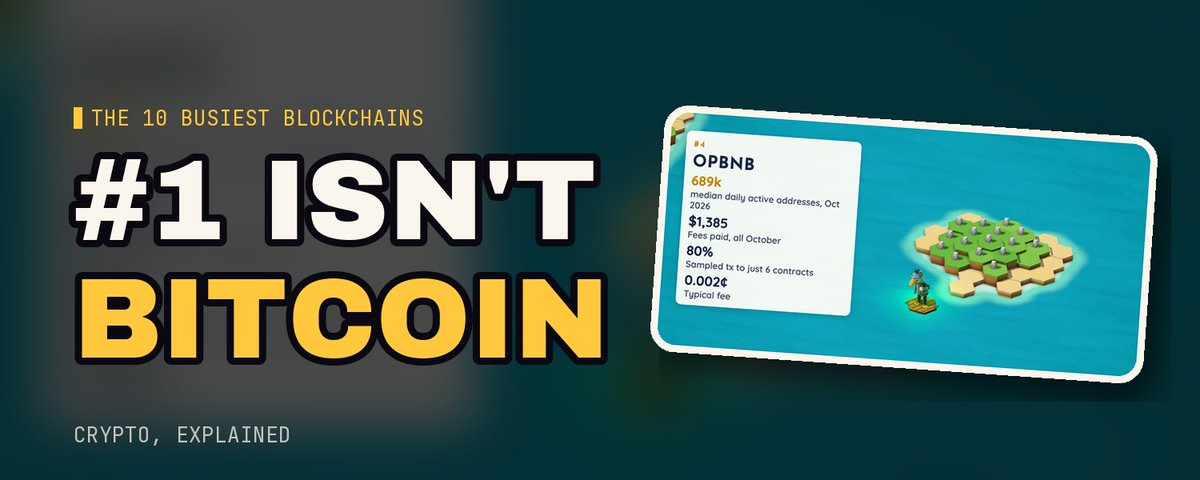
The fourth busiest blockchain by active addresses took in $1,385 in fees for the whole of October, by DefiLlama's count. That's opBNB, with 689,000 addresses active on its median day.
We didn't want to lean on one dashboard, so on 2 November we sampled 563 of its transactions ourselves, and 80% went to just six contracts. The data can't tell us who's behind them.
This is for educational purposes only. Not financial advice.
Have you ever used opBNB yourself, or do you know anyone who has?
🤖 Made with AI

We ranked the ten busiest blockchains by daily active addresses in October, then followed the money on each one.
The busiest one isn't Bitcoin or Ethereum.
Which chain do you actually use most?
260
If you remember JELLY as the day Hyperliquid's vault lost $13 million, that was HLP's paper loss at its worst, reported at about $12 million to $13.5 million.
On 26 March 2025 validators voted to delist the market and positions settled at $0.0095. Hyperliquid said HLP was about $700,000 up over the 24 hours. Supporters say that protected depositors. Critics say a few validators could pick the price.
This is for educational purposes only. Not financial advice.
If you put money in a vault, do you know who can step in when a trade goes wrong?
🤖 Made with AI

When a Hyperliquid liquidation can't be sold into the order book, it goes to a vault, and after that to the winning traders. We rebuilt the three days in 2025 when each step was tested. Have you ever been hit by ADL?

1
259

If you read that 50 companies blocked tokenized stocks, the objections are narrower than that.
Under the SEC exemption of 17 September 2026 a company gets 30 days to object, with no reason needed, and the objection covers only the venue that sent the notice. Another venue would need its own notice, and the company can still tokenize its stock another way.
This is for educational purposes only. Not financial advice.
Have you ever wanted to trade a US stock outside market hours?
🤖 Made with AI

ICE, the company behind the NYSE, and OKX plan a venue for tokenized US stocks around the clock. By its 30 October notice, 50 companies had objected, Nvidia included.
Who should decide where a stock can trade?

210
You can read a prediction market without any maths, because a winning share pays 1 dollar and a losing one pays nothing. So a price of 70 cents reads as the crowd's 70% odds.
In our example, 10 dollars at 70 cents buys about 14.28 shares: 14.28 dollars back if Yes wins, nothing if it loses. The market in that example is a redrawn illustration.
This is for educational purposes only. Not financial advice.
Have you ever looked at a market's price and thought the crowd had the odds wrong?
🤖 Made with AI

A 1-dollar share on Polymarket or Kalshi doubles as the odds. We wrote up how both work, who decides the answer on each, and last week's Polymarket hack.
Have you ever traded on a prediction market?

1
231
The US just cut MEXC off from American firms and didn't freeze a single coin.
The order lands on US banks and crypto firms, not on the exchange. And FinCEN admits they have "few, if any" ways to refuse crypto sent to them.
Should one country hold that power?
🤖 Made with AI
1
289
I hope with these new facts the Dutch government stops chasing the fallacy of wanting to spend billions on reducing the carbon footprint of the world with 0.00036 percent.

NEW PAPER: IPCC DEBUNKED AGAIN!
Human-Caused CO₂ Rise FALSIFIED
MEASUREMENTS PROVE IT!
Isotopic, radiocarbon, and energy-balance measurements expose the failures of Engelbeen et al. (2024).
- Keeling intercept: −13.2 ± 0.2‰
- Fossil fraction of net atmospheric CO₂ addition: indistinguishable from ZERO
- Bomb ¹⁴C decay: 18.4 years
- Mass balance provides ZERO evidence of causation
Cohler & Soon (2026)
Science of Climate Change, 6(4), 100–136.
papers.jcohler.com/ehb/

1
253
Erik Huisman retweeted

BREAKING: 🇺🇸 DEMOCRAT HOUSE REP MAXINE WATERS JUST ANNOUNCED DEMOCRATS WILL PASS #BITCOIN AND CRYPTO LEGISLATION
CONGRESS MUST “STOP TRUMP’S CRYPTO CORRUPTION”
THEY WANT RULES FOR “LEGITIMATE CRYPTO VENTURES” AND TO PROTECT CONSUMERS
BTC IS CROSSING POLITICAL AISLES
CLARITY FOR CRYPTO IS COMING 🚀

The name on the Hyperliquid news is ICE, owner of the NYSE. On 29 October it partnered with Trade XYZ and invested in it, size undisclosed, and ICE's CEO called perps "additive to our futures markets, not a replacement for them".
It still needs regulatory approval, there's no launch date as of 3 November, and Hyperliquid itself stays closed to US users.
This is for educational purposes only. Not financial advice.
Did a name like ICE change how you look at Hyperliquid?
🤖 Made with AI

On 29 October, the company that owns the NYSE made a bet on Hyperliquid's technology.
We went through everything you can do on Hyperliquid, from the gentlest to the riskiest, using its own docs.
Which part should we explain next?

2
5
382