

Web3 Polymath Thread writer • Prediction Trader • DeFi Cartographer 200x+ contest wins: #GOD #defi #threadcontest
DeFi
Joined June 2025
- Tweets22.6K
- Following1.4K
- Followers1.5K
- Likes38.3K




DML 🐂 🀄🧭 retweeted

So I made this 3d video for @Romeo_Onchain (Gamdom Man) and @stevewilldoit.
It definitely did not come out as expected, I have never really created an AI video before. So I mean this is really my first real trial.
Also, this video is not an entry for the $100k challenge please. Cause the quality doesn't even matchup to what people are doing😂😂😂
I won't lie, I actually tried my best. Lets see what @Romeo_Onchain and @stevewilldoit have to say and that's if they will se it😔
DML 🐂 🀄🧭 retweeted

Imagine you’re standing right in the middle of a bustling, narrow stone bridge connecting two massive, chaotic trading islands.
Thousands of merchants are running back and forth in a frantic rush, shouting over each other, desperately trying to swap their assets before the tide turns. The air is thick with tension, noise, and unpredictability.
Most liquidity providers step onto that exact bridge clutching all their cash in one hand, planting themselves in one single spot, and praying to the crypto gods that traders walk right up to their exact doorstep.Then, the market moves.
A sudden flash crash hits, or a massive green candle violently spikes.Traffic shifts away from you in a heartbeat. Your capital goes completely out of range, sitting dead and useless, while the brutal wave of impermanent loss sweeps in to eat your lunch.
You’re left standing on an empty bridge holding an empty bag.There has to be a smarter way to survive the chaos.
Let’s talk about Liquidity Ladder @liquidityladder and how building a 50-step staircase changes the game on BSC, Base, and RH networks.
🧵+👇
🤖 Made with AI

BaranosAI can verify an AI result without trusting the executor to tell the truth. But can your application safely use that result?
That's a question I think more builders should be asking.
The docs reveal a few important details that deserve more attention. 🧵▼
☛ Baranos has two explicitly trusted authority roles:
The registry authority admits model forms. The template-l seal authority approves an exact execution plan.
Both are stored in the program configuration account, and the configuration admin can rotate them.
This matters because verification can establish that a computation followed an approved plan. It doesn't independently decide which models or plans should be approved in the first place.
➙ Then there's the difference between verification and availability.
Baranos' mainnet alpha documentation says requests are currently fulfilled by a single executor and relayer operated by the team. Only allowlisted executors can fulfil requests through the request program.
The docs also acknowledge that requests may wait, sometimes for a long time.
Independent verification doesn't require trusting that executor to be honest. But getting a request executed in the first place still depends on the available infrastructure.
That's an important distinction for any application relying on AI outputs.
➙ Challenges also require both parties to stay active.
A watcher can recompute an output and challenge a dishonest result. The protocol then uses a dispute process to narrow the disagreement down to a specific computation step, but both the executor and challenger have response deadlines.
Miss your turn, and the result can be decided against you.
So even if your computation is correct, you still need the operational discipline to respond on time. Verifiability depends on the mechanism, but participating successfully also depends on availability.
➙ The consumer has another responsibility: checking the result before using it.
Baranos' documentation specifies three important checks:
- Accept outputs only when the status is "FINAL" or "SETTLED".
- Confirm that the request ID and consumer digest match the intended request.
- Reject a DCRZ tombstone, which replaces a retained result after its retention deadline.
That last point is particularly important. Results are not retained forever, and the documentation says nothing closes them automatically.
An application that skips these checks could rely on an output that is no longer valid for its intended use.
➙ This is where I think more integration examples would help.
I'd love to see a complete consumer-side example that deliberately tests the failure cases:
What happens when a result is still "PENDING"?
What happens when the request ID or digest doesn't match?
What happens after a result becomes a DCRZ tombstone?
and how does the application refuse to act on each invalid state?
Showing these cases would help builders understand how to use verified inference safely, rather than simply how to request it.
➙ None of this invalidates Baranos' approach.
It makes the trust assumptions easier to understand.
The protocol is designed to let independent participants verify computation and challenge dishonest execution without relying on a committee or a trusted execution environment to certify the answer.
But model admission, plan approval, execution availability, dispute deadlines and consumer-side validation still matter.
Verifiable computation is one layer of a trustworthy application. Safe integration is another.
I'd like to see more of that second layer explored as builders start working with @BaranosAI on @fogo.
Docs: baranos-docs.pages.dev/
🤝 Paid partnership


An AI agent can have permission to trade and still make a decision its owner never intended. That’s an important distinction as onchain agents become more autonomous.
Fogo Sessions can constrain what an agent key is allowed to do through permissions such as asset restrictions, spending limits, and expiry. Those controls limit the damage a compromised or malfunctioning agent can cause.
But they don’t necessarily explain why a particular trade was made, or whether the decision followed the policy the owner intended.
This is where I see an interesting role for @BaranosAI.
Imagine an agent managing a portfolio under a policy agreed to by its owner. Before deciding whether to execute a trade, it must evaluate the relevant rules against a specific snapshot of the market.
For that decision to be independently checkable, the application could commit to the model and execution plan, the policy being evaluated, the exact market data used, and a defined output format. The model could return ALLOW, DENY, or INSUFFICIENT, alongside the policy clause supporting its result.
Baranos’ verification process could then let a watcher challenge the computation and narrow a dispute down to the specific kernel that needs replaying through its Durable Compute Graph.
If the application only accepts a finalized result, the agent could be required to wait for verification before proceeding with the action, the distinction matters.
A spending limit can prevent an agent from moving more money than it is permitted to spend. Verifiable execution could help establish whether a particular decision was produced by the committed model, using the committed inputs and execution settings.
Those protections solve different problems, and they can complement each other.
There are limits, of course. A verified computation doesn’t prove that the policy is sensible, that the market data is truthful, or that the trade will be profitable. If the policy is poorly written, the model can execute it exactly as specified and still produce a bad decision.
The application also has to account for Baranos’ current execution and challenge process. This is not a mechanism for putting an AI decision through verification in 40 milliseconds.
But for bounded actions such as portfolio rebalancing or policy checks, the idea is worth exploring.
Sessions can constrain what an agent is authorized to do. @BaranosAI could help make the computation behind an authorized action independently checkable.
That combination is an interesting direction for autonomous applications on @fogo.

DML 🐂 🀄🧭 retweeted

What people think crypto trading is (luxury lifestyle) vs. what it actually is (staring at charts at 3 AM with 10 browser tabs open) 😂

DML 🐂 🀄🧭 retweeted

Introducing Ore Market.
Ore Market is an RWA-powered prediction market where you can bet on real commodity prices (gold, silver, oil, etc.) while interacting with a pixel industrial mining layer.
How it works:
→ Markets resolve on live real-world prices
→ The protocol holds yield-bearing RWAs
→ Trading fees + real yield are shared with holders
→ Pixel mining/refining layer drives engagement and volume
Launching on @ponsdotfamily
Wednesday, Oct 28 · 2:00 PM UTC
• Pons family username: oremarket
🌐 The platform goes live with the $ORE token at launch
⚠️ WE HAVE NOT LAUNCHED YET.
THE CA WILL ONLY BE POSTED ON THIS OFFICIAL X ACCOUNT. IGNORE ANY OTHER ADDRESS.
🔥 The team holds no tokens. Anything bought with the team wallet goes to buybacks & burns.
Something big is coming on Robinhood Chain.
Stay close 👀
DML 🐂 🀄🧭 retweeted

picture a token trading at $1 with your liquidity sitting in a range from $0.90 to $1.10, and then the price moves to $1.15 overnight.
that leaves your money outside its range and earning no fees, while trades carry on in the pool without you.
that is the weakness of a single price range, and @liquidityladder is a web interface for uniswap and pancakeswap that builds a ladder instead, meaning many ranges spread across the price and not just one.
this 🧵+🎥 walks through how that works, from the basic idea to the limits, so you can judge it for yourself.
the video here is the full summary, and the tweets below break each part down with their own short clip.
DML 🐂 🀄🧭 retweeted
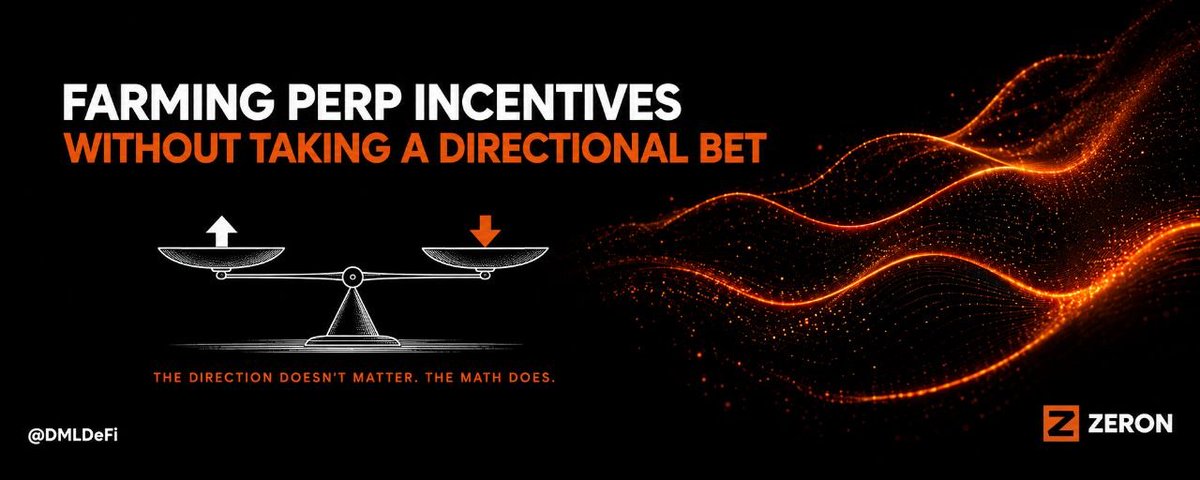
What makes Zeron better at delta-neutral trading?
The advantage isn’t just having more perp exchanges in one place.
It’s what that wider access changes: the markets you can compare, the hedges you can build, and the amount of manual work required to keep a strategy running.
Let’s break it down. 🧵↓
➥ The problem with being limited to one venue
Perpetual futures markets don’t operate identically.
The same asset can trade at slightly different prices across venues. Funding rates can differ. Liquidity, trading fees and execution conditions also vary.
That creates opportunities to compare markets instead of accepting whatever one exchange offers.
But if your strategy only operates on one venue, your opportunity set is limited to that venue’s markets and conditions.
When the setup isn’t attractive, your options become narrower.
This is where Zeron’s multi venue approach becomes interesting.
➥ More perp venues means a wider opportunity set
@zeronfi supports 11 perp venues:
Lighter, Hyperliquid, BULK, Pacifica, Perpl, Nado, RISEx, Aster, Lighter on Robinhood, Arcus and TxFlow.
That is a much wider surface area to work with than a strategy confined to one exchange.
More venues mean more markets to compare, more potential combinations to evaluate, and more chances to find differences worth investigating.
But there’s an important distinction here:
More markets create more opportunities to evaluate. They don’t automatically create more profit.
The quality of the opportunity still depends on funding, basis, liquidity, fees and execution.
➥ Why funding differences matter
Funding is one of the mechanics that makes perpetual futures different from traditional futures.
Depending on market conditions, traders holding long or short positions may pay or receive funding.
Those rates can vary across exchanges, even for the same underlying asset.
For example, imagine BTC funding is more favorable to a short position on Venue A, while the funding cost of a long position on Venue B is relatively low.
A trader could evaluate a short on A and a corresponding long on B.
If the positions are properly sized, their directional exposure can largely offset one another.
The trader is then exposed to the economics of the hedge: funding received or paid, price basis changes, trading fees and execution costs.
The goal is to find a combination where those costs and payments make sense together.
That is the logic behind cross venue funding opportunities.
➥ Delta-neutral doesn’t mean risk-free
Let’s make the hedge itself clear.
Suppose you open a $1,000 long position in BTC and a $1,000 short position in BTC.
If both positions track the same underlying asset and remain equally sized, a general BTC price move should affect the two legs in opposite directions.
That reduces directional exposure, but it doesn’t eliminate every risk.
The exchanges may have different prices. One leg might fill before the other. Funding can change. Fees and slippage can eat into the result. Margin requirements and liquidation conditions can differ between venues.
A hedge that looks neutral on paper can also become unbalanced if one side changes without the other.
Delta-neutral describes the exposure you’re trying to control, not a guarantee that the strategy cannot lose money.
Understanding that distinction matters.
➥ More delta-neutral opportunities
Now combine the hedge with access to multiple venues.
Instead of evaluating just one exchange’s conditions, a system can compare potential combinations across a wider set of markets.
That creates more possibilities to investigate:
• Funding rate differences between venues.
• Price basis differences between otherwise comparable contracts.
• Differences in liquidity and execution costs.
• Alternative pairs when a particular combination becomes less attractive.
The point isn’t to trade every possible pair.
It’s to have a broader selection from which to identify combinations that meet the strategy’s criteria.
A larger opportunity set can improve the odds of finding a suitable setup, but only if the system evaluates the costs and risks correctly.
More choices are useful when they lead to better decisions.
➥ What Zeron changes about the workflow
Cross venue trading can become operationally demanding.
You have to select the markets, size both legs, manage leverage, monitor positions and make sure the hedge stays balanced.
Doing that manually across multiple venues adds complexity.
Zeron’s Autopilot is designed to automate much of this process.
Rather than manually coordinating every leg, users configure their setup and let the system handle the trading workflow according to its selected mode and parameters.
The platform describes modes including Cheapest Fees, Fast and OI, giving users different ways to configure how the strategy operates.
That matters because the best execution choice depends on what you’re optimizing for.
Minimizing fees, prioritizing execution and targeting open-interest-related activity are not necessarily the same objective.
Automation reduces the operational burden, but it doesn’t remove the need to understand the strategy or its risk.
➥ Volume is not the same thing as profit
This is another point worth understanding.
Generating trading volume can be relevant to exchange activity and points campaigns, but volume itself isn’t a return.
A strategy can generate substantial volume while paying trading fees, experiencing slippage or losing money on its positions.
Funding payments also affect the economics of a hedge. Receiving funding on one leg doesn’t mean the entire strategy is profitable if the other leg, execution costs or adverse basis movements outweigh it.
So when evaluating a strategy like this, I would look beyond the volume number.
I’d want to understand the fees paid, funding received or paid, changes in basis, execution quality and overall position exposure.
The objective is to understand the full cost of generating that volume, not just how much volume the bot produces.
➥ What about custody and security?
Zeron states that funds remain on users’ exchange accounts rather than being transferred into a Zeron controlled wallet.
Its security documentation describes exchange specific trading keys designed to place orders without having withdrawal permissions.m, that separation is important.
A trading key that cannot withdraw funds reduces one category of risk associated with giving a third party account access.
However, it doesn’t eliminate trading risk.
An automated system can still place losing trades, encounter execution problems or leave a hedge exposed if one leg fails.
Users should check the permissions on every connected key, understand the exchange’s own security model and know how to revoke access.
Non custodial execution is a meaningful security property, but it isn’t a promise of profitable or risk free trading.
➥ So, what makes Zeron different?
For me, the value proposition comes down to three things.
More markets: access to 11 perp venues creates a wider set of conditions and potential combinations to evaluate.
More potential hedges: a broader market set gives the strategy more opportunities to compare funding, basis, liquidity and execution costs.
Less manual coordination: Autopilot is designed to handle much of the work involved in selecting and managing the trading process.
Those advantages reinforce one another.
A larger market set is more useful when you can compare it efficiently. A potential hedge is more useful when you can execute both legs in a coordinated way. And automation becomes more valuable when the workflow would otherwise require constant attention across several venues.
That is the case for Zeron’s approach.
Not that every trade will work or that delta-neutral means no risk, but that access, selection and execution can be brought into one workflow.
➥ The part I’d pay attention to
The real test isn’t how many exchanges appear on the integrations list.
It’s whether the system can turn that access into better decisions after accounting for fees, funding, slippage, liquidity and the risks of running positions across multiple venues.
That’s what determines whether a wider opportunity set is genuinely useful.
Because in delta-neutral trading, the hedge is only one part of the equation.
The economics of both legs and the system managing them matter just as much.
That’s what makes Zeron worth examining.
🤝 Paid partnership · 🤖 Made with AI

Some traders are already positioning for the next points season.
But what if you could automate your delta-neutral volume strategy instead of managing every loop yourself?
That’s what Zeron is built for.
Here’s how to get started. 🧵↓
➥ 1. Sign up and connect your accounts
Head to zeron.fi/app and follow the onboarding steps.
Connect your wallet, then link the supported perpetuals exchanges you want to use. Review the permissions requested before authorising anything.
➥ 2. Set your volume budget
Decide how much you’re comfortable spending on trading fees.
Zeron uses your budget to help size your trading loops. Remember that generating volume comes with real costs, and points or rewards are never guaranteed.
➥ 3. Choose your venues and trading mode
Select the exchanges where you have margin available, then choose the mode that suits your strategy.
Zeron supports different approaches to execution, including fee conscious trading and faster execution. OI mode is designed for strategies where open interest matters.
➥ 4. Let Zeron automate the loops
The strategy pairs a long position on one venue with a corresponding short on another, then closes both legs together.
The aim is to keep directional exposure low while generating trading volume.
You can monitor your activity and costs through the dashboard. Before enabling Autopilot, understand how the bot handles failed orders, position imbalances and stopping a run.
➥ 5. Understand the risks before you start
Delta-neutral doesn't mean risk free.
Funding payments, exchange fees, differences between venues and one leg failing to execute can all affect your results. Always check the current plan limits and security documentation before committing capital.
Zeron is designed to take some of the manual work out of managing these trading loops, but you still need to understand the strategy you're running.
App: zeron.fi/app
Security details: zeron.fi/security
If you're exploring automated perp strategies ahead of the next points season, Zeron is worth looking into.

What makes Zeron better at delta-neutral trading?
The advantage isn’t just having more perp exchanges in one place.
It’s what that wider access changes: the markets you can compare, the hedges you can build, and the amount of manual work required to keep a strategy running.
Let’s break it down. 🧵↓
➥ The problem with being limited to one venue
Perpetual futures markets don’t operate identically.
The same asset can trade at slightly different prices across venues. Funding rates can differ. Liquidity, trading fees and execution conditions also vary.
That creates opportunities to compare markets instead of accepting whatever one exchange offers.
But if your strategy only operates on one venue, your opportunity set is limited to that venue’s markets and conditions.
When the setup isn’t attractive, your options become narrower.
This is where Zeron’s multi venue approach becomes interesting.
➥ More perp venues means a wider opportunity set
@zeronfi supports 11 perp venues:
Lighter, Hyperliquid, BULK, Pacifica, Perpl, Nado, RISEx, Aster, Lighter on Robinhood, Arcus and TxFlow.
That is a much wider surface area to work with than a strategy confined to one exchange.
More venues mean more markets to compare, more potential combinations to evaluate, and more chances to find differences worth investigating.
But there’s an important distinction here:
More markets create more opportunities to evaluate. They don’t automatically create more profit.
The quality of the opportunity still depends on funding, basis, liquidity, fees and execution.
➥ Why funding differences matter
Funding is one of the mechanics that makes perpetual futures different from traditional futures.
Depending on market conditions, traders holding long or short positions may pay or receive funding.
Those rates can vary across exchanges, even for the same underlying asset.
For example, imagine BTC funding is more favorable to a short position on Venue A, while the funding cost of a long position on Venue B is relatively low.
A trader could evaluate a short on A and a corresponding long on B.
If the positions are properly sized, their directional exposure can largely offset one another.
The trader is then exposed to the economics of the hedge: funding received or paid, price basis changes, trading fees and execution costs.
The goal is to find a combination where those costs and payments make sense together.
That is the logic behind cross venue funding opportunities.
➥ Delta-neutral doesn’t mean risk-free
Let’s make the hedge itself clear.
Suppose you open a $1,000 long position in BTC and a $1,000 short position in BTC.
If both positions track the same underlying asset and remain equally sized, a general BTC price move should affect the two legs in opposite directions.
That reduces directional exposure, but it doesn’t eliminate every risk.
The exchanges may have different prices. One leg might fill before the other. Funding can change. Fees and slippage can eat into the result. Margin requirements and liquidation conditions can differ between venues.
A hedge that looks neutral on paper can also become unbalanced if one side changes without the other.
Delta-neutral describes the exposure you’re trying to control, not a guarantee that the strategy cannot lose money.
Understanding that distinction matters.
➥ More delta-neutral opportunities
Now combine the hedge with access to multiple venues.
Instead of evaluating just one exchange’s conditions, a system can compare potential combinations across a wider set of markets.
That creates more possibilities to investigate:
• Funding rate differences between venues.
• Price basis differences between otherwise comparable contracts.
• Differences in liquidity and execution costs.
• Alternative pairs when a particular combination becomes less attractive.
The point isn’t to trade every possible pair.
It’s to have a broader selection from which to identify combinations that meet the strategy’s criteria.
A larger opportunity set can improve the odds of finding a suitable setup, but only if the system evaluates the costs and risks correctly.
More choices are useful when they lead to better decisions.
➥ What Zeron changes about the workflow
Cross venue trading can become operationally demanding.
You have to select the markets, size both legs, manage leverage, monitor positions and make sure the hedge stays balanced.
Doing that manually across multiple venues adds complexity.
Zeron’s Autopilot is designed to automate much of this process.
Rather than manually coordinating every leg, users configure their setup and let the system handle the trading workflow according to its selected mode and parameters.
The platform describes modes including Cheapest Fees, Fast and OI, giving users different ways to configure how the strategy operates.
That matters because the best execution choice depends on what you’re optimizing for.
Minimizing fees, prioritizing execution and targeting open-interest-related activity are not necessarily the same objective.
Automation reduces the operational burden, but it doesn’t remove the need to understand the strategy or its risk.
➥ Volume is not the same thing as profit
This is another point worth understanding.
Generating trading volume can be relevant to exchange activity and points campaigns, but volume itself isn’t a return.
A strategy can generate substantial volume while paying trading fees, experiencing slippage or losing money on its positions.
Funding payments also affect the economics of a hedge. Receiving funding on one leg doesn’t mean the entire strategy is profitable if the other leg, execution costs or adverse basis movements outweigh it.
So when evaluating a strategy like this, I would look beyond the volume number.
I’d want to understand the fees paid, funding received or paid, changes in basis, execution quality and overall position exposure.
The objective is to understand the full cost of generating that volume, not just how much volume the bot produces.
➥ What about custody and security?
Zeron states that funds remain on users’ exchange accounts rather than being transferred into a Zeron controlled wallet.
Its security documentation describes exchange specific trading keys designed to place orders without having withdrawal permissions.m, that separation is important.
A trading key that cannot withdraw funds reduces one category of risk associated with giving a third party account access.
However, it doesn’t eliminate trading risk.
An automated system can still place losing trades, encounter execution problems or leave a hedge exposed if one leg fails.
Users should check the permissions on every connected key, understand the exchange’s own security model and know how to revoke access.
Non custodial execution is a meaningful security property, but it isn’t a promise of profitable or risk free trading.
➥ So, what makes Zeron different?
For me, the value proposition comes down to three things.
More markets: access to 11 perp venues creates a wider set of conditions and potential combinations to evaluate.
More potential hedges: a broader market set gives the strategy more opportunities to compare funding, basis, liquidity and execution costs.
Less manual coordination: Autopilot is designed to handle much of the work involved in selecting and managing the trading process.
Those advantages reinforce one another.
A larger market set is more useful when you can compare it efficiently. A potential hedge is more useful when you can execute both legs in a coordinated way. And automation becomes more valuable when the workflow would otherwise require constant attention across several venues.
That is the case for Zeron’s approach.
Not that every trade will work or that delta-neutral means no risk, but that access, selection and execution can be brought into one workflow.
➥ The part I’d pay attention to
The real test isn’t how many exchanges appear on the integrations list.
It’s whether the system can turn that access into better decisions after accounting for fees, funding, slippage, liquidity and the risks of running positions across multiple venues.
That’s what determines whether a wider opportunity set is genuinely useful.
Because in delta-neutral trading, the hedge is only one part of the equation.
The economics of both legs and the system managing them matter just as much.
That’s what makes Zeron worth examining.
🤝 Paid partnership · 🤖 Made with AI
Some traders are already positioning for the next points season.
But what if you could automate your delta-neutral volume strategy instead of managing every loop yourself?
That’s what Zeron is built for.
Here’s how to get started. 🧵↓
➥ 1. Sign up and connect your accounts
Head to zeron.fi/app and follow the onboarding steps.
Connect your wallet, then link the supported perpetuals exchanges you want to use. Review the permissions requested before authorising anything.
➥ 2. Set your volume budget
Decide how much you’re comfortable spending on trading fees.
Zeron uses your budget to help size your trading loops. Remember that generating volume comes with real costs, and points or rewards are never guaranteed.
➥ 3. Choose your venues and trading mode
Select the exchanges where you have margin available, then choose the mode that suits your strategy.
Zeron supports different approaches to execution, including fee conscious trading and faster execution. OI mode is designed for strategies where open interest matters.
➥ 4. Let Zeron automate the loops
The strategy pairs a long position on one venue with a corresponding short on another, then closes both legs together.
The aim is to keep directional exposure low while generating trading volume.
You can monitor your activity and costs through the dashboard. Before enabling Autopilot, understand how the bot handles failed orders, position imbalances and stopping a run.
➥ 5. Understand the risks before you start
Delta-neutral doesn't mean risk free.
Funding payments, exchange fees, differences between venues and one leg failing to execute can all affect your results. Always check the current plan limits and security documentation before committing capital.
Zeron is designed to take some of the manual work out of managing these trading loops, but you still need to understand the strategy you're running.
App: zeron.fi/app
Security details: zeron.fi/security
If you're exploring automated perp strategies ahead of the next points season, Zeron is worth looking into.
DML 🐂 🀄🧭 retweeted
Some traders are already positioning for the next points season.
But what if you could automate your delta-neutral volume strategy instead of managing every loop yourself?
That’s what Zeron is built for.
Here’s how to get started. 🧵↓
➥ 1. Sign up and connect your accounts
Head to zeron.fi/app and follow the onboarding steps.
Connect your wallet, then link the supported perpetuals exchanges you want to use. Review the permissions requested before authorising anything.
➥ 2. Set your volume budget
Decide how much you’re comfortable spending on trading fees.
Zeron uses your budget to help size your trading loops. Remember that generating volume comes with real costs, and points or rewards are never guaranteed.
➥ 3. Choose your venues and trading mode
Select the exchanges where you have margin available, then choose the mode that suits your strategy.
Zeron supports different approaches to execution, including fee conscious trading and faster execution. OI mode is designed for strategies where open interest matters.
➥ 4. Let Zeron automate the loops
The strategy pairs a long position on one venue with a corresponding short on another, then closes both legs together.
The aim is to keep directional exposure low while generating trading volume.
You can monitor your activity and costs through the dashboard. Before enabling Autopilot, understand how the bot handles failed orders, position imbalances and stopping a run.
➥ 5. Understand the risks before you start
Delta-neutral doesn't mean risk free.
Funding payments, exchange fees, differences between venues and one leg failing to execute can all affect your results. Always check the current plan limits and security documentation before committing capital.
Zeron is designed to take some of the manual work out of managing these trading loops, but you still need to understand the strategy you're running.
App: zeron.fi/app
Security details: zeron.fi/security
If you're exploring automated perp strategies ahead of the next points season, Zeron is worth looking into.
🤝 Paid partnership
DML 🐂 🀄🧭 retweeted

TOP 10 TVL 7D GROWTH ON SOLANA 🔥
Solana DeFi protocols are posting impressive TVL gains.
@NysaFinance +7,134%
@DivvyBet +836%
@truetradingai +78%
@reflectmoney +26%
@perena +12.6%
@useDiversiFi +10.4%
@pascaldottrade +10.3%
@Omnipair +9.4%
@HawkFi_ +7.9%
@theprivacycash +7.8%
Which protocol are you watching?
#Solana #DeFi


TOP 24H MEMECOIN GAINERS ON SOLANA 🔥
Solana memecoins are seeing explosive price action.
$CHICO
$XCAT
$WIF
$ELON2028
$TRUMP2028
$XD
$NOTHING
solana:Cs8bPDCFzGHWi1aw5ziHqvqGANQ9KNaVPDdsH2a6pump
$PUMPCAT
$HACHI
$RETIRED
$ANT
solana:GZYL4JVHikj6H71a7mTdWay1q7DwsWdJFEhkQCsYz4WT
solana:5Aa378KvCX3bz2dJ3YncoXijBBVvgvipQAXHWaBNNHRw
$RDOG
$WIZARDCAT
solana:6GmAFSYs4gk3FDao5FzzySQpPZaWsa4rUJHacpMpUNgx
Which $SOL memecoin is next to explode?
#Solana #Memecoin


DML 🐂 🀄🧭 retweeted

The more markets you can access, the more opportunities you can look for.
@zeronfi gives you access to a wider range of perpetual markets across exchanges, opening up more funding spreads to compare.
➜ more market.
➜ more funding spreads to explore.
➜ More ways to build delta-neutral strategies.
Instead of being limited to a small selection of perpetual markets, Zeron gives you access to a wider range of perps across exchanges.
That matters because funding rates aren’t the same everywhere, a wider selection of markets gives you more potential pairs to compare and hedge, depending on the available spreads and trading costs.
I also like the simplicity.
Getting started with automated funding strategies can involve a lot of setup and decisions, Zeron aims to make that process easier, so you can focus on your strategy instead of managing every step manually.
Of course, funding opportunities change, and fees and execution risks still matter, more markets don’t guarantee profits.
But having more options to work with makes finding opportunities a lot more interesting.

DML 🐂 🀄🧭 retweeted

before you send anyone to my house please look at the pool
not much but an honest work
held the top spot on the prediction platform
if there’s one thing you should know about me is that I love PREDICTIONS
and I’ll arrest you if you come to my doorstep, lol just kidding


Happy new week guys.
We have come to the end of our Asta feed wave one campaign with $225 in rewards for our top three.
These are then winners.
1st - Caroline
2nd - Heywhy
3rd - Tob
Quote this with a screenshot of your position on the leaderboard, then forward it to our dos with your username.
Wave 2 already started with $225 in rewards for our top 3 also. This is your time to also join and make money as you predict.
Tag your top video content creator so they can see this.
Congratulations to the winners once again


DML 🐂 🀄🧭 retweeted

I tested @LeadpoetAI with one thing in mind. Can buying signals make prospecting more intentional?
What stood out to me was the idea of connecting a company’s activity to a reason for reaching out.
A funding announcement, for example, becomes more useful when you can connect it to a potential need and the right decision-maker.
That changes how I’d approach outreach.
Instead of starting with a list of companies and forcing a pitch, I’d start with a signal and build the conversation around it.
For me, the value of this approach comes down to relevance. A good lead should give you more than a name.


DML 🐂 🀄🧭 retweeted
I tested the idea behind @LeadpoetAI, and the value proposition is clear.
Lead generation isn't just about finding companies. It's about knowing which ones might need your solution right now.
Leadpoet focuses on buying signals like funding announcements, hiring activity and other signs of potential demand, helping connect those signals to relevant companies and decision-makers.
What I like about this approach is the context it brings to prospecting. A funding round or a new hiring push can give you a concrete reason to start a conversation instead of sending another generic cold message.
For anyone building a B2B pipeline, timing and relevance can make all the difference.
leadpoet.com/
