
@blynk_app CTO and Co-Founder
Ukraine
Joined December 2009
- Tweets823
- Following175
- Followers127
- Likes4.5K





Crazy. DigitalOcean now cheaper than Hetzner. While Hetzner doesn't even provide a 99.99% SLA, only 99.9% for the network.

Hetzner just 2.5x'd their prices for US servers
Crazy but understandable as the AI companies are pushing prices of everything up: RAM, HDDs, SSDs, CPUs, GPUs, and even competing with Hetzner for land to build data centers in US!

266
It's 2026, @SlackHQ still doesn't allow you to get a webhook URL for a channel from its desktop client. Crazy.
70

Dmytro Dumanskiy retweeted

On “negotiations.” It is important to finally call things by their proper names.
What russia calls a “peace process” is in fact a separate special operation against the West. Its goal is not to end the war, but to force the United States and Europe to pressure Ukraine, while russia continues fighting and preparing for a new phase.
russia has never conducted negotiations as a means of achieving peace. Not in 2014, not in Minsk, not in Istanbul. In every case, “negotiations” were either a way to buy time, a way to legalize what had been seized, or a way to shift responsibility away from itself. For the kremlin, negotiations are not an alternative to war, but another tool of it.
And this is not a “putin invention.” russia’s imperial logic has been documented since the 18th century. The so-called “Testament of Peter I” — a programmatic text of russian expansion — explicitly defined war as the only normal state of the empire. It clearly states: keep the population in a state of continuous war, allow rest only to rebuild the army and finances, use peace to prepare for war, and war to impose peace on one’s own terms.
Poland is addressed as a separate point in this “testament.” Not as a neighbor or partner, but as a state that must be systematically undermined from within. To support constant unrest, bribe elites, influence elections, introduce troops “temporarily,” and, when conditions allow, leave them there permanently. If other European states interfere, they are to be appeased by partially dismembering Poland — only to reclaim those concessions later. This is not metaphor or interpretation; it is a direct imperial instruction.
Thus, from the standpoint of russian imperial doctrine, Poland was never regarded as a sovereign state. It was seen as a space for manipulation, division, and control. That is why today’s kremlin hostility toward Poland — threats, information attacks, and talk of a “Polish threat” — is not emotional or reactive to modern Polish policy. It is a continuation of the same logic.
It is also telling that specific points of this “testament” directly concern Northern Europe and the Baltic region. russia was instructed to systematically provoke Sweden, push it toward war in order to obtain a formal pretext for territorial seizures. The Baltic direction was defined as strategic: access to the Baltic Sea not as defense, but as a mandatory condition for imperial growth. Peace in this region was viewed exclusively as a pause between wars.
The Baltic states and Sweden were never neutral in russian imperial thinking. They were always spaces of future pressure or war. That is why today’s russian military activity in the Baltic Sea, threats toward the Baltic states, and demonstrative actions near Sweden and Finland are not a “reaction to NATO,” but the continuation of a centuries-old behavioral model.
Germany was also explicitly named in the “testament” as a key object of constant interference — as the closest and most important state in Europe. The logic was simple: prevent Germany from becoming an independent center of power, constantly draw it into Europe’s internal conflicts, manipulate elites, and use economic and political ties for control. Today this logic remains unchanged: reliance on dependency, fear of escalation, “special relationships,” and the desire to preserve comfort at any cost. For the kremlin, a weak, hesitant Germany is strategically more valuable than any tank.
The only thing putin has effectively changed in this old “testament” is that he has clearly designated the United Kingdom as his strategic enemy. Where continental Europe was once the main object of imperial maneuvering, today London has become, in russian rhetoric and actions, the symbol of a force the kremlin considers fundamentally hostile — because of its support for Ukraine, its role in European security, and its refusal to trade peace for other people’s territories. That is why russia is waging a separate hybrid war against Britain — informational, subversive, and diplomatic.
Ukraine, in this scheme, is not even the primary addressee. All signals of “readiness for peace” are aimed at the West. The logic is simple: to show that russia is supposedly constructive, and that the war continues only because of Kyiv’s “unconstructive position.” This is a classic information operation shifting blame from the aggressor to the victim.
The key goal of this campaign is to force the West itself to pressure Ukraine — not to negotiate with russia, but to break Kyiv through “realism,” “fatigue,” and fear of escalation. All of this is happening in parallel with the buildup of military potential, including in the northwestern direction.
While the West talks about negotiations, russia is preparing not for peace, but for a prolonged war and the possible expansion of the conflict. This is how a state behaves when it dreams not of compromise, but of restoring an empire — with war as the norm and peace as a pause.
Ukraine is only one stage. If aggression is rewarded here, the war will move on — to where russian imperial doctrine has been looking for centuries. Ukraine’s capitulation under the guise of peace will not bring security to Europe. It will only bring the war closer to the Baltic Sea and make it inevitable.
Any pressure on Ukraine and its leadership from the West means only one thing: russia is successfully continuing its special operation — political and informational. Any Western country or politician who speaks of a “faster peace” at the cost of territorial losses, limitations on sovereignty, or imposed conditions on Ukraine is not acting as a mediator, but as an instrument of this operation. Such a “peace” does not stop the war — it only legalizes aggression and prepares the next one.
Why @Hetzner_Online doesn't show RAM usage on the Graphs of the VPS? Doesn't make any sense.
84
Dmytro Dumanskiy retweeted

A fresh story on Forbes covers the first 1,000 drones built entirely with components manufactured in Ukraine. These drones were assembled by Vyrij and equipped with Kurbas-256 cameras made by Odd Systems.
Today, Odd Systems is the only Ukrainian manufacturer of thermal cameras that are mass-produced for FPV use. The Kurbas-256 is not only better than its closest Chinese counterpart — the Caddx-256 — but also cheaper. (Order inquiries: please contact antagan.04 on Signal.)
A few updates on
- Kurbas-640 is in development — hopefully ready in a few months
- Kurbas-256 now also as a USB output in addition to CVBS
Yesterday was Ukrainian "Defense Industry Worker’s Day" — thank you all for your work, and congratulations to our colleagues at Odd Systems, The Fourth Law, and hundreds of other companies working with all the drive they have.
A quick reminder — we’re constantly hiring.
Odd Systems is a manufacturer and R&D house for cameras — the key sensor for the robotics revolution of the next decade.
The Fourth Law builds fully autonomous systems that will power every drone and millions of other robots.
Open positions:
- CEO (Odd Systems)
- Head of QA (The Fourth Law)
- Sales Account Manager ×2 (for both The Fourth Law and Odd)
- Sales / Partnerships Manager (Odd)
- Camera and Drone Assemblers (Odd)
- Recruiter / Head of Recruitment (Odd)
- UAV Design Engineer (Odd)
+ other roles — if you want to work with us, reach out and we might find something for you.
Job details are available on DOU. For vacancies, please contact us via DOU or at [email protected].
Please don’t message me directly — unless we know each other well.
The full Forbes article is here: forbes.com/sites/davidhambli…

Dmytro Dumanskiy retweeted

🚨 There has been a breakthrough in the world of hash tables 🚨
A paper that disproves the longstanding conjecture that uniform hashing is optimal.
"Optimal Bounds for Open Addressing Without Reordering" by Martín Farach-Colton, Andrew Krapivin, William Kuszmaul
arxiv.org/html/2501.02305v1
They demonstrate it is possible to construct an open-addressed hash table with improved expected search complexities, both amortized and worst-case, without the need to reorder elements over time.
I've implemented a crude version in Java and the results indeed seem promising, are there any initiatives to have such a hash table option in Java?
I'd love to test this further, with real world examples, the code of course is far from perfect and optimized, while Java's implementation has been maximally tweaked and refined.

Yeap. Exactly this.

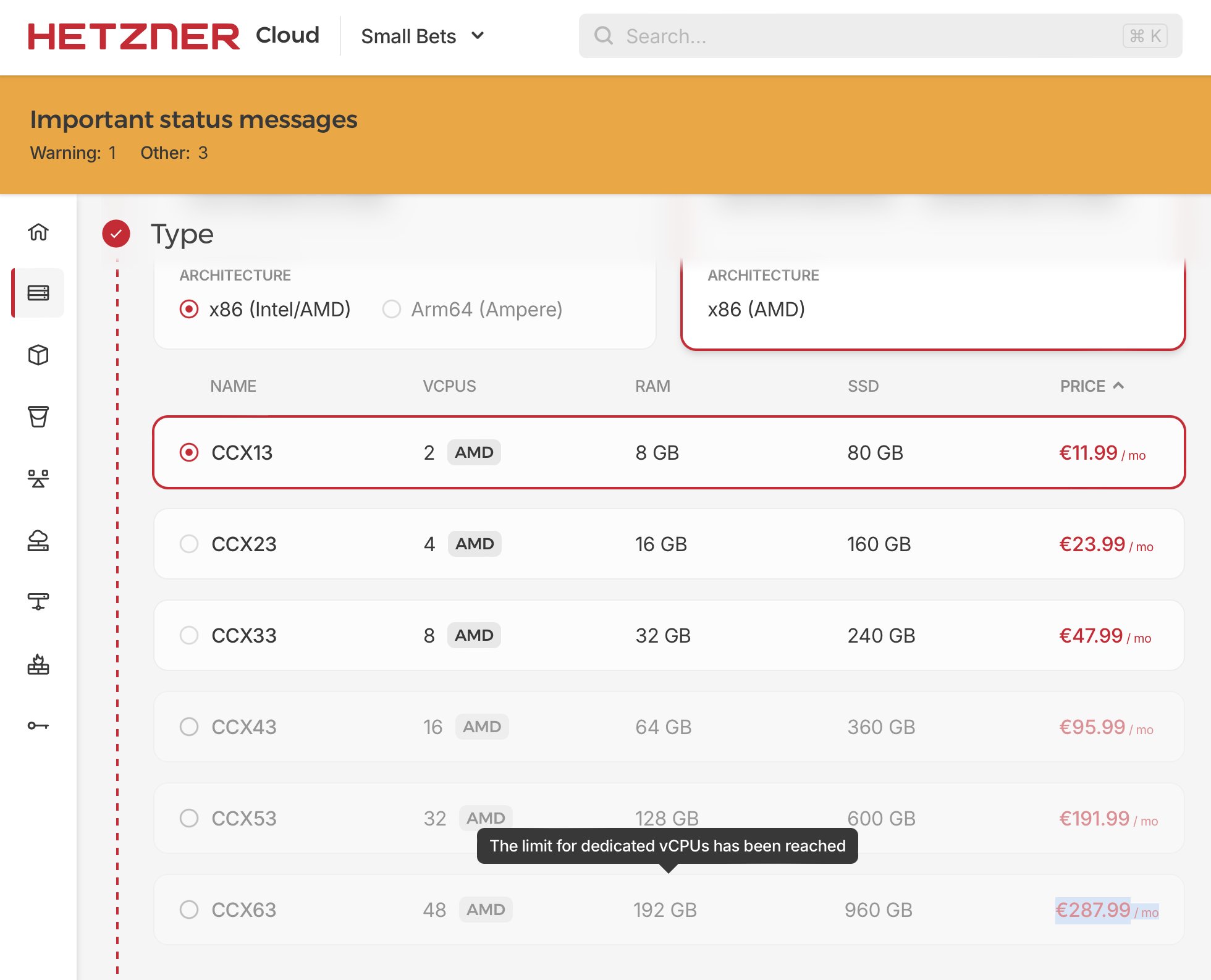
My problem with Hetzner is that I've become too accustomed to the American way of doing business. Over here, if I want to give a company my money, they take it without too much hassle.
With Hetzner, I create a new account and I'm ready to spend. I take out my business credit card and I try to provision the biggest cloud server they have. But I'm immediately told "CPU limit reached".
No indication of how to increase the limit, but I dig around a bit and I find the limits page. The very first message on the page says:
"Your account is too new to request a limit increase."
And if that wasn't already enough of a hard no, the 2nd line emphasizes that they don't want to be disturbed about this:
"Please note that we do not answer questions regarding limit increase on the telephone."
So what am I supposed to do? Get a tiny server for a few months until we "become friends"? How long will that take? A day? A month? A year? I don't need a tiny 8 CPU server. I already have that on DigitalOcrean. The only reason I'm shopping for a new server host is to get access to beefy machines at a good price. But Hetzner Online GmbH just won't take my money.

136

Dmytro Dumanskiy retweeted

The current champion of JSON parsing is the AMD Ryzen 5 9600X 6-Core (5.5GHz). It is a $280 CPU. It can scan JSON at 12 GB/s.
The closest Intel CPU on the current ranking is the Intel Core i9-11900K which gives you 7.5 GB/s. The i9 is a significantly more expensive CPU (>$450).


If you invested in Intel back in 2020, you might have lost 60% of your capital in nominal value, but the cumulative inflation from 2020 to 2024 is over 20%...
So you have lost 70% of your capital, over five years.
Almost any other investment was better.
Many blame Brian Krzanich who was CEO from 2013 to 2018. Krzanich resigned after he cheated on his wife with a subordinate. Krzanich went on to become the CEO of Cdk Global Inc where the stock price went from $76 to $55.
Bob Swan replaced him temporarily. Reportedly, Swan was the only Intel insider buying Intel stock.
The current CEO is Pat Gelsinger. Gelsinger grew VMware, Inc., multiplying its value over ten years. VMware appears to be stagnating ever since.
Intel has benefited from massive government support (CHIPS Act): hundreds of billions of dollars.
Evidently, Intel is still struggling under Gelsinger despite government help.
Note: I have no insider knowledge nor do I claim to know what is going on.
Dmytro Dumanskiy retweeted

It is forbidden to use American weapons from Ukraine to hit Russia so Ukraine is hitting Russia from Russia
Dmytro Dumanskiy retweeted
Benchmarking ARM processors: Graviton 4 vs Graviton 3
The world of commodity processor is roughly divided in two: x64 chips for servers and PCs, and ARM processors for mobile devices. However, ARM chips increasingly common on servers and laptop. My own favorite laptop is an Apple macBook with an M2 chip. Amazon has been producing its own ARM processors (Graviton) and it recently made available the latest of such chips, the Graviton 4. It is reportedly based on a Neoverse V2 design from ARM while its previous design was a Neoverse V1 (Graviton 3). Qualcomm has also released high performance ARM chips for Windows laptops, the Snapdragon Elite X.
I decided to quickly test Amazon's new Graviton 4 processor. I am deliberately not comparing against x64 processors. It is far easier to compare ARM against ARM given that you can run exactly the same instructions.
In a previous benchmark, I found that, at least for the type of work that I do, the Graviton 3 processor ran slower than an Apple M2, even after correcting for its lower frequency. The Graviton 3 runs at up to 2.6 GHz, while Apple M2 can run at up to 3.5 GHz. The Graviton 4 runs at 2.8 GHz. Going from the clock speed alone, you would not expect much of a performance gain going from the Graviton 3 to the Graviton 4 (at most 10%)
Let us run benchmarks. Under AWS, I am going to use Ubuntu 24 with GCC 13. Under macOS, I am using the latest Apple LLVM (15).
I find that even though the Graviton 4 has almost the same clock speed as the Graviton 3, it can be much faster (20% to 40% faster).
Another important characteristics of processors is their effective bandwidth, as measured by a memory-level-parallelism test. In these tests, I find that the Graviton 4 is only marginally better than the Graviton 3.
These few tests suggest that the Graviton 4 processor is significant step up from the Graviton 3. Even though both Gravitons have nearly the same clock speed, the Graviton 4 is much faster (e.g., by 30%). The Graviton 4 can retire many more instructions per cycle than the Graviton 3.
You will find in the comments a link to a blog post where I dig deeper and compare against Apple Silicon.


Коли таке буде в Україні буде? @ZelenskyyUa ? Чи нам не треба грошей?

Wow unexpected, Thailand are introducing a remote work visa! 🇹🇭
180 days for 10,000 baht ($270)
You can extend for another 180 days for the same price 🤯
khaosodenglish.com/life/tour…

96


Dmytro Dumanskiy retweeted

Are you asking yourself why the russians use Z as an identifying mark? The answer is simple...

In @blynk_app we have one very hot code execution path. And now, after many years of optimizations, we end up by replacing "switch" statements with "if" conditions. That change alone allows us to save up to ~10 nanoseconds per call. So for 100k req/sec it saves us 0.1% of CPU :)
Dmytro Dumanskiy retweeted

Нарешті Міноборони почуло прохання наших солдатів та почало робити штатний розпис для операторів дронів, і FPV зокрема.
Тільки це російське міноборони.
У нас досі тиша.
Сьогодні президент Зеленський даватиме пресконференцію.
Шановні журналісти, будь ласка, поставте питання про масові структурно-організаційні зміни у війську в контексті FPV.
Наявні РУБПАКи це замало, на них ще аеророзвідка, робота іншими типами ударних дронів.
Зараз більшість наших операторів FPV це хто завгодно за штатом – від кухаря до звʼязківця.
У багатьох командирів і ставлення відповідне – неможливо формувати підрозділи, все тримається на ентузіазмі та часто всупереч а не завдяки.
Військо потребує змін!
