

@DataSecChron
Account based inUnited States
About this account
- Account based in
- United States
- Connected via
- United States App Store
Account-level information from X, not a live location or the device used for a specific post.
Senior Data Analyst ➡️ Cybersecurity. Atmospheric Sciences background. ISC2 CC certified. Documenting the pivot @ DataSec Chronicles. New blog posts Mon & Fri📊🌐
Maryland, USA
Joined May 2026
- Tweets6K
- Following1.3K
- Followers1.7K
- Likes8K







Pinned Tweet
👋🏽 Hi, I'm Tasha.
As an atmospheric scientist, I spent years reading storm data for anomalies. Now I hunt them in network traffic.
Same instinct, different domain. 📊
By day, I'm a Senior Data Analyst living in SQL, Python, and dashboards. I founded DataSec Chronicles to document my pivot into cybersecurity — the real learning journey. The wins, technical hurdles, and study strategies, from earning my ISC2 CC ✅ to working toward SC-900 and Security+.
DataSec Chronicles is the story. DataSec Labs is where I put it into practice — interactive challenges and hands-on projects you can actually try.
I've been online since dial-up screamed at you before letting you in and Y2K was going to end the world. 😂 The interwebs raised me; now I'm learning to defend them.
Whether you're a data nerd, a cyber practitioner, a fellow career-changer, or just someone who appreciates good data hygiene and a warm cup of chai, welcome to my corner of the interwebs.
What to expect:
🔍 Data & cyber insights — complex concepts made simple
📚 The pivot journey — study tips, resource reviews, and what I'm learning
🌱 Community — a space to learn out loud and grow together
Drop a comment introducing yourself, what you're working on, or what brought you into tech 👇🏽
💜 datasecchronicles.com

A cybersecurity headline catches your attention. Now what?
Before sharing it, ask:
🔹 Is this a vulnerability, an exploit, or a confirmed breach?
🔹 Who or what is actually affected?
🔹 Is there evidence of active exploitation?
🔹 Has the vendor published an advisory?
🔹 What mitigations or patches are available?
🔹 When was the information last updated?
The headline gets your attention. The details help you understand the risk.
Bookmark this for the next big security headline.
One thing I keep thinking about from building AlertCadence last week: the storage decision.
I considered MongoDB Vector Search but used regular document storage instead. Fetch advisories, upsert by CVE, and keep a history of generated briefs.
For roughly 6 advisories a week, embeddings would’ve added complexity I didn’t need.
Knowing which features to skip is a skill too. 🔐
#BuildInPublic #MongoDB #Cybersecurity
I attended today's Cyber Career Realities Revealed webinar, exploring career pathways across the NIST NICE Framework.
A few takeaways that stood out:
🔹 Career transitions don't mean starting over. Experience from different industries and backgrounds can bring valuable perspectives to cybersecurity.
🔹 Take inventory of your experience. Review your resume, identify transferable skills, and use resources like the NICE Framework to identify gaps you can close through targeted learning and practical experience.
🔹 Build your foundations. Networking, the OSI model, and problem-solving still matter as technology evolves.
🔹 Get hands-on. Build home labs, participate in CTFs, document projects on GitHub, and explore free resources.
🔹 Curiosity, critical thinking, and communication matter just as much as technical skills.
🔹 Cybersecurity is a team sport. Learn from others, ask questions, and share knowledge.
One message really stuck with me: We can be our own educators.
As someone transitioning from data analytics into cybersecurity, this was a great reminder that I'm not starting from scratch. I'm building on what I already know. 💜
#Cybersecurity #NICEFramework #CareerTransition
💡 One Thing I Learned This Week:
AI is accelerating vulnerability discovery, but what happens when we're finding vulnerabilities faster than we can fix them?
This week, I followed the discussions surrounding the PHP security vulnerabilities and read research about the growing backlog of unresolved vulnerabilities.
That stood out to me.
AI can help researchers discover weaknesses faster.
Discovery is only one part of the process.
Someone still has to validate the findings.
Determine which vulnerabilities pose the greatest risk.
Develop and test patches.
Deploy those patches.
And verify that the fixes actually work.
Not every organization has the same resources to do all of that.
One finding particularly caught my attention: HackerOne reported that vulnerability backlogs grew 131% over two years, even as average resolution times decreased.
That made me think about a few questions:
What happens when discovery outpaces remediation?
How do security teams prioritize an increasing number of findings?
Are we improving security if we're finding more vulnerabilities but struggling to resolve them?
And how can AI help with the rest of the process, not just discovery?
I'm learning that faster discovery doesn't automatically mean faster protection.
Finding a vulnerability is important.
The real goal is reducing the risk it creates.
What's one thing you learned this week?
(sources in replies 👇🏽)
#Cybersecurity #AISecurity #BuildInPublic
📚 Sources for this week's OTILTW:
🔹 PHP Foundation — Today's PHP Security Release and How We're Strengthening PHP Security
thephp.foundation/blog/2026/…
🔹 Microsoft Security — 3 Lessons from Frontier AI Vulnerability Research
microsoft.com/en-us/security…
🔹 HackerOne — Research on Growing Vulnerability Backlogs
hackerone.com/press-release/…

Day 22 of #31DaysSafer 🔐
Welcome to Week 4: Resilient Daily Habits! 🍂
Today: Apply the 3-Second Phishing Rule.
Ever received a message urging you to click a link or take action immediately?
Phishing messages often create a sense of urgency so you act before thinking.
Before clicking a link, opening an attachment, or responding to an urgent request, pause for three seconds.
Check who sent it and where it wants you to go. For sensitive requests, visit the official app or website directly instead of using the message's link.
Sometimes, a few seconds of hesitation can prevent a costly mistake.
One small step. One day safer. 🍂
#CybersecurityAwarenessMonth #DigitalHygiene #InfoSec

Having goals is one thing. Making room for them in an already busy life is another.
Progress takes prioritizing, managing your time, and knowing you can’t do it all at once.
You don’t have to do everything today to keep moving forward.
Sustainable progress is still progress. 💜
A critical vulnerability doesn’t wait for a convenient time.
The PHP security concerns are a reminder of something I’m learning in cybersecurity: vulnerability management goes beyond identifying CVEs.
It’s about assessing risk, prioritizing patches, and having a plan when an immediate fix isn’t available.
#CybersecurityAwarenessMonth
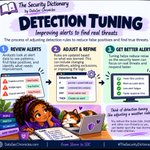
📖 The Security Dictionary: Detection Tuning
Not every security alert points to a real threat.
So how do security teams reduce unnecessary alerts without missing something important?
That's where Detection Tuning comes in.
→ Plain English: Detection Tuning is the process of adjusting and improving security detection rules to reduce false positives while maintaining the ability to identify real threats.
→ Think of it like: Fine-tuning a weather radar. You want to filter out unnecessary noise so you can better identify the storms that actually need attention.
→ Example: A detection rule repeatedly flags a legitimate administrative tool as suspicious. After investigating and confirming the activity is authorized, analysts refine the rule to account for that specific behavior while continuing to detect potentially malicious use.
→ Why I'm learning it: Detection Tuning connects several concepts I've been studying: SIEM, alerts, false positives, log analysis, and threat hunting.
Coming from data analytics, I find this especially interesting because it involves examining patterns, evaluating results, and improving how a system identifies meaningful activity.
The goal isn't simply fewer alerts. It's better alerts that help analysts focus on what matters.
#Cybersecurity #TheSecurityDictionary #LearnWithMe

New Emoji Sunday theme this week 👀 THE TREAT. What’s a treat you’re looking forward to — in 3 emojis? I’ll guess it Sunday, 6 PM ET
Day 21 of #31DaysSafer 🔐
Today: Charge Safely.
We're wrapping up Week 3: Mobile Shielding! 📱
Ever plugged your phone into a public USB charging station without thinking twice?
Public charging ports can potentially be modified to access your data or install malware. This is known as "juice jacking."
Take a few minutes to think about how you charge your devices when you're away from home.
Use your own charger and a wall outlet when possible, or carry a portable power bank.
A little preparation can help you avoid unnecessary risks.
One small step. One day safer. 🍂
#CybersecurityAwarenessMonth #DigitalHygiene #InfoSec

My 13-year-old this morning: “The bus is moving slow.”
Meanwhile, I'm tracking it on the app like, “The bus is RIGHT THERE!” 😭😂
We open the front door, and sure enough, the bus is already pulling up to the stop!
My two middle schoolers went from casually walking to sprinting in seconds! 🏃🏽♀️💨
Nothing like some unexpected morning cardio! 😂
Attended Pinterest Creator Day today! 📌✨
A few takeaways that stood out:
📌 Evergreen content: Pins can continue being discovered long after publication.
🔎 Search optimization: Create content around questions people are actually asking.
💾 Saves over likes: Pay attention to whether people find your content worth revisiting.
💡 Originality & expertise: Your knowledge and perspective matter more than chasing virality.
🔄 Repurposing: Give existing content a fresh angle instead of constantly creating something new.
🤝 Trust: Build relationships through authentic, useful content.
My biggest takeaway? Content on Pinterest has a longer shelf life.
As someone creating educational cybersecurity content, that really resonated with me. Useful information doesn't stop being valuable just because it's no longer new.
A funny side note: I spent part of the livestream troubleshooting missing audio, only to discover it was playing through my husband's Bluetooth earpiece. 😭😂🎧
Still walked away with some valuable insights!
#PinterestCreatorDay #ContentCreation
Attended today's @SANSInstitute webinar, “Breaking Into Cybersecurity: Real Stories from Recent Graduates,” during #CyberCareerWeek. 🔐 💜
It was refreshing to hear from professionals who took different paths into cybersecurity.
A few takeaways that stood out:
🔹 Don't let anyone put you in a box. Your previous experience matters, even if it comes from another field.
🔹 Certifications aren't the whole story. Build projects, apply what you've learned, and demonstrate what you can do.
🔹 Apply intentionally. Don't count yourself out just because you don't meet every qualification.
🔹 Get comfortable being uncomfortable. Growth requires curiosity, adaptability, and a willingness to keep learning.
🔹 AI is a tool, not a substitute for judgment. Learn how to use it, recognize its limitations, and verify its outputs.
🔹 Build genuine connections. Find people you can learn from, collaborate with, and grow alongside.
🔹 Don't let rejection define your journey. Take breaks when you need them, but keep moving forward.
One message especially stayed with me:
You don't have to fit into someone else's definition of what a cybersecurity professional should look like.
As someone transitioning from data analytics into cybersecurity, that resonated.
The skills, experiences, and perspectives we bring from other fields aren't something to leave behind. They're part of what makes us valuable.
Thank you to @SANSInstitute, @NISTCyber, and the panelists for sharing your stories and encouraging those of us navigating our own paths into cybersecurity!
The journey continues. 💜
#Cybersecurity #CareerTransition
Well, I have some exciting news! 👀
I got accepted into the Meta Global AI Developer Hackathon! 🎉
I'll be participating in the Indie Developer Track, where I'm planning to build an AI-powered cybersecurity mystery game. 🔎🤖
I've never used Meta's models before, so this should be an interesting challenge!
Excited to learn, experiment, and see what I can create! 💜
#MetaAI #BuildInPublic

Hey DEVs! 👩🏽💻
This might be an opportunity worth checking out!
Meta is hosting a Global AI Developer Hackathon with 10 days to build, $1M in total prizes, and an indie developer track for individual builders.
Applications close October 25 (or earlier if spots fill up).
🔗 cerebralvalley.ai/e/meta-ai-…

Day 20 of #31DaysSafer 🔐
Today: Give Your Search More Privacy.
Have you ever searched for something online and started seeing related ads everywhere?
Search engines can collect information about what you search for, your location, and your interests.
Take a few minutes to review your search settings.
Consider trying a privacy-focused search engine, limiting search tracking, and reviewing your saved search history.
Small changes can help reduce how much information is collected about your online activity.
One small step. One day safer. 🍂
#CybersecurityAwarenessMonth #DigitalHygiene #InfoSec

You know what? Sometimes you just have to apply.
Not knowing if you're qualified enough.
Not knowing if you'll get accepted.
Not knowing how it'll turn out.
Just put yourself out there.
The answer is already no if you never try. 💜
We crossed 100 followers over at The Security Dictionary! 🥹🎉💜
What started as a way to better understand cybersecurity terms I kept seeing in job descriptions is becoming a little learning community.
Two terms a week, with plenty of research, creativity, and curiosity along the way.
Thank you to everyone who's followed along, saved a post, or participated in a quiz!
Connie and her little supervisor are celebrating! 😂🐈
📸 Instagram: thesecuritydictionary
#TheSecurityDictionary #LearnInPublic

📖 The Security Dictionary: Vulnerability Management
Finding a security weakness is one thing.
But how do organizations decide which weaknesses to fix first, and how do they make sure those fixes actually work?
That's where Vulnerability Management comes in.
→ Plain English: Vulnerability Management is the ongoing process of identifying, assessing, prioritizing, and addressing security weaknesses in systems, software, and infrastructure.
→ Think of it like: Regular home inspections. 🏠 You look for problems like broken locks, leaks, or cracks, figure out which ones pose the biggest risks, fix them, and keep checking for new issues.
→ Example: A security team scans its systems and discovers several vulnerabilities. Instead of treating every finding equally, the team considers severity, exploitability, and potential impact to determine what needs attention first. After fixes are applied, they verify that the weaknesses have been addressed.
→ Why I'm learning it: Vulnerability Management connects several things I'm learning about cybersecurity: risk assessment, threat intelligence, detection, and incident response.
I'm learning that identifying vulnerabilities is only part of the job. Understanding which ones matter most, why they matter, and what to do about them is just as important.
Coming from data analytics, the prioritization piece is especially interesting to me. Not every finding carries the same risk, and context matters when deciding where to focus.
#Cybersecurity #TheSecurityDictionary #LearnWithMe
