

Making data analytics clearer for beginners 📊 | Data career insights & practical business examples.
Nigeria
Joined September 2019
- Tweets8.3K
- Following2.3K
- Followers1.2K
- Likes42.8K







Pinned Tweet
Learning data analytics in public has taught me something deeper than Excel or SQL. 📊
You can start from somewhere completely different and still build something meaningful.
I studied Animal Science.
I taught in classrooms.
I worked in customer service and sales.
Now, I'm learning data analytics.
And honestly, starting over isn't always easy.
There are days when you feel behind.
Days when you wonder if you're learning fast enough.
Days when the people around you seem miles ahead.
But I'm learning that progress doesn't require you to have everything figured out.
It starts with asking better questions.
1. Start with the question, not the tool.
Before opening Excel, ask:
What decision will this analysis help someone make?
2. Understand your data.
Where did it come from?
What does it leave out?
Can you trust it?
3. Learn the fundamentals.
Tools will change.
AI will get better.
But the ability to think clearly will always matter.
4. Learn to communicate.
Finding an insight is one thing.
Explaining it clearly enough for someone to act on it is another.
5. Build by solving real problems.
Don't just learn formulas.
Don't just watch tutorials.
Take a messy problem.
Work through it.
Make mistakes.
Figure it out.
Share what you learned.
AI can write a formula or SQL query in seconds.
But knowing what to ask, what to investigate, and what the answer actually means is the skill I'm building.
I'm Obinna.
I'm learning data analytics in public, one real problem at a time.
If you're learning a new skill, changing careers, or starting over too, you're not alone.
We're building from where we are.
What are you currently learning that could change your career?

In Excel, "Lagos" and "Lagos " look the same on screen and don't count the same.
A trailing space is invisible, survives your filter, and splits one category into two. COUNTIF just returns a smaller number and nothing warns you.
1
1
5
Took a meeting today for a job in Enugu that has nothing to do with my next move.
I asked the title, the pay date and the bonus target before agreeing to anything.
It's a new store, so I'd set it up from scratch with nobody's habits to undo. That part I want.
1
21
Dates stored as text sort alphabetically, not by time. January lands next to October and Excel doesn't warn you.
Real dates sit on the right of the cell. Text sits on the left.
Check which side yours are on before you group a pivot by month.
14
The Superstore file has 9,995 rows. That's not 9,995 orders.
One order can sit across several lines, one per product. Count the rows and you get a bigger number than the business actually took.
If the question is how many orders, count distinct Order IDs.
1
17
Nothing in Excel warns you when a range is too short. A SUM that stops at row 1,000 while the data runs to 9,995 gives you a number that looks fine, and every chart built on it inherits the gap. Before you trust a total, click the formula and look at where the range actually ends
3
2
25
A finding is only worth what you can defend.
If someone asks where the number came from, the answer has to be a formula you can say out loud, not a file you can point at.
1
15
The first thing I do before touching a new file is copy it. Rename the copy, leave the original alone.
Half of getting better at Excel is being willing to break something, and you're only willing when you know you can get it back.
1
16
Excel is not a spreadsheet, it's a question-asking tool. SUM asks one question. SUMIF asks a better one. Most people stop at SUM, accept the total, and never find out what's inside it.
The only thing that has moved anything for me this month is one finished piece with a real number in it. Not threads, not tips, not posting more. Take one dataset, find one thing that's wrong, write it up. That's the whole strategy.
I still get the syntax wrong the first time. Every time. What changed is that I now open the file anyway instead of waiting to feel ready. If you're starting late, the gap isn't talent, it's reps. Open the file tonight.
2
36
A blank cell is not a zero. SUM ignores it. AVERAGE ignores it. But your percentage of the total quietly changes, and your row count stops matching your answer. Before you trust a number, find the blanks. Filter for empty, count them, then decide what they actually mean
1
17
1,871 order lines in the Superstore file lost money. That's 18.7% of the table.
Average loss was about 83 each. That's small enough that no single row looks like a problem.
Before you trust a profit total, run COUNTIF on the profit column for anything below zero.
1
14
1,448 followers on LinkedIn, and the follower count isn't what brings in clients for my profile work.
The posts get people to click through. The profile is built to catch them when they land.
Funnel first. Volume second.
1
2
40
I've been calling it waiting. Some days it's just wasting.
Applications are out and nothing is paying in the meantime. I'm 34 and I want a family.
One day my own work will pay enough that I stop working for other people. Today I need a job.
1
27
Excel first, then SQL. You can spend a year in Excel and still not know what to check in a number, and SQL will just let you query the wrong thing faster.

1
34

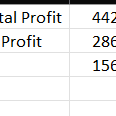
Split the Superstore profit by discount and the whole story changed.
Full-price orders: 320,987.60 profit.
Discounted orders: -34,590.60.
I went in looking for a rounding error. It was a pricing problem.
1
34