


David retweeted

Miyamoto discusses what the Order of Culture award means to him:
"I feel quite embarrassed, to be honest, but I am truly honored to have been chosen for such a prestigious award.
As I often say, I do not create games all by myself. This award is the result of the work I have done alongside many others, and I accept it as a representative of that entire team.
Lately, in particular, I have had the opportunity to collaborate with people from fields beyond just video games—such as on "Super Nintendo World" at Universal Studios Japan and various film-related projects. I would like to share the joy of this award with all of them.
Recently, there have been several milestones, such as the 40th anniversary of The Legend of Zelda, and I myself have often mentioned that it has been 45 years since I began making games. However, when I really think about it—having joined Nintendo in 1977 and immediately becoming involved in game development—it has actually been 50 years. Since "50 years" is a nice, round number, I’ll use that figure today.
Fifty years ago, I began working in a medium called "games"—a medium whose very nature was, at the time, not even clearly defined. I have been able to continue this work ever since. I believe I am receiving this recognition precisely because I was there from the very dawn of the industry, and I feel that I have led a very lucky life."
(Machine Translation)
news.denfaminicogamer.jp/int…

David retweeted

The Internet goes on high alert after discovery of 8 compromised TLS certs arstechnica.com/security/202…

French AI #slopcore may be the next great thing to come out this year.


David retweeted

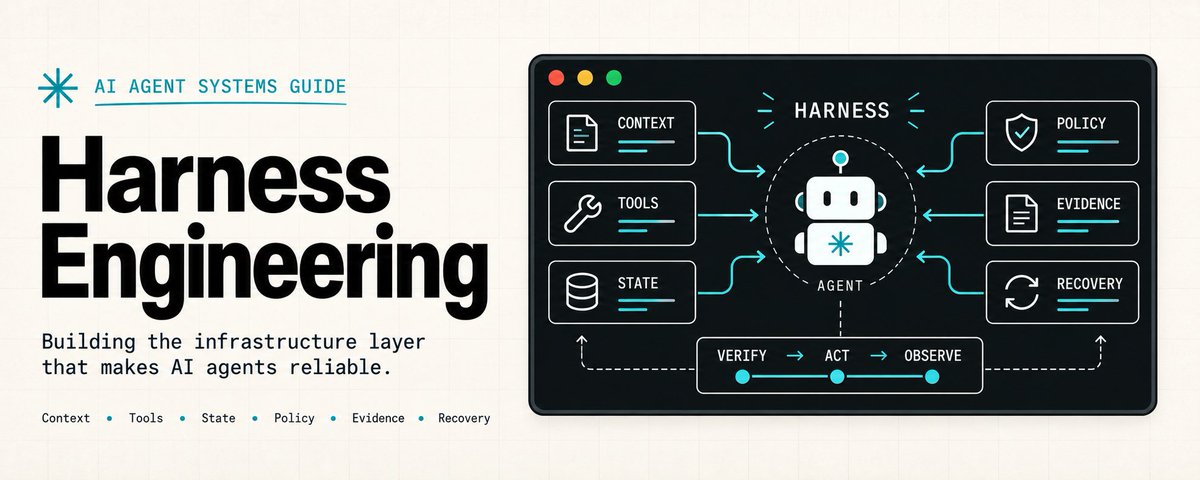
Harness Engineering could be the missing layer between smart models and reliable AI agents.
It gives agents context, safe tools, durable state, verification and recovery.
In this article, I show you how.
David retweeted

people who laugh and say karpathy's latest tips are outdated - i suspect the vast majority of them have not even tried the tips yet
i just tested the ASD-STE100 wording rule and it's surprisingly good at helping increase clarity of model response, even within html artifacts. but the trick is that the full ruleset is a bit too strict and you need to pick a subset
one prompt you can run super easily:
"randomly sample 10 session transcripts where i worked with you interactively within the past week. apply ASD-STE100 rules to assistant responses and analyze which rules would have increased clarity, reduced confusion and improved the conversations, then document those rules in my user level AGENTS.md"
you might be impressed!

We'll be spending a lot more time trying to understand the outputs of language models. A few thoughts, tips & tricks:
Writing. Something I've had success with: Ask your LLM to explain something in ASD-STE100, it's a controlled language specification originally developed for aerospace maintenance documentation. LLMs well-versed in this language and it comes with heavy constraints on clean writing style that I often find a lot more readable. Sometimes I've tried to soften it a bit e.g. ask for "80% of the way to ASD-STE100" because the spec is quite stringent. But even better:
Diagrams / images. Instead of writing, ask your LLM to create a diagram. These can be a lot easier to process, parse, and understand. But even better:
Web pages. Ask for output "in HTML" to get a beautiful, interactive webpage. LLMs are getting really good at frontend and can create beautiful experiences, animations, etc. But even better:
Explainer videos. The output format I am most bullish on is fully custom / bespoke explainer videos generated on any arbitrary topic. Experiment with things like "Create a 3b1b style video explainer on X. Use my ElevenLabs API key for audio narration". (you'd need an API key for the latter or you can ask your LLM to find you decent free alternatives that use your local compute). This is actually starting to work!
In summary:
- As LLMs get better, they will do more and more of the legwork autonomously, and a lot more of our work will rise up the abstractions into oversight and understanding.
- Luckily, LLMs can help here too because as intelligence and code are increasingly abundant, you can ask for large, custom, discardable software artifacts (e.g. web apps, video explainers) that would have never made sense to create before. Push the boundaries here and you'll be surprised.

David retweeted

I want to prevent a race into unmonitorability kicked off by confused reporting. The depth of the computation graph for our present frontier models, including Astra, is within a factor of two of GPT-4.
OpenAI has worked to preserve and utilize chain-of-thought monitoring since our very first reasoning models. We deeply care about this technique, as it can give us a view into how model alignment generalizes from its training distribution. I do think it is fragile and unfortunately trending in a negative direction, for reasons not contingent on architecture changes that I will write about soon. But there are things we can do to strengthen it, and it's a core goal of our current research program.
Where Should We Live? My (WIP) Framework for Optimizing a Family’s Life
davidfchang.medium.com/where…
David retweeted

Duncan Trussell recorded this conversation with his mother while she was facing terminal cancer.
What you’re hearing isn’t scripted. It isn’t performed. It’s a son sitting with his dying mother trying to hold onto every word before the words run out.
And she, the one facing the end, is the one doing the comforting.
That is what makes these conversations so extraordinary. Not the wisdom itself, as profound as it is. But who it’s coming from. A woman who had every reason to be consumed by her own fear choosing instead to spend what little time remained helping her son understand how to live without her.
These recordings became the heart of The Midnight Gospel. And I always go back to watch it again.
They remain some of the most honest conversations about death, love and what it means to be human ever put on screen…
David retweeted

Scrum made sense at companies/teams that shipped a new version of their product every 2-3 months (or less frequent)
As soon as a team got to shipping daily or had CD: they only held teams back
Most startups + Big Tech moved on a decade+ ago, legacy companies remained only

David retweeted

🥳 This week we announced Agent Substrate. It's the compute runtime (that can work on Kubernetes) that enables everything you've seen from me. We can suspend and resume so fast that you can do it per tool call.
👉 github.com/agent-substrate/s…
👉 github.com/agent-substrate/e…
David retweeted

new post: the senior engineer death spiral
sunilpai.dev/posts/the-senio…
a friend just started a big job and asked for some advice. so I braindumped a monologue about a super common failure mode I see with engineers and posted it here, hope it helps whoever it can.

“Una vez, conocí,
A un señor que jamás se reía…
Y después, comprendí,
De negocios tan solo entendía…”
- Piero
David retweeted

Haven’t seen anyone talk about this, but the @nytimes made an interactive map called The American Mosaic, showing ancestry groups that make up every U.S. census tract.
There are many interesting communities to explore. You can zoom in and see what makes up your own neighborhood:
nytimes.com/interactive/2026…

David retweeted

Two economists mathematically proved that AI will destroy the economy.
Researchers from Wharton and Boston University published a terryfiying paper called "The AI Layoff Trap."
They mapped out the economic end-game of the AI transition, and it exposes a fatal flaw in competitive capitalism.
When a company replaces a worker with AI, it captures 100% of the wage savings.
But that displaced worker is also a consumer. When they lose their job, they stop buying things.
The company gets all the savings, but the loss of consumer demand is spread across the entire economy.
If there are 20 competitors in a market, a CEO only absorbs 1/20th of the economic damage their layoffs just created.
So every single rational CEO has a mathematical incentive to automate as fast as possible.
They can literally see the cliff approaching, and they still step on the gas.
It triggers an unavoidable Prisoner’s Dilemma. If you don't automate, your competitors will, and they will crush you on price.
It doesn't just hurt workers. It destroys the businesses, too.
The economy gets trapped in an automation arms race. Companies fire their workforce to stay competitive, until the entire consumer base is completely hollowed out.
At the limit, the paper concludes: “Firms automate their way to boundless productivity and zero demand.”
And the scariest part?
The researchers mathematically tested every popular fix.
Universal Basic Income? Fails. It raises the living standard but doesn't change the corporate incentive to cut jobs. Retraining? Fails. Worker equity? Fails.
The paper proves that more competition actually makes the collapse happen faster. And "better" AI makes the damage worse.
The only thing that mathematically stops the collapse is a targeted automation tax, forcing companies to pay for the purchasing power they destroy before they automate the job.

David retweeted

This paper gives a fancy name to a problem you can already feel in your bones
"The Tragedy of the Cognitive Commons." Checking AI output requires deep expertise. Deep expertise comes from doing grunt work for years. And grunt work is the first thing AI eats
So we're building systems that need expert supervision while dismantling the only known process for making experts
The paper calls the shared pool of human expertise the "cognitive commons." Every profession drinks from it. Nobody's refilling it.
By eliminating junior roles, each company is acting totally rationally, and the collective result: a profession that can't catch AI's mistakes anymore because it never learned to do the work in the first place
Who checks AI's homework in 15 years?
