

Every choice you make kills off other possibilities. What you give up and what you choose—that is what defines who you are.
Joined April 2026
- Tweets598
- Following181
- Followers180
- Likes2.6K








Pinned Tweet
Today, 1 ZEC is worth only 0.01 BTC. Someday, 1 $ZEC will be worth more than 1 BTC.
6
944



NVIDIA is not an ordinary company.
What it needs is a CEO who can do more than manage today’s business. It needs someone who can see where technology is heading over the next decade and lead the company beyond its existing boundaries.
What makes Jensen Huang truly irreplaceable is not his financial management skills, but his strategic vision for the future of computing. The launch of CUDA in 2006 is the perfect example.
Today, NVIDIA faces challenges that may be even greater than those of the past.
AI technology is evolving at an unprecedented pace. As AI-assisted programming, automated code migration, and compiler optimization continue to advance, the CUDA ecosystem moat that NVIDIA spent two decades building could gradually be weakened by AI itself.
The irony is that the very technology capable of eroding CUDA’s competitive moat may be the same artificial intelligence that NVIDIA helped bring into the world.
When that day comes, where should NVIDIA go next? Which technologies should it bet on? How can it build new competitive moats?
These are not questions that can be answered simply through financial management, sales expertise, or the execution of existing product roadmaps.
Whether Colette Kress can lead NVIDIA through the AI era and create another decade of technological leadership and success remains highly questionable.
Even with Jensen Huang at the helm, NVIDIA would not be guaranteed to maintain its dominance amid such rapid technological change. Without him, that strategic uncertainty only grows.
NVIDIA’s greatest risk is not losing today’s market share. It is losing the ability to create the technological advantages of tomorrow.
30
Deep thinker retweeted

Over the past week, I’ve been overwhelmed by the love and support of friends, industry colleagues, and people I've never met. Thank you to everyone who has shown kindness to my family and me. It means the world to me.
I came to the United States 53 years ago, and becoming an American citizen is one of the greatest gifts and proudest moments of my life. NVIDIA has been my life’s work. Building it into the company it is today alongside my colleagues has been a privilege and an honor. Nowhere but in America could a company like NVIDIA be possible. I love our country, and I love NVIDIA.
I did not live up to the standards expected of everyone at NVIDIA, and I have made serious mistakes in my personal life. I created problems for the Board that I deeply regret. I own my mistakes completely, and I am committed to cooperating with the Board’s independent investigation.
Since my departure, I’ve seen an outpouring of calls from NVIDIA’s employees, investors, business partners, and customers for me to return as CEO. Many continue to reach out to me directly as the company navigates complex technology, market, competitive, and geopolitical dynamics. NVIDIA is a once-in-a-generation company. If the Board of Directors decides that my return is in the best interest of our shareholders, our employees, the company, and America, I would be honored to answer these calls and return as CEO.
Thank you again to everyone who has shared their good wishes. I am profoundly humbled by your support. To my family: I love you, and I will spend the rest of my life being worthy of yours.
Jensen
As one of the most iconic NFT projects in the world, BAYC has seen its floor price decline by more than 97% from its all-time high. This is not merely the downfall of a flagship NFT project, but a reflection of the struggles facing the entire NFT market.
Over the past few years, the NFT market’s prosperity has been largely built on images, scarcity, celebrity endorsements, and speculative consensus. People bought NFTs not because of their intrinsic value, but because they believed someone else would eventually pay a higher price for them.
As long as new capital continued to flow in, this model could generate extraordinary wealth. But when liquidity dries up and the opportunity for profit disappears, a valuation system built on speculation inevitably begins to collapse.
Scarcity does not equal value. Without genuine demand, scarcity is virtually meaningless.
However, this does not signify the failure of NFT technology. Rather, it indicates that the speculative business model that once dominated the NFT market is losing its vitality.
The true value of NFTs lies not in the images themselves, but in what they represent and the unique properties that blockchain technology provides: verifiability, traceability, proof of ownership, and resistance to tampering.
The future value of NFTs should be built on genuine human needs:
• Historical value: Recording wars, peace, technological breakthroughs, and defining moments in human civilization.
• Emotional value: Permanently preserving birthdays, weddings, wishes, and the precious moments of our lives.
• Cultural value: Preserving art, ideas, the spirit of an era, and humanity’s collective memory.
• Ownership value: Serving as digital representations of real-world asset ownership, intellectual property, and rights to economic benefits.
An image may lose its market value, but history does not lose its significance because of falling prices. A keepsake may have no resale value, yet still hold irreplaceable emotional value.
Not every valuable NFT needs to command a high price, and not every NFT needs to be traded.
NFTs should be more than speculative instruments. They should become digital archives of human civilization, permanent records of personal memories, and a bridge connecting rights in the physical and digital worlds.
This is the true direction of NFTs.
loveforpeace.si/wishes
#NFT
28
As Bitcoin’s price continues to decline and MSTR’s ability to raise capital gradually weakens, MSTR could shift from being Bitcoin’s largest incremental buyer to its largest potential seller.
The very force that once drove Bitcoin’s price higher could eventually become the force that accelerates its decline.
This is the greatest systemic risk inherent in MSTR’s business model.
37

Capital flows according to a fundamental economic principle: it moves toward undervalued opportunities that offer both profit potential and security, while flowing away from markets characterized by excessive valuations, diminishing returns, and mounting risks. Therefore, no industry or market can remain a permanent reservoir of capital.
After more than a decade of development, the cryptocurrency market has gradually evolved from an emerging market into a relatively mature financial market. As overall valuations have risen, the extraordinary wealth-creation opportunities of its early years have gradually diminished, making it increasingly difficult to achieve outsized returns.
Aside from highly leveraged derivatives trading, which amplifies both returns and risks, the crypto spot market no longer offers a significant return advantage over other financial assets. During certain periods, it has even underperformed the S&P 500, while exposing investors to greater price volatility and asset security risks.
Under these circumstances, if the cryptocurrency industry fails to address fundamental issues such as exchange hacks, wallet security, and protocol vulnerabilities, continued capital outflows will be a natural consequence of market evolution.
Capital has neither faith nor loyalty. When a market fails to deliver returns commensurate with its risks, while another offers more stable and secure investment returns, capital will naturally redirect itself.
For investors, whether in stocks, gold, real estate, or cryptocurrencies, what truly matters is not remaining attached to a particular asset class, but identifying opportunities whose intrinsic value has yet to be fully recognized by the market.
The essence of investing is not loyalty to any particular asset, but identifying the gap between price and value amid the constant movement of capital.
49
Frequent security incidents are undermining the very foundation of the cryptocurrency market — trust.
Cryptocurrencies derive their unique value from financial privacy, borderless transactions, asset sovereignty, and, in the case of certain cryptocurrencies, resistance to inflation. Yet all of these advantages depend on one fundamental prerequisite: security.
If even the world’s largest cryptocurrency exchange cannot guarantee the safety of its users’ assets, if reports of wallet theft continue to emerge, and if investors begin to question whether their assets are truly secure, confidence in the entire market will gradually erode.
The cryptocurrency market has now returned to its most fundamental question: How can we make investors feel genuinely secure?
First, security upgrades to the underlying blockchain technology. These include post-quantum cryptography, protocol vulnerability remediation, and smart contract security. Cryptocurrencies must not only withstand today’s attacks but also be capable of defending against future technological threats.
Second, financial privacy protection. Fully transparent public ledgers are themselves a security vulnerability. When anyone can track an individual’s wealth, fund flows, and transaction history, the exposure of wealth also means exposure to risk. Privacy is not only a fundamental right but also an essential security mechanism. Reducing the attack surface is often more effective than continuously adding layers of defense.
Third, improvements in asset custody and management. Both centralized exchanges and personal wallets need more robust permission isolation, multisignature mechanisms, risk controls, and asset recovery solutions. Security should not depend on a single individual, device, or institution. Nor should a single operational mistake cost investors their life savings.
Fourth, stronger accountability and asset protection mechanisms. Reserve transparency, asset segregation, independent audits, risk reserve funds, and loss compensation mechanisms should become fundamental industry standards rather than optional measures.
Over the past decade, the cryptocurrency industry has focused heavily on transaction speed, scalability, liquidity, and profit opportunities, yet it has never fully resolved the most fundamental issue: security.
Without security, there is no trust.
Without trust, there is no long-term capital.
Without long-term capital, there can be no truly mature financial system.
The next chapter of cryptocurrency should not merely be a revolution in wealth creation, but a revolution in financial security.
2
87
loveforpeace.si/wall.html#op…
Dear Jensen Huang,
In one of your speeches, you once said:
“Your pain and suffering will strengthen your character, your resilience, and agility, and they are your ultimate superpowers.”
Now, as you face one of the most difficult moments of your life, I hope your own words will become a source of strength for you.
May you emerge from this chapter stronger than ever.
I have immortalized these words on the Ethereum blockchain as a wish for you.

37
Deep thinker retweeted
🤦♀️ Jensen made a rookie mistake. He had a board.
In 2014, my board kicked me out for saying no to spies.
In 2026, Jensen’s board kicked him out for saying yes to one.
So the board gets you either way.
Founders: Don’t have a board.
Be the board 😏
CUDA, GPU architecture, the developer ecosystem, and next-generation product roadmaps have already evolved into a massive organizational infrastructure. The board may believe that NVIDIA can continue executing its existing strategy even without Jensen Huang.
But I believe this is precisely where the greatest risk lies: Being able to execute the strategy Jensen Huang created is not the same as being able to envision and shape the next decade as he did.
NVIDIA without Jensen Huang may continue to dominate for another five years. But what happens after that?
41
Why do I believe ZEC may be better suited than BTC to meet the wealth protection needs of high-net-worth individuals?
For many wealthy individuals, the greatest value of cryptocurrency lies not merely in investment returns, but in financial sovereignty, privacy, and asset security.
This demand is not necessarily driven by illegal intentions. The greater one’s wealth, the more important it becomes to diversify assets, reduce dependence on individual financial institutions, and protect financial privacy.
In the traditional financial system, assets such as bank deposits, stocks, and other financial products generally rely on centralized institutions for registration, custody, and management. This means that while individuals may own their wealth, they do not necessarily have complete, independent control over it.
This is why stablecoins such as USDC are not necessarily the ideal choice for every high-net-worth individual.
Stablecoins offer price stability and strong liquidity, but their issuers have the ability to freeze tokens held at specific addresses. For those who prioritize financial sovereignty, this represents a significant centralization risk.
Bitcoin is different.
Bitcoin has no centralized issuer or administrator capable of unilaterally freezing on-chain assets. As long as holders securely control their private keys, third parties generally cannot directly restrict the transfer of their assets in the same way they can freeze bank accounts or centrally issued stablecoins.
This is one of Bitcoin’s most important features: control over wealth shifts from financial institutions to the individual holding the private keys.
However, BTC still has one major limitation: a lack of financial privacy.
Bitcoin’s transaction history is entirely public. Once an address is linked to a real-world identity, blockchain analysis can potentially reveal the holder’s assets, transaction history, and financial relationships.
For ordinary people, this may seem like a privacy concern. But for individuals with substantial wealth, public exposure of financial information can also create risks of fraud, extortion, hacking, and even threats to personal safety.
This is where $ZEC takes things a step further than BTC.
ZEC not only allows individuals to maintain self-custody of their assets, but also enables shielded transactions that conceal sensitive information such as transaction amounts, senders, and recipients.
BTC addresses the question of who controls your wealth. ZEC goes further by addressing who gets to see your wealth.
For high-net-worth individuals, the combination of these two capabilities may be more attractive than the prospect of price appreciation alone.
Of course, censorship resistance does not mean exemption from the law, and financial privacy does not mean immunity from legitimate judicial enforcement. ZEC also faces real challenges involving price volatility, liquidity, wallet security, and regulation.
Nevertheless, I have always believed that financial privacy is a severely underestimated need.
And that is one of the fundamental pillars of ZEC’s value proposition.
Jensen Huang’s greatest strength has never been his management skills. It has always been his vision.
If you look back at his public speeches and interviews from twenty years ago, you’ll be amazed to discover that many of his predictions about parallel computing, general-purpose GPU computing, and the future of computing architecture now seem almost prophetic.
In 2006, NVIDIA introduced CUDA. At the time, GPUs were primarily seen as tools for graphics processing. Artificial intelligence was still far from becoming the center of the technology industry, and almost no one could have imagined that GPUs would one day become one of the most important foundations of the AI era.
But Jensen Huang saw it coming. More importantly, he didn’t just see the future. He had the courage to invest in it and the determination to stay the course for nearly two decades.
Throughout those long years, CUDA did not immediately generate commercial returns proportional to the investment. Despite market skepticism, technological uncertainty, and enormous R&D costs, Huang never gave up.
That is what makes him truly irreplaceable.
Management skills can be developed. Talented professional executives can be hired. But people who can foresee the direction of technological development ten or even twenty years in advance, and who possess the courage and patience to lead an entire company toward that future, are not merely rare. They are almost nonexistent.
The most important responsibility of a CEO at a great technology company has never been simply to maintain daily operations or deliver better quarterly earnings. It is to identify the company’s next path forward before the next technological revolution arrives.
Managers determine how efficiently a company operates. But truly visionary leaders determine where that company will go.
NVIDIA’s success today is not simply the result of catching the AI wave. It is the result of Jensen Huang spending nearly twenty years preparing for that wave before it arrived.
If NVIDIA wants to continue its extraordinary success, what it needs is not merely a manager, but a visionary leader who can guide the company into the future.
48
Why Is Jensen Huang Almost Irreplaceable to NVIDIA?
Because the most important responsibility of a CEO at a great company is not simply to keep the business running, but to see where the future is heading and lead the company in the right direction.
Management skills can be developed, and operational talent can be hired. But leaders who can recognize technological trends a decade ahead of everyone else—and have the courage and patience to stay committed to their vision—are extraordinarily rare.
In 2006, NVIDIA introduced CUDA. At the time, most people saw GPUs as nothing more than graphics processors. Very few understood why graphics cards needed general-purpose computing capabilities, let alone imagined that GPUs would one day become the foundation of artificial intelligence.
For many years before the AI boom, CUDA did not generate commercial returns proportional to the investment it required. Yet NVIDIA continued investing in development tools, software infrastructure, and its developer community.
Jensen Huang wasn’t betting on a particular product. He was betting on an entirely new era of computing that had yet to arrive.
History proved him right.
Today, NVIDIA’s competitive moat extends far beyond GPU performance. It includes the software ecosystem, developer community, and computing platform built around CUDA over the past two decades. These advantages cannot be replicated in just one or two product generations.
But here is the real question: Success over the past twenty years does not guarantee success over the next ten.
AI is evolving from model training to large-scale inference, from data centers to robotics, autonomous vehicles, and the physical world. Computing architectures, software ecosystems, energy requirements, and even entire supply chains could undergo profound transformations.
What NVIDIA does not lack today is talented engineers, managers, or executives. Even if Jensen Huang were to leave, the company could continue operating normally and might maintain its competitive strength for a considerable period.
But keeping a great company running and leading a great company into the future are two entirely different things.
What NVIDIA truly needs is not a CEO who can manage the company as it exists today, but a leader who can envision the world ten years from now and has the courage to keep investing in that future.
That requires extraordinary vision, experience gained through multiple industry cycles, resilience in the face of criticism, and the discipline to prioritize long-term strategy over short-term gains.
More importantly, it requires the willingness to challenge one’s own past achievements and drive the next technological revolution, even after achieving extraordinary success.
Jensen Huang is not irreplaceable forever. But finding someone who possesses all these qualities while also deeply understanding NVIDIA’s technology and culture would be extraordinarily difficult.
A good CEO knows how to keep a company profitable. A great CEO knows where its future profits will come from.
What makes Jensen Huang so difficult to replace is not simply that he built the NVIDIA we know today, but that he may still be the person best equipped to lead NVIDIA into its next era.
🤖 Made with AI

1
1
104

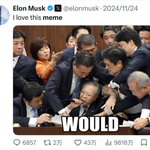
Elon Musk once mentioned “would,” and the meme coin skyrocketed from a market cap of just a few hundred thousand dollars to a peak of $700 million.
This time, Bernie reminds me of what happened with would.


2
45
The fundamental reason crypto continues to attract ordinary people comes down to one thing: the opportunity to make money.
Whether it’s meme coins or NFTs, the speculative frenzies of the past have essentially been different games in the same casino. Meme coins speculate on emotions and collective belief, NFTs on images and scarcity, while leveraged trading directly amplifies human greed and fear.
Why has HYPE been so strong? Because Hyperliquid has captured the most fundamental speculative demands of the crypto market: high leverage, deep liquidity, and 24/7 trading, effectively bringing the casino directly on-chain.
Traditional casinos require gamblers to walk through their doors. An on-chain casino only requires a connected wallet. No opening hours, no geographical boundaries. Anyone can participate at any time.
In this sense, Hyperliquid is becoming one of the most prominent on-chain casinos in the crypto world, with HYPE serving as its core asset.
But there’s a question worth considering: Casinos can keep making money, but gamblers cannot keep winning forever.
The speculative booms of meme coins and NFTs depend on a constant influx of new capital. Highly leveraged trading, however, doesn’t even require the market to keep rising. As long as prices continue to fluctuate, speculators will keep coming back to place their bets.
This is why trading platforms can remain highly profitable even during market downturns.
However, if the crypto industry ultimately relies on gambling to attract users, it will never truly replace traditional finance.
Speculation can generate liquidity, but it cannot create lasting value for an entire industry.
The real future of cryptocurrency should not be about building more casinos. It should be about establishing safer, more transparent, and more efficient financial infrastructure.
Casinos can make a few people rich, but only genuine value creation can bring an entire industry to maturity.
60
Exchange after exchange is being hacked. What’s being lost isn’t just billions of dollars in assets, but confidence in the entire crypto market.
Security is the foundation of any financial system. If crypto can’t even guarantee the safety of assets, how can it possibly replace traditional finance?
As market confidence declines, capital continues to flow out, liquidity dries up, and the entire crypto market faces a major shakeout.
Without liquidity, meme coins lose the fuel that drives speculative frenzies. Without sustained capital and community consensus, NFTs that rely solely on hype around digital images will struggle to maintain their value.
But this doesn’t mean the end of meme coins or NFTs. It means they must return to what truly gives them value.
The future of meme coins should be rooted in trending events, cultural phenomena, and the collective emotions of an era. The future of NFTs should lie in permanently preserving history, memories, rights, and things of genuine value.
Speculation can create short-lived prosperity, but it cannot sustain an industry’s future.
Liquidity determines how prosperous a market can become. Security and real value determine how far it can go.
47
Deep thinker retweeted

I wanted to test Fable 5.2's quality with one-shot prompts without human feedback.
Everything in this game is from scratch: models, sounds, textures. ~$550 at API pricing, ~2.7M output and 445M input tokens, heavily cached. Took 8 hours!
Play it here: claude.ai/artifact/BGY1SztrA…