




niku retweeted
🚨 CANTON NETWORK IS GEARED FOR A MEGAPUMP AND THE INFRASTRUCTURE TALKS LOUDER THAN HYPE
It’s about real capital efficiency, on-chain liquidity, and institutional adoption - the kind that fuels sustained moves
Here’s why $CC could see explosive growth 👇
TRILLIONS OF IDLE COLLATERAL EXIST
Right now, massive amounts of collateral sit idle, over-posted, or trapped overnight. That’s capital that could be working intraday. Unlocking it creates enormous flow potential for markets that rarely move this efficiently.
REAL-TIME ONCHAIN MOBILITY CHANGES THE GAME
Unlike traditional finance where collateral is stuck in reconciliations and intermediaries, Canton allows instant reuse across counterparties. Liquidity can circulate without delay - faster capital means bigger market moves.
HIGH-IMPACT USE CASES ARE ALREADY PROVEN
Canton isn’t theoretical. Key applications include:
- Repo markets
- High-quality liquid assets (HQLA)
- Tokenized funds
- Digital money for settlements
These create the foundation for always-on, frictionless markets.
LIVE TESTS SHOW FUNCTIONALITY
Market participants have already executed fully on-chain collateral financing. Real assets settled after hours, and collateral was reused across multiple counterparties. This proves the system works under real conditions.
STRUCTURAL ADVANTAGE OVER OTHER NETWORKS
Few platforms can move institutional-scale collateral in real time without friction. Canton’s architecture gives it first-mover advantage in efficiency, which often translates to adoption-driven price moves.
CAPTURING INTRADAY FLOW MEANS VOLATILITY POTENTIAL
Whenever idle capital becomes tradable in real time, markets respond aggressively. Expect sharp swings as institutional users optimize positions, arbitrage inefficiencies, and redeploy assets instantly.
INFRASTRUCTURE LEADS NARRATIVE, NOT THE OTHER WAY AROUND
Canton’s growth won’t need hype cycles. Once flow increases and liquidity proves itself, price follows. Early movers benefit because adoption precedes public awareness.
⸻⸻⸻⸻⸻⸻⸻⸻
Canton isn’t just another blockchain project.
It’s a capital efficiency play at scale.
When trillions of collateral can move frictionlessly,
the market doesn’t wait - it accelerates.
$CC isn’t a guess - it’s a structural setup for a megamove.

niku retweeted
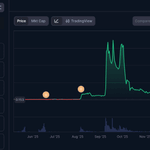
$DCR is around $25 right now, and it really does feel like one of those "dead coin" charts that suddenly goes crazy when no one is looking.
There are only 21M DCR available, and only ~17M are in circulation. This means that the float is not infinite, and when liquidity gets low, it doesn't take a lot of demand to move the price. When the market finally goes back to low-float, structurally tight names, coins like this can change prices quickly.
Also, $DCR isn't just a random story token. It is a real L1 with a hybrid PoW + PoS model, and the community runs it instead of VCs. The protocol literally pays for itself through a treasury model that gives 10% of block rewards to development. This is rare in crypto and makes it much less reliant on outside capital or hype cycles.
It's also interesting that the tape has been getting better without anyone noticing. Over the past week and month, volume rose and price action started to lean positive. This is what usually happens when people put their money in early instead of chasing it later. It's the classic "accumulation first, breakout later" pattern, and most retail traders only notice it after the move has already started.
The timing isn't random on a larger scale either. People are getting tired of meme noise and crowded blue chips, so the market has slowly started to move back toward themes like "privacy + governance." If Bitcoin cools off and investors start looking for coins with a better structure and a smaller supply, $DCR is a perfect fit.
Volatility is another big sign. $DCR has been trading in a smaller range lately, even though the volume is going up. These volatility squeezes don't last long. When they do break, they usually break hard. Similar setups have led to quick expansions of 20-40% in short time frames in the past.
When you put it all together, the setup is pretty straightforward: a thin float, a capped supply, real fundamentals, funding for development built into the protocol, and early signs that big money is getting ready before the crowd shows up. That's how you usually get asymmetric moves: by the time retail finally notices, the price is already higher and the "easy entry" is gone.
At $25, $DCR doesn't look like a sleepy mid-cap anymore; it looks more like a coin that could suddenly change its price if volume and news catch up at the same time.

niku retweeted
Trading Polymarket in 2026 is like trading during the first weeks of altseason in 2020.
It’s a phase most people still don’t fully understand.
Back in 2020, altcoins were massively mispriced. Early money didn’t just bet on price moves, they positioned ahead of the narrative
Catching waves before retail FOMO took over. Liquidity was thin, market makers were still waking up, and volatility was all over the place. Those who timed it right saw gains that felt almost too easy.
Now, Polymarket is in a similar phase. Markets are starting to see larger flows, but they’re still driven by narrative shifts and headline reactions.
The difference is, the liquidity isn’t there yet for most markets. Some of the moves are so predictable they feel almost like deja vu - a mispriced market catches a headline, a sudden rush of retail FOMO, and then a price correction once the reality settles.
If you’re early, you can still grab the best entries, but the crowd is starting to catch on.
Polymarket is far from efficient, and if you’re on top of the trends, you can outsize your positions, just like early altseason trades. With smart execution and proper sizing, you can catch the bigger waves before everyone else jumps in.
So, like the early days of altseason, the best trades are still happening on the edge, and being early means you’ll capture the returns before anyone else even realizes they’re on the wrong side of the trade.

niku retweeted
$DASH will hit $400 if it breaks $125, which could happen very soon.
DASH has already surged 125% this month and climbed from $22 to $149 in Q4 2025.
Current price is holding $80-92 with support at $50, and the next resistance level is $125, after which the path to $400 opens with no obstacles in sight.
So First reason: Privacy coins are finally back in investor focus.
This week the entire privacy coin sector is flying simultaneously - $DASH +71% in 24 hours, XMR, DCR, ZEN all rising at the same time.
This is not coincidence, it's rotation into privacy assets because people are starting to understand that privacy could be the next mainstream theme after AI.
The last time privacy coins had synchronized rallies like this was before the 2017-2021 bull run.
And second reason: Technical breakout has already started and timing is critical.
DASH just broke through multiple resistance levels and current momentum shows $125 could fall within days.
Once $125 breaks, the rest is just distance because the next psychological level is $400, which analysts call the "ambitious target".
From $22 to $400 is 1700% profit, but looking at DASH history, it has already done this before.
Examples of coins that rallied this aggressively:
Monero (XMR) surged 200%+ in weeks whenever privacy became relevant.
Zcash (ZEN) caught spikes of 150-200% when privacy was the center of attention.
Decred (DCR) surged 100%+ along with the rest of the privacy sector in Q1 2017 and Q4 2021.
This is not a new story - privacy coins always rocket when regulation starts pressuring centralized transactions.
All conditions align: sector in focus, technical breakout ready, historical examples prove it's possible.
Time to watch DASH closely, because if the breakout above $125 happens, $400 won't be a dream but just price discovery.

niku retweeted
Solana just nuked Starknet and Crypto Twitter is still processing it.
The official post went straight for the kill: "Starknet has 8 daily active users, 10 daily transactions, and still has a 1b MC and 15b FDV. Send it straight to 0"
This is dangerous because the numbers are outdated (Starknet actually has 65k users now), but that doesn't matter - Solana isn't trying to be accurate, they're trying to set the narrative.
When your official account says a competitor should "go to 0," it's not shade, it's psychological warfare.
Here's what actually happened:
Every new person searching "Starknet" now sees "Solana says it's basically dead" as the first thing.
Starknet's CEO responding with jokes about "bald marketing interns" is good defense, but it doesn't undo millions of people seeing the attack.
Solana timed this while SOL was trading $147 with strong momentum - you attack when you're winning.
The real lesson:
First narrative wins, data is secondary.
You don't need to be right, you need to say it loudest and earliest.
By the time Starknet posts their "actual" 65k users, the damage is already normalized.
This is how market psychology flips: one viral post from an official account can reset how an entire community perceives a competing project.

niku retweeted
🚨 $DN — ON-CHAIN DATA POINTS TO A POSSIBLE TEAM-RELATED DUMP, AND THIS IS NOT A SMALL SIGNAL
This isn’t Telegram drama or Twitter FUD.
This is about wallet behavior, supply flow, and trust erosion — the things that actually break structures.
Wallets involved:
0x7ecbaa53935Aff35b6C048FBDcC8B0a2DAe69009
0xFa7574bb3303E83cDe78dfEeA357e82b103224F2
Here’s why this deserves close attention 👇
1/ ON-CHAIN DOESN’T LIE — SUPPLY IS HITTING THE MARKET
Charts react after tokens are sold. On-chain data shows when distribution starts. These wallets display behavior consistent with intentional selling, not random retail exits or one-off transfers.
2/ THE SELLING IS STRUCTURED, NOT EMOTIONAL
This isn’t a single panic dump. It’s controlled flow — broken into chunks, timed, and routed to liquidity venues. That pattern is typical of insiders managing exposure, not users rage-selling.
3/ TEAM-ADJACENT WALLETS CHANGE THE ENTIRE CONTEXT
When wallets linked to early allocation, insiders, or team infrastructure start distributing, the market doesn’t just price the sell — it prices future trust. That’s a much heavier discount.
4/ TIMING SUGGESTS MAXIMUM DAMAGE WITH MINIMUM NOISE
Selling during periods of thinner liquidity or after local highs increases downside impact without drawing immediate attention. This is how slow bleed scenarios begin.
5/ WATCH HOW PRICE RESPONDS TO BOUNCES
In healthy markets, heavy selling gets absorbed and price snaps back. In distribution phases, bounces are weak, short-lived, and sold into. That’s the key tell to monitor now.
6/ COMMUNICATION MATTERS MORE THAN EVER
If this flow is legitimate (vesting, ops, treasury), transparency is critical. Silence allows the worst narrative to win — and markets always assume the worst when teams don’t speak.
7/ THIS IS HOW CONFIDENCE UNWINDS
Downtrends rarely start with crashes. They start with:
– insider selling
– fading rallies
– declining volume on bounces
– growing distrust
By the time panic shows up, insiders are already out.
⸻⸻⸻⸻⸻⸻⸻⸻
This isn’t about fear.
It’s about supply dynamics and credibility.
Price can recover from bad sentiment.
It rarely recovers quickly from sustained insider distribution.
Ignore the noise.
Watch the wallets —
they move first, charts follow.

niku retweeted
🚨 ERIC ADAMS ACCUSED OF $3M FRAUD AFTER $NYC COIN LAUNCH
This isn’t just another crypto scandal or political drama
It’s a clear example of how authority, narrative, and retail trust can be weaponized and why regulators watch these cases so closely
Here’s why this matters 👇
1/ THE $BTC MAYOR IMAGE CREATED INSTANT LEGITIMACY
Eric Adams actively branded himself as a crypto-friendly leader - taking paychecks in Bitcoin, promoting innovation, and publicly aligning with the crypto community. That image wasn’t neutral. It built perceived credibility and lowered skepticism.
2/ NYC COIN WAS DRIVEN BY SYMBOLISM, NOT FUNDAMENTALS
The token’s appeal wasn’t based on cash flows, utility, or adoption. It was built on association: New York City, political backing, and the idea of civic crypto. When narrative leads and substance follows, risk concentrates fast.
3/ $3M IS SMALL MONEY - BUT A BIG SIGNAL
From a market perspective, $3M isn’t systemic. From a regulatory and reputational perspective, it’s perfect. It’s small enough to prosecute cleanly and large enough to make a public example.
4/ RETAIL CONFUSES AUTHORITY WITH DUE DILIGENCE
Political figures, city branding, and public endorsements create false safety signals. Retail often assumes legitimacy equals safety. That assumption is where most losses originate.
5/ EXPECT THIS CASE TO BE USED AS A REGULATORY REFERENCE
These stories don’t disappear. They get cited in:
– policy discussions
– enforcement reports
– future crypto regulations
Each case strengthens the argument that token launches need stricter oversight.
6/ POLITICS + TOKEN ISSUANCE IS A STRUCTURAL RISK
Politicians are optimized for optics, not investor protection. When tokens are tied to political narratives, accountability becomes blurred - especially once money changes hands.
7/ DAMAGE EXTENDS BEYOND ONE TOKEN
Every high-profile failure tied to a known public figure reinforces skepticism toward the entire sector. Legitimate projects pay the price through tighter rules and slower adoption.
⸻⸻⸻⸻⸻⸻⸻⸻
This isn’t a story about Bitcoin failing.
It’s a story about trust being sold faster than value was built.
Crypto doesn’t break because of technology -
it breaks when narratives replace fundamentals.
And when politics enters the market,
retail usually learns last.


niku retweeted
IRANIAN SECURITY FORCES HAVE MOVED ABOUT $1 BILLION IN CRYPTO SINCE 2023.
A new blockchain analysis says the flows ran through two UK-registered exchanges, with the goal being simple: route value outside the traditional banking choke points and keep sanctions from biting as hard.
The important detail is the rail, not the headline.
The report points to heavy use of $USDT on Tron, because it’s fast, cheap, and liquid enough to move size without looking like a “bank transfer” in the old world.
And this is where the compliance story gets ugly.
If the analysis is right, those exchanges processed the bulk of the activity while the entity involved is globally sanctioned. That’s not a “crypto is neutral tech” debate - it’s a straight-up regulatory failure mode.
What this changes for the market is second-order.
When flows like this get publicly mapped, the response is rarely subtle: freezes, delistings, bank partner pressure, and exchanges getting forced to prove they’re not a laundering lane.
It also kills the lazy take that “on-chain means invisible.”
On-chain is auditable. The problem is enforcement lag - the trail exists first, consequences come later, and that gap is where a lot of these operations live.
If you’re trading anything touched by these rails, the practical risk is simple:
liquidity can vanish overnight if an exchange gets squeezed, and stablecoin redemptions can turn into a headline the moment issuers or regulators decide they want a clean example.
So yeah, this isn’t just an Iran story.
It’s a reminder that the “regulated vs unregulated” split in crypto is about to get weaponised even harder in 2026.
Do you think the next move is targeted enforcement on the exchanges, or pressure on the $USDT rails themselves?


niku retweeted
🚨 ALON TWEETED FOR THE FIRST TIME IN A WHILE AND $PUMP REACTED IMMEDIATELY
It’s about attention shock, reflexive flow, and how thin markets behave when the loudest signal returns
When he starts speak, liquidity listens.
Here’s why $PUMP just entered a dangerous phase👇
ATTENTION SHOCK IS REAL FLOW
Alon tweets aren’t news - they’re distribution.
They inject attention into markets instantly, pulling in traders who weren’t positioned minutes earlier. In low-liquidity environments, attention is liquidity.
$PUMP IS BUILT FOR REFLEXIVE MOVES
Tokens like $PUMP thrive on momentum loops.
Price moves → attention spikes → more buyers chase → price moves again. That reflexivity is how giga moves start, not how they end.
LIQUIDITY IS TOO THIN FOR CONTROL
Order books can’t absorb sudden demand.
Even modest inflows can push price vertically when sellers step back and spreads widen. That’s when charts stop respecting “levels”.
POSITIONING WAS ASLEEP
Before the tweet, $PUMP wasn’t crowded.
No aggressive leverage, no funding extremes, no widespread conviction. That’s exactly the environment where surprise catalysts do the most damage - to shorts and sidelined traders.
SOCIAL FLOW ALWAYS LEADS PRICE
By the time charts look obvious, the move is already extended.
Alon-driven cycles usually start on social velocity, not technical confirmation. Charts follow attention, not the other way around.
VOLATILITY IS NOT A WARNING - IT’S THE MECHANISM
Sharp wicks, violent pullbacks, fake tops - all normal.
That’s how weak hands exit and stronger conviction accumulates. Smooth moves don’t create giga pumps.
THESE MOVES DON’T LAST - BUT THEY MOVE FAST
This isn’t a long-term valuation story.
It’s a timing and flow event. Speed matters more than conviction, and hesitation gets punished.
⸻⸻⸻⸻⸻⸻⸻⸻
Alon tweets don’t signal tops or bottoms -
they trigger attention cascades.
$PUMP doesn’t need fundamentals.
It needs eyes, speed, and imbalance.
And right now,
imbalance just entered the chat.

niku retweeted
I found 10 Polymarket wallets that keep printing on hype markets
I wrote a small scanner that takes the 20 fattest markets by daily volume, pulls the top holders, then looks for the same wallets repeating across multiple markets. After that I filtered for the highest overlap plus real activity in the last 30 days.
The idea is simple: most people gamble one headline at a time. These guys show up again and again, across different “hot” topics, with the same sizing discipline and the same tempo.
Here are the 10 wallets with the strongest overlap and recent activity:
0x9d84ce0306f8551e02efef1680475fc0f1dc1344
30d vol $967,535 - PnL $2,618,357 - win rate 63%
0xa8c63f775ddbbe66b56614191747def3021444e8
30d vol $311,826 - PnL $76,237 - win rate 71%
0x9703676286b93c2eca71ca96e8757104519a69c2
30d vol $427,449 - PnL $128,967 - win rate 64%
0xbaa2bcb5439e985ce4ccf815b4700027d1b92c73
30d vol $643,034 - PnL $482,267 - win rate 75%
0x01542a212c9696da5b409cae879143b8966115a8
30d vol $265,296 - PnL $149,403 - win rate 70%
0xd218e474776403a330142299f7796e8ba32eb5c9
30d vol $1,175,602 - PnL $958,059 - win rate 67%
0x33e073440d9ac43e2e190e910f0b02b2fbd17d46
30d vol $182,013 - PnL $75,381 - win rate 59%
0xe7387473b067235436884d16799777cf279edf65
30d vol $64,365 - PnL $54,797 - win rate 65%
0x011f2d377e56119fb09196dffb0948ae55711122
30d vol $1,033,809 - PnL $457,901 - win rate 56%
0x090a0d3fc9d68d3e16db70e3460e3e4b510801b4
30d vol $738,416 - PnL $507,690 - win rate 54%
What’s consistent across these wallets isn’t “magic predictions”. It’s repeatable edge and process - they stick to the liquid markets, avoid ego trades, and grind small mispricings instead of chasing the loudest narrative.
DYOR and verify on-chain, but if you’re trying to level up on Polymarket, tracking repeat whales like this teaches you more than reading timelines.
Do you prefer copying whale flow, or fading the crowd and taking the other side?

niku retweeted
Truebit just got drained for 8,535 $ETH.
And this one wasn’t “bad price action” or “whales dumping” - it was a straight smart contract failure that let someone print $TRU for free and arb it into real $ETH.
Here’s the core mechanic (and why it’s so nasty):
The attacker hit an old bonding-curve style bug where the purchase price could return 0 for a big enough mint, meaning they could “buy” huge amounts of $TRU for nothing.
Then they just looped it: mint $TRU at 0 cost → sell into liquidity → repeat, until the pool was empty.
The most absurd detail: the exploit path literally involved calling a function named Attack. That’s not CT slang - it’s in the on-chain trace.
On-chain, you can see the footprint clearly:
8,535 $ETH extracted (roughly $26.5M at the time)
massive $TRU transfers (we’re talking billions of tokens moving) as the loop runs
the drain split across addresses as the $ETH gets consolidated
Truebit’s side also made it clear this wasn’t “expected behaviour” - they acknowledged an exploit and even floated a bounty-style return offer (reported as 20%).
Why this matters (beyond $TRU holders getting nuked):
Legacy contracts are the quiet killers.
You don’t need a new zero-day if there’s an old pricing function that no one stress-tested under extreme inputs.
And once a loop like this works, it’s not “a one-time hack” - it’s a reusable playbook. Same pattern shows up again and again in bonding curves, illiquid pools, and unpatched DeFi code.
What I’d watch next is mechanical:
do the stolen funds keep routing through obfuscation rails (mixers have been mentioned in reporting)
do CEXs/bridges start freezing obvious endpoints
does the team ship a clean post-mortem + hard disable, or does this fade into silence
If you’re still playing legacy DeFi, treat “old contract” like “live grenade”. One bad function is enough to turn a token into zero overnight. DYOR.

niku retweeted
Zcash just lost its core builder org overnight
and $ZEC is getting repriced on pure governance risk, not “tech broke”
Multiple outlets are reporting that the entire Electric Coin Company (ECC) team resigned at once after a governance clash with Bootstrap, the nonprofit that oversees the org structure around Zcash development.
ECC’s CEO Josh Swihart described it as a “constructive discharge” - basically saying the board changed employment terms so drastically the team couldn’t keep working under them.
The key clarification: the Zcash protocol doesn’t “stop”. It’s open-source and the chain keeps running.
But the market still reacts because the protocol surviving is not the same thing as the roadmap staying coherent.
Here’s the part that hits price:
$ZEC isn’t a meme coin where builders don’t matter
the “value” is heavily tied to whether the core privacy stack keeps shipping, stays funded, and doesn’t fragment into competing camps
And this is why the selloff was immediate. Reporting today had $ZEC down around the mid-teens on the headline, which is exactly how governance shocks trade - fast dump first, questions later.
What to watch next is pretty mechanical:
who actually carries the dev roadmap under Bootstrap now, and how quickly they can stabilise messaging
whether the exiting team’s “new company” becomes a real alternative gravity well for Zcash builders and narrative
whether this turns into a clean transition, or a slow community split (the thing that kills confidence over months)
Code can keep running. Communities can keep posting.
But when core teams walk, markets price the uncertainty immediately - because governance risk is the one thing you can’t patch with a hotfix.


niku retweeted
$FET is taking back old levels the clean way
and that’s usually what you see when the worst part is already done
I’ve been watching this structure for a while and what stands out isn’t a vertical rip
it’s how controlled the reclaim has been, almost like the market is doing inventory cleanup
$FET isn’t blasting through resistance and leaving a mess behind
it keeps coming back to old levels, tapping them, then sitting there long enough to absorb the supply
you can see where sellers show up, you can see the pause, and you can see the level stop acting like a ceiling
That’s the difference between a bounce and a reclaim.
A bounce is “touch level, reject, fade”
a reclaim is “touch level, stall, accept, then move on”
And the acceptance part is what people underestimate.
When price keeps revisiting the same area without dumping back through it, it’s basically telling you supply at that level is getting spent
the sellers aren’t gone, they’re just getting filled
This is also why the move feels slower than what CT usually chases.
It’s not one candle doing all the work, it’s the market doing the boring part:
pausing, letting late sellers exit, letting new buyers step in without panic
When a chart starts reclaiming levels like this - controlled retests, shallow pullbacks, and clean holds - it usually means forced selling already happened earlier
what’s left is rotation, not capitulation
The simple read from here is mechanical:
if $FET keeps holding reclaimed zones instead of instantly bleeding back below them, the next leg tends to arrive quietly
usually off boredom and positioning, not euphoria
Worst case is obvious too:
if these “reclaims” keep turning into wicks and give-backs, then it’s still just range chop wearing a nicer outfit

niku retweeted
🚨 THE MADURO SITUATION IN VENEZUELA ENDED UP SUPPORTING CRYPTO MARKETS
What looked like pure political risk on the surface quietly reinforced crypto’s core use cases
Markets didn’t react emotionally - they reacted structurally
Here’s why this mattered 👇
1/ POLITICAL UNCERTAINTY ACCELERATES CAPITAL FLIGHT
When leadership risk rises, confidence in local financial systems erodes fast.
Crypto becomes a neutral escape valve for capital seeking safety and mobility.
2/ SANCTIONS FEARS STRENGTHEN ALTERNATIVE RAILS
The Maduro situation revived expectations of tighter sanctions and financial isolation.
That increases reliance on crypto for cross-border transfers, trade settlement, and value storage.
3/ REAL-WORLD DEMAND BEATS NARRATIVES
This wasn’t about speculation.
Local and regional demand rises when traditional rails become unreliable and that demand hits the market directly.
4/ BITCOIN BENEFITS FROM NON-SOVEREIGN STATUS
Events like this remind investors why BTC exists.
No central issuer, no political allegiance, no policy risk - just network rules.
5/ MACRO RISK DOESN’T MEAN CRYPTO RISK
Instability doesn’t automatically push markets into “risk-off.”
Often it pushes capital away from states and toward neutral systems.
6/ FLOW MOVES BEFORE THE STORY
Price responds to positioning and liquidity, not headlines.
By the time media framed the situation as “bullish for crypto,” the adjustment was already underway.
7/ THIS FITS A LONG-ESTABLISHED PATTERN
Currency controls, political pressure, and leadership crises have repeatedly increased crypto adoption.
Venezuela is another data point - not an exception.
⸻⸻⸻⸻⸻⸻⸻⸻
Crypto doesn’t rally because of chaos.
It rallies because it works when systems don’t.
The Maduro situation didn’t create a new narrative - it reinforced an old one.
Function beats fear.

niku retweeted
🚨 48 COUNTRIES ARE ROLLING OUT MASS CRYPTO DATA COLLECTION
This isn’t a rumor or a future proposal
It’s already starting this year
Crypto is entering a new surveillance phase - quietly
Here’s what actually matters👇
1. THIS IS ABOUT SYSTEMATIC DATA COLLECTION, NOT ONE-OFF REPORTS
From this year, crypto platforms in 48 countries are required to record user transactions specifically for tax purposes.
Not just balances - activity.
Who transacted, when, how much, and with whom.
This is infrastructure being built, not enforcement headlines.
2. CARF IS THE CRYPTO VERSION OF FATCA
The OECD’s CARF standard is designed to do for crypto what FATCA did for banking.
Standardized reporting.
Uniform data formats.
Cross-border compatibility.
Once systems are aligned, information flows automatically.
3. THE REAL SHIFT HAPPENS IN 2027
2025-2026 is the data accumulation phase.
2027 is when cross-country data exchange begins.
That’s when tax authorities stop operating in silos.
Jurisdiction hopping becomes far less effective once databases talk to each other.
4. THIS PRIMARILY TARGETS INTERMEDIARIES - NOT PROTOCOLS
CARF focuses on custodial platforms, brokers, and centralized services.
DeFi itself isn’t the reporting entity.
But the on/off ramps are.
That’s where identity, records, and compliance converge.
5. PRIVACY ISN’T DEAD - BUT IT’S BEING PUSHED TO THE EDGES
For most users, convenience will outweigh privacy.
They’ll stay on compliant platforms.
Privacy doesn’t disappear - it migrates to self-custody, P2P, and protocol-native activity.
That split will define the next phase of crypto usage.
6. THIS WILL CHANGE USER BEHAVIOR GRADUALLY, NOT OVERNIGHT
There won’t be a single shock event.
Instead:
• more KYC friction
• fewer “grey zone” assumptions
• higher compliance costs
Most people adapt quietly.
Markets price this kind of shift slowly.
7. REGULATION LIKE THIS SIGNALS MATURITY, NOT THE END
Governments don’t build reporting frameworks for things they expect to disappear.
They build them for systems they expect to persist.
Surveillance is a cost of adoption - not a contradiction of it.
⸻⸻⸻⸻⸻⸻⸻⸻
Crypto isn’t being banned.
It’s being mapped.
The wild west phase is ending - the infrastructure phase is beginning.
Those who understand the shift early
won’t be the ones scrambling in 2027.

niku retweeted
I spent the last week building and testing a Polymarket bot and it completely killed the “easy automation” narrative.
This isn’t a story about printing money with code.
It’s about fragile edge, parameter risk, and how most bots fail even when the idea is sound.
Polymarket already has automated traders, but that doesn’t mean the market is efficient. The inefficiencies just moved.
The BTC 15-minute UP/DOWN market is a good example. Each round resets liquidity, participants trade with emotion instead of probability, and fast price moves cause massive overreactions. That environment constantly produces mispricing - but only for a few seconds, and only if execution is precise.
The core logic I tested was intentionally boring:
wait for an aggressive move early in the round, take the side everyone just panic-sold, and hedge only when the combined price of both outcomes drops below fair value. One attempt, two orders, then walk away.
No martingale.
No revenge trades.
No looping into the same position.
Most of the work wasn’t writing the bot - it was figuring out whether it should exist.
Polymarket doesn’t provide usable historical micro-data, so standard backtesting doesn’t work. I had to build my own dataset in real time. Over several days, I recorded millions of price snapshots with timestamps and round context just to replay scenarios and stress-test parameters under

niku retweeted
🚨 17 YEARS AGO TODAY BITCOIN WAS BORN
On January 3, 2009, Bitcoin’s network launched
The Genesis Block was mined
Just code released into a broken financial world
That moment still defines everything we trade today 👇
1/ THE GENESIS BLOCK WAS A POLITICAL AND MONETARY STATEMENT
Embedded in Block 0 was the headline:
“The Times 03/Jan/2009 Chancellor on brink of second bailout for banks.”
This wasn’t decoration.
It timestamped Bitcoin’s birth inside a financial crisis.
Bitcoin wasn’t created to optimize payments - it was created to remove trust from money.
2/ BITCOIN LAUNCHED WITHOUT A MARKET AND THAT MATTERS
There was no way to buy $BTC.
No valuation model.
No promise of upside.
Early participants weren’t investors.
They were cypherpunks, engineers, and idealists testing whether
a permissionless monetary system could survive contact with reality.
That’s why Bitcoin’s culture is fundamentally different from most crypto.
3/ SCARCITY WAS NON-NEGOTIABLE FROM DAY ONE
21 million supply.
Predictable issuance.
Halvings every ~4 years.
No central bank.
No emergency lever.
No bailout function.
This is why Bitcoin behaves differently in macro stress.
It doesn’t respond to policy — it exposes it.
4/ SECURITY CAME BEFORE ADOPTION
For years, Bitcoin was “useless” to most people.
But during that time:
• the code was battle-tested
• the mining incentive system stabilized
• nodes decentralized globally
By the time price mattered, the network was already hard to kill.
5/ EVERY HALVING REWIRES MARKET BEHAVIOR
Issuance drops, miner economics shift, and supply pressure resets.
But halvings don’t move markets instantly.
They change structure.
Scarcity tightens first.
Then volatility expands.
Then narrative catches up.
Most people only notice the last part.
6/ BITCOIN HAS OUTLIVED EVERY CRITIC
Declared dead hundreds of times.
Banned, mocked, ignored, attacked.
And yet:
Blocks keep getting mined.
Difficulty adjusts.
Consensus holds.
That’s not marketing success.
That’s system design.
7/ FROM AN EXPERIMENT TO A MACRO ASSET
Bitcoin is now:
• held by institutions
• traded globally 24/7
• discussed by governments
• used as a hedge, a risk asset, and a reserve candidate
But at its core, it hasn’t changed.
The rules written in 2009 still apply today.
8/ TIME IS BITCOIN’S REAL ADVANTAGE
Every year it runs without interruption increases its credibility.
Every cycle filters out weak conviction.
Every block adds history.
Markets reward novelty in the short term.
They reward endurance in the long term.
⸻⸻⸻⸻⸻⸻⸻⸻
Bitcoin didn’t launch with hype.
It launched with an idea strong enough to survive without it.
17 years later, that idea is still producing blocks - whether markets believe in it or not.

niku retweeted
🚨 WHAT TO EXPECT FROM CRYPTO IN 2026
2026 won’t reward the old playbook. No clean cycles. No broad “up only” phases
Crypto is entering a mature, capital-driven regime and that changes how money is made
Here’s the real framework👇
1/ BITCOIN BECOMES AN ALLOCATION, NOT A TRADE
$BTC is no longer a reflexive momentum asset.
ETFs, funds, and treasuries treat it as exposure, not a lottery ticket.
That means longer ranges, slower trends, and moves dictated by macro liquidity - not by halvings or hype. Expect frustration, not fireworks.
2/ THE FOUR-YEAR CYCLE IS EFFECTIVELY DEAD
2025 proved it. The market front-ran the halving, then stalled.
When everyone knows the play, the edge disappears.
From here, timing comes from liquidity regimes, not calendars. Anyone waiting for “the next cycle” will be late.
3/ ALTSEASON RETURNS - BUT ONLY FOR THE FEW
2026 won’t lift everything.
Capital will concentrate into select narratives with liquidity, relevance, and survivability.
Most altcoins never recover. A small subset delivers violent upside. Selection becomes everything.
4/ ROTATION REPLACES EUPHORIA
Money will move in waves: BTC → ETH → select alts → back to safety.
These rotations will be fast, brutal, and unforgiving.
Miss the window and the trade is gone. Overstay and profits evaporate.
5/ LIQUIDITY DOMINATES EVERYTHING
Rate cuts, dollar weakness, fiscal stress, and risk appetite will dictate direction.
When liquidity expands, crypto explodes.
When it contracts, narratives die instantly. Fundamentals won’t save you from macro.
6/ VOLATILITY COMES IN SHORT, VIOLENT BURSTS
Long periods of boredom. Then sudden, aggressive moves.
That’s how institutional markets behave.
Overtrading gets punished. Patience and positioning get paid.
7/ WHALES AND FUNDS RUN THE TAPE
Retail chases. Smart capital rotates.
Expect fakeouts, stop hunts, and price moves with no headlines.
Price will always move before the explanation appears on Twitter.
8/ SURVIVAL BECOMES A STRATEGY
Risk management matters again.
Cash becomes a position.
Not being in bad trades will outperform being in “almost right” ones.
⸻⸻⸻⸻⸻⸻⸻⸻
2026 isn’t about hype - it’s about discipline.
Fewer opportunities, but much larger asymmetry for those who wait.
Crypto is no longer a casino. It’s a battlefield of capital, liquidity, and timing.
The money will still be made -
just not by those trading it like it’s still 2021.

niku retweeted
The “What price will BNB hit before 2027?” market looks like a simple numbers game. In reality, once you trade it - especially with a bot - it becomes obvious this market is less about valuation and more about how people anchor to narratives over long horizons.
BNB is a special case on Polymarket. It’s not just a token, it’s an ecosystem proxy, a regulatory proxy, and a Binance risk meter all rolled into one. That creates persistent disagreement on what “fair price” even means, which is exactly why this market stays inefficient.
What stands out immediately is how loosely traders treat time. “Before 2027” is far enough away that people express conviction without cost. Bulls anchor to past ATHs and supply burns. Bears anchor to regulation headlines and exchange risk. Neither side is forced to be precise, so price drifts more on sentiment than on probability.
Running a bot on this kind of market highlights a recurring pattern: upside targets get bid too early and stay overpriced for too long. Every positive catalyst - burns, volume spikes, ecosystem launches - gets extrapolated straight to the extreme end of the range. The market consistently prices optimism faster than it prices reality.
Downside, on the other hand, is episodic. Regulatory fear or Binance-related news causes sharp repricing, but those moves fade once nothing structurally breaks. Over time, the market oscillates between fear spikes and slow optimism bleed, rather than converging cleanly to a single probability.
Another issue is how traders misuse round numbers. Levels like $1k, $2k, $3k become psychological magnets. They’re not probabilities - they’re narrative checkpoints. Bots don’t care about those numbers. They care about how often price overshoots them relative to how often those outcomes actually resolve.
The key insight isn’t “BNB will hit X.” It’s that long-dated price markets systematically overprice extremes because humans love asymmetric payoff stories. A bot exploits that by fading stretched targets, re-entering after fear-driven drawdowns, and letting time decay do the work.
This market isn’t about forecasting Binance’s future. It’s about trading how humans argue about Binance’s future for the next two years. And those arguments are far more predictable than the actual price path.
If BNB hits a big number before 2027, it won’t be because the market guessed right early. It’ll be because price wandered there while traders repeatedly mispriced how hard and how long that journey really is.
