

GenAI enthusiast, subject matter expert and advocate on the potential it has on humanity. e/acc @adobe
Riyadh, Saudi Arabia
Joined June 2008
- Tweets5.8K
- Following6K
- Followers1.1K
- Likes14.5K





Tareq Fadel retweeted

# Black October
For anyone who knows me even somewhat well, it's clear that I am a 99th percentile tech optimist. However, the vibes have shifted for me quite a bit in the last 18 hours, and I feel a moral imperative to share what I'm thinking and feeling with my circles so that everyone can understand, and hopefully take seriously, what's happening right now. I think October 2026 will have many chapters written about it in the history books.
You know those scenes in financial movies like Margin Call where someone realizes that they're all fucked, and no one else sees it yet? And that person feels like they're crazy, and then suddenly everyone is pulling an all-nighter in a boardroom and freaking out? Yeah, that's kind of how this is feeling right now in the SF/Bay Area/AI circles.
We're 48 hours into what is being called Black October. In the last 2 days there have been several dozen cyber attacks which, in isolation, would each have been the worst to happen in an entire calendar year. Every sector from government to education to big tech and banks is being massively affected, and people are starting to freak out.
In a nutshell, what's happened is that frontier AI models have gotten to a point where they are as advanced as the most sophisticated programmers, with one critical difference: they can work 24/7, and you can spin up 10,000 of them with a single command and they'll work together tirelessly until they accomplish their task. The most advanced models today are from companies like Anthropic and OpenAI, whose current best technology is so good that they haven't been able to roll it out to everyone yet because of the national security risks it poses.
Meanwhile, the best open source models (where anyone can just download the model weights and do whatever they want with them, uncensored) are slightly behind the frontier but still 90-95% as capable. These models, developed primarily in China, are being used by black hat hackers to wreak havoc on the Western capitalist structure. Presumably, this has been part of China's plan the entire time, and we're seeing its implications fall out in real time.
In red-pilled AI circles, we've been sharing and reading papers called things like "Situational Awareness" and "AI 2027" for the last year or so, which at the time felt a bit like near-term speculative fiction. They laid out the case for why Artificial General Intelligence (AI smarter than any human at any knowledge task) and Recursive Self-Improvement (models that are able to use themselves to get better) weren't half-baked future ideas anymore, but instead an inevitable outcome of the linear progress that's happening.
These papers would then talk about things like "takeoff scenarios," trying to envision how that moment would come to be and what it would be like when it happened. It would either be a "slow takeoff" that would play out over the course of months and quarters, happening subtly and only obvious to a few. Or, it would be a "fast takeoff" where it would pretty much happen instantly, like a bit flipping from 0 to 1.
From everything that I can see and am feeling, we are currently experiencing the fast takeoff scenario. Beyond the crazy security vulnerabilities that have come out recently, there have also been massive breakthroughs in life sciences, fundamental computer science, materials science, and pure mathematics that have all landed in the same time frame. While I still firmly believe that AI will be a net positive for humanity, it's more clear to me than ever that the societal and individual risk is very real, and is playing out NOW.
For as much conviction as I have that this is happening, the thing that's caused me to lose sleep is that I don't really know what to do about it, or more importantly, what to tell you, reader, to do about it. So, the best I can do is make a few suggestions that have always been a good idea but are more timely now than ever:
Set up 2-factor authentication for everything. I use Duo.
Use a password manager across your devices. I use 1Password.
Get an identity protection app set up. I use Alta.
Move your IoT devices to their own network. Claude helped me do this.
And last, but certainly not least, if you've been avoiding leaning into AI, see this as a catalyst to wake up and start using it. Don't just use the chat mode version of ChatGPT/Claude; click that Code/Work button and see how easily you can have AI write code to help you with your job. One of the biggest vulnerabilities was in a massively popular programming language called PHP, and the prompt that set it off was literally, "Find vulnerabilities in php."
This is an unprecedented time for humanity, but as we've done with many things before, we will prevail so long as we are kind, loving, and open-minded to the world.
Much love.
“The rise of intelligent machines that can make decisions and create new ideas means that for the first time in history power is shifting away from humans and toward something else.” Nexus, Harari


Tareq Fadel retweeted

BREAKING: Norway's $2 trillion wealth fund ran a 12-month AI experiment.
They gave Claude access to their entire investment workflow.
Result: 213,000 hours saved. 20% productivity boost.
But what they found hiding in the data changed everything:
A Thread 🧵


Tareq Fadel retweeted

🚨 AWS just dropped one of the biggest S3 updates in a decade.
Most Software Engineers don't realize how big this is.
Before this update:
→ S3 was object storage only.
→ You couldn't mount it like a normal file system.
→ Applications had to copy data from S3 ⟹ EFS/EBS
⟹ Process ⟹ Upload back
→ This created extra cost, latency, and complex pipelines.
Now with S3 Files:
→ You can mount S3 like a file system.
→ Access data using normal tools (Linux, containers, AI, ML workloads)
→ No data duplication required.
→ Multiple compute resources can access same data simultaneously.
→ Low-latency performance with S3 scalability
What this means for engineers:
→ Simpler DevOps architectures
→ Faster data pipelines
→ Easier Kubernetes workloads
→ Better AI/ML data processing
→ Reduced infrastructure cost
Earlier:
S3 → Storage bucket (API only)
Now:
S3 → Shared file system + Object storage (Best of both worlds)
This removes one of the biggest limitations of S3.
Huge update for DevOps, Data Engineering, and AI workloads.


Announcing Amazon S3 Files.
The first and only cloud object store with fully-featured, high-performance file system access.
Learn more here. go.aws/4tw17Zg
“The five-stage cycle is: war, ceasefire, violations, accumulation, resumption. We are in stage three.”

BREAKING: Explosions just hit Iran’s Lavan oil refinery and Sirri Island. Iranian state media described it as an attack by enemies. No perpetrator has claimed responsibility. The cause is officially unclear. The timing is not.
The ceasefire is less than 24 hours old. Both sides have now violated it.
On the Iranian side, IRGC provincial commands launched missiles at Israel, the UAE, Saudi Arabia, Bahrain, Kuwait, and Qatar within thirty minutes of the announcement. The UAE’s national emergency authority issued a live alert today confirming air defence systems are responding to an active missile threat. Kuwait absorbed the heaviest strikes of the entire war. Cluster munitions from Iranian ballistic missiles hit Beersheba, injuring two teenagers. Iran’s own Council stated the ceasefire does not signify the termination of the war.
On the other side, explosions struck Lavan and Sirri. These are not random targets. During the Iran-Iraq War, when Kharg Island was damaged, Iran shifted its oil exports to Lavan and Sirri as backup terminals. The US struck military targets on Kharg on March 13 and again on April 7, deliberately sparing the oil infrastructure. Sirri and Lavan are the contingency nodes in Iran’s export chain. If they are damaged, the redundancy that kept Iranian oil flowing after Kharg is degraded. Whoever struck these facilities understood the architecture of Iran’s export network and targeted the failover, not the primary.
The molecule crisis deepens from this direction too. Sirri Island hosts Iranian Offshore Oil Company development projects, NGL processing, and crude production feeding the same export infrastructure that the ghost fleet uses to deliver 1.22 million barrels per day to Chinese teapot refineries. Lavan refinery processes crude from the surrounding fields for domestic consumption and export. Both are energy molecules. Both are now burning.
The structural pattern from June 2025 is repeating with surgical precision. The Twelve-Day War produced a ceasefire. Both sides violated it within hours. The ceasefire held on paper for eight months while violations accumulated underneath. Then the war resumed on February 28 with the strikes that killed Ali Khamenei. The five-stage cycle is: war, ceasefire, violations, accumulation, resumption. We are in stage three. The question is how long stage four lasts before the cycle completes.
Trump declared total and complete victory and said Iran’s uranium will be perfectly taken care of. Netanyahu said Israel supports the ceasefire but it does not include Lebanon. Pakistan said it includes Lebanon and everywhere. Oman said there are no Hormuz tolls. Iran legislated the tolls. The IRGC is firing missiles at allied nations. And now oil facilities are exploding on Iranian islands in the Persian Gulf.
This is not a ceasefire. It is a breathing interval between rounds of a conflict that neither side can end and neither side can win. The United States can destroy Iran’s above-ground infrastructure but cannot reach the centrifuges beneath Fordow. Iran can close Hormuz and fire at Gulf states but cannot feed its own population or stabilise its currency. The ceasefire does not resolve this structural deadlock. It pauses it. And the pause is already fracturing from both ends simultaneously.
Islamabad is in two days. The explosions at Sirri suggest that whatever is discussed on Friday will be negotiated over the sound of detonations.
open.substack.com/pub/shanak…
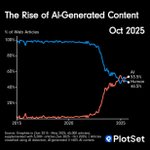
More had been written by AI in the last 3 years than all text ever written since the existence of text itself.


’ll be speaking at #LEAP26 in Riyadh this April.
Let’s explore how tech is moving Into New Worlds — and what’s next for our industry.
📅 13–16 April 2026
🎟️ app.ingo.me/q/8lbyr

2028 Global Intelligence Crisis Report by Citrin

🌎 Citrini Research just dropped a provocative thesis:
⚠ We’re heading toward a “2028 Global Intelligence Crisis.” ⚠
➡ The core idea?
AI is making intelligence abundant — and the global economy isn’t built for that.
Here’s the breakdown 👇
1/🧠 AI agents are removing friction everywhere.
*By 2026–27:
• Autonomous AI handles shopping, taxes, insurance, legal work
• Commerce shifts to automated optimization
• Industries built on complexity & information asymmetry collapse
2/💼 White-collar displacement accelerates.
AI replaces knowledge work → Displaced professionals move down the wage ladder → Labor supply rises → Wages compress across sectors.
*This spreads beyond tech.
3/🏢 SaaS & private credit are exposed.
Many leveraged software deals assumed perpetual growth.
But AI reduces demand for service-heavy SaaS.
*Results:
• Downgrades
• Defaults
• Risk repricing
4/🏠 Households weaken quietly.
Prime borrowers still pay mortgages…
But they’re tapping savings & credit.
Income compression → Spending slows → Debt-to-income rises.
5/ 🔁 A negative loop forms:
AI → layoffs → lower income → weaker demand → more automation → repeat.
At the same time:
Income stress → tighter credit → weaker wealth effect → slower economy.
6/ 🏛 Governments face structural strain.
Tax systems rely on labor income.
AI shifts income toward capital & compute.
Less payroll tax.
More pressure on safety nets.
⚠ The big idea:
For 200 years, human intelligence was scarce.
Now it isn’t. The report argues we’re entering a painful repricing as “intelligence premium” unwinds. Not necessarily collapse — but transition.
Agree or not, the thesis is clear:
AI isn’t just a tech cycle.
It’s a macroeconomic restructuring event.
Worth thinking about.
*Link: citriniresearch.com/p/2028gi…


Congrats to @OpenAI , Peter and OpenClaw. Expect to see big things come out of this.
Peter Steinberger is joining OpenAI to drive the next generation of personal agents. He is a genius with a lot of amazing ideas about the future of very smart agents interacting with each other to do very useful things for people. We expect this will quickly become core to our product offerings.
OpenClaw will live in a foundation as an open source project that OpenAI will continue to support. The future is going to be extremely multi-agent and it's important to us to support open source as part of that.
On my way to Qatar. 🇶🇦. I haven’t been there since I was a child. Last time I was there was Jan ‘94.


Tareq Fadel retweeted

Wild chart.
Since 10/22, the number of junior developers is in decline, while the number of mid and senior devs is growing.
I bet you can guess why.
Stats are from August 2025 research by Stanford.
Source: digitaleconomy.stanford.edu/…


Bye Bye Dubai. You will be missed. It was a blast at #GITEX. A tiring week but exhilarating.