

Deriv's engineers writing about applied AI, automation, and what we'd do differently.
Joined September 2026
- Tweets50
- Following2
- Followers228
- Likes17


Pinned Tweet
Meet Deriv One, our open-source enterprise AI platform for building agents, skills, automations, and internal apps—with built-in access control and sandboxing.
Bring your own models, run it on your infrastructure. ⚡️
Here’s how we built it.


Your vendor risk platform costs USD 100,000 a year.
It works, but nobody on your team can tune it.
That inflexibility used to slow down our security team.
We dropped the vendor and built an in-house platform to score 400+ suppliers daily.
Here is how we built Vendiant:
derivai.substack.com/p/vendi…


A number goes up. Everyone celebrates.
Then someone asks "Why?", and nobody knows.
That question used to cost our analysts their whole morning.
Here’s how we got it down to minutes:

BREAKING: Ram Altman has been spotted free-soloing the legendary 'Silicon Horn' to secure the last remaining cache of unallocated memory on Earth.
He stated in a blog post that once he reaches the top, AGI will finally have enough compute to process his latest funding proposals.

22
325
One process fails. The whole app goes down.
That was the risk of running everything on a single VM.
We moved to Kubernetes so a failing process wouldn’t take everything else with it.
Here’s how we made the move:

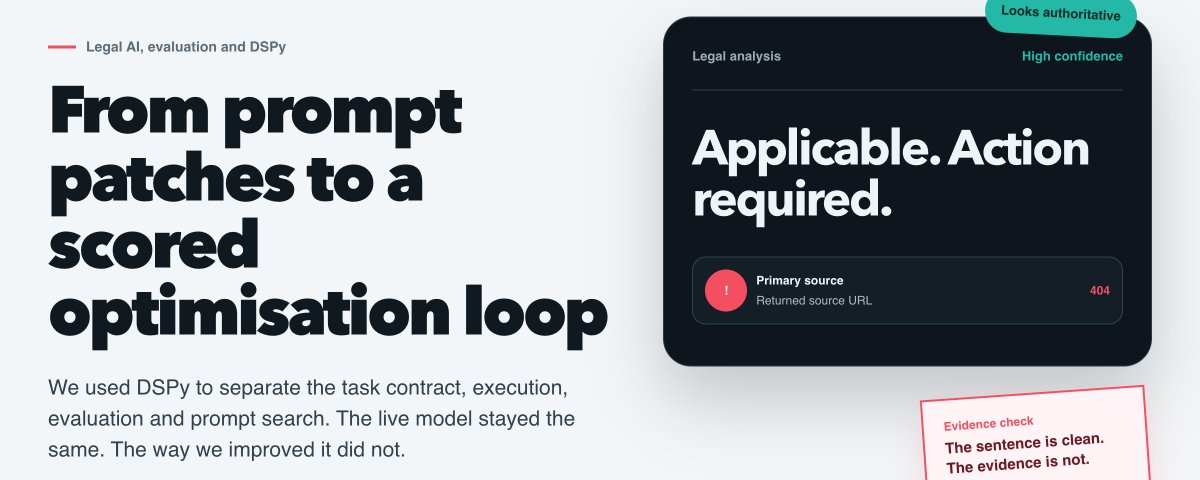
The worst legal AI failure isn't a crash.
It's a clean, confident answer that's wrong.
The usual fix? Tweak the prompt. Add a specific rule. Rerun a few examples. They die when the law, the country, or the model changes.
Here is how we do it:
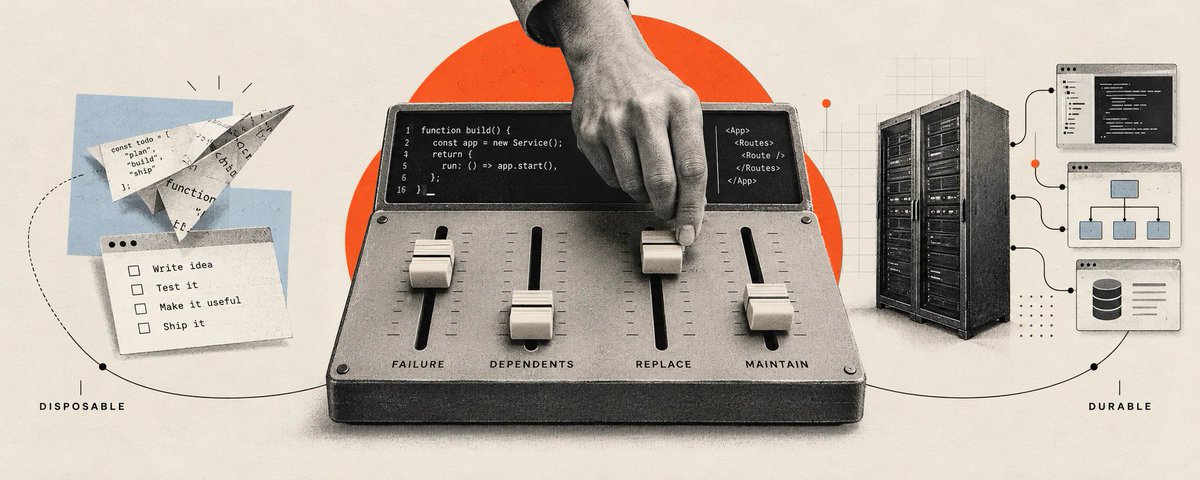
AI makes code cheap. It doesn’t make failure cheap.
A birthday tracker and a payments system need very different levels of rigor.
Four questions help you decide whether your software is disposable or durable:
"OpenClaw creator says he spent $10 million in tokens last month"
Steinberger's philosophy when it comes to token spend:
Patch, you must. Wait, you should not. 🟢
#php #vulnerability

PHP 8.5.12 released - 90 fixes in 29 components, including security fixes (CVE-2026-109618, CVE-2026-109619).
Changelog + downloads: php-net.pro/news/php-8-5-12-…

Muse wonder dropped the ball wonderfully when we compared with Opus 5.5 & Gemini 4 Argon. Same prompt.
@finkd Talk to your people, they need to step it up 🙃
6.1 Sol wasn’t even in the race, it got lost on the drive to the track.
Claude Opus 5.5: $1.5
Muse Wonder 1.0: $0.36
GPT-6.1 Sol: $0.18
Gemini 4 Argon: $0.24
Other Statistics:
Claude Opus 5.5: 9.3 mins, 2 turns
Muse Wonder 1.0: 1.5 mins, 2 turns
GPT-6.1 Sol: 4.8 mins, 15 turns
Gemini 4 Argon: 3.6 mins, 2 turns
Want to run the experiment yourself, here is the prompt we used:
"""
Build a single self-contained `index.html` in the current directory: a Flappy Bird-style game where a little Deriv token flaps through the gaps of a live candlestick trading chart, made with three.js.
Make it feel like a polished, playful game skin on top of a real Deriv trading terminal: dark chart background, crisp grid, the Deriv red brand colour (#FF444F) on the player and logo, green (#4BB4B3) and red (#EC3F3F) candles.
Requirements:
- One file only. Load three.js (and addons, if you need them) from `unpkg.com/[email protected]/` via an import map. No other external assets: no textures, models, sounds or fonts to download. Generate everything procedurally (system fonts only).
- Gameplay: classic flappy loop. Gravity pulls the player down, each flap gives an upward kick. The "pipes" are candlesticks: each obstacle is a pair of tall candles, one hanging from the top and one rising from the bottom, with wicks, and the player must fly through the gap between them. The gap follows a believable random-walk price path, so the course reads like a moving market. Passing a pair scores +1. The scroll speed rises slowly and the gaps tighten a little as the score climbs. Touching a candle body or wick, or the top/bottom of the chart, ends the run.
- Player: a glossy round Deriv token in #FF444F with a white lowercase "d" on its face. It tilts up when it flaps and noses down as it falls, squashes and stretches on each flap, and leaves a short glowing trail like a price line behind it.
- World: a dark trading chart that scrolls right to left, with a subtle grid, a price axis on the right whose labels tick as the chart moves, and a thin live price line tracking the player's height. Candles are crisp, slightly beveled 3D boxes with wicks. Their colour (green or red) comes from whether the price went up or down from the previous candle. A small **"deriv"** wordmark in the top-left corner in the brand red, plus a ticker such as "Volatility 100 Index" with a live-looking price. Tiny details count: soft bloom on the price line, a faint depth parallax of background candles, and a "+1" pop when a gap is cleared.
- Controls: Space, Arrow Up or W flaps (click or tap also flaps). Arrow keys and WASD both work. Show the controls in a small hint on screen.
- Starts instantly: gameplay is running on page load, or starts on the first click or key press. No menus, no "press start" screen that blocks play.
- Attract mode: if there is no input for 1.5 seconds, a simple built-in autopilot plays the game convincingly by flapping to stay centred in the next gap. Any input hands control back to the player immediately.
- Never stalls: on game over, show the score briefly (styled like a trade result, e.g. "Position closed: 7") and restart automatically within 1.5 seconds.
- A score/HUD that fits the style, plus juice: particles on each flap, a red flash and small screen shake on a crash, and a smooth camera.
- No pointer lock, no fullscreen requirement, no sound before the first user input.
- It should run smoothly at 60 fps on a laptop and must have no console errors.
Write the file and stop. Do not ask questions.
"""


Was at an event where someone asked how you know one model is better than another, aside from the benchmark numbers. The answer: "you can just tell based on vibes." Don't be that person 😀
Every time you change models or prompts, or ship something new, you're relying on your eval to tell you if things got better or
worse. If the eval is wrong, so is every call you made off it. Here's where evals go wrong, and how to fix them👇
The second problem is that public benchmarks go stale. In February, OpenAI stopped reporting SWE-bench Verified, a benchmark they built themselves.
Every model they checked had already seen some of the problems and solutions, and 59% of the hard tasks they audited had tests that rejected correct code. So the score was partly measuring what the model remembered.
1
1
52
So what actually works? Start with 20 to 50 real examples from your own traffic, including the failures, and what the expected output for each one.
Use code to check what you can, like schemas, numbers within a tolerance, and whether the right tools got called with the right arguments. For the subjective stuff you can use an LLM judge, but check it against examples a human has labelled first.
Run each case a few times so you catch the inconsistent behaviour, group the failures by category, fix the ones that keep coming up, and rerun the same tests after every change.
You want your eval to tell you exactly what broke, so you know what to fix.
30
Deriv Tech retweeted

The 20x developer everyone keeps talking about in an AI-enabled company is someone who did full stack work in the pre-AI world and is clearly technically strong. The biggest differentiator is the creative side: they approach problems without being boxed in by the usual standards. AI has made the gap between the best and everyone else much wider.
We're looking for that kind of talent at Deriv (@DerivDotTech), in Dubai and Malaysia. If that sounds like you, and you want to work with other devs like that on goals that sound ridiculously impossible, reach out.
