

Avid Reader | Data-Driven Research & Analysis | SEBI Unregistered | Let Data Speak Louder Than Words | Sharing insights freely for better investing.
india
Joined June 2018
- Tweets12K
- Following15
- Followers149K
- Likes9.7K







FDs vs Equity: Returns Matter, But Capital Protection Matters More!
Many self-proclaimed investment experts often dismiss Fixed Deposits (FDs), arguing that they fail to beat inflation, interest income is taxable, and wealth creation is possible only through equities or mutual funds. They conveniently highlight the potential of equity returns while overlooking the risks involved.
But investment decisions cannot be based on returns alone. They must also consider an individual's age, income, financial commitments, risk appetite and need for liquidity and capital protection.
For millions of small investors, senior citizens and retirees, FDs are not necessarily a poor investment choice. They offer predictable returns, relative stability and protection of principal, subject to the applicable deposit insurance limits and the financial strength of the institution. Many investors are also in lower tax brackets, making the tax impact different for each individual.
On the other hand, equity investments carry market risks. Even fundamentally strong, established companies with decades of track records can witness 40–50% corrections. Look at several leading FMCG companies over the past five years. Investors who entered at higher valuations have experienced substantial erosion in their portfolio value, despite investing in reputed businesses.
A 40–50% decline is not a small temporary inconvenience for someone who depends on that capital for retirement or regular expenses. Recovering from such losses requires much higher returns, and there is no guarantee of when that recovery will happen.
We must understand one fundamental difference:
➡️FDs are primarily meant for capital preservation, stability and predictable income.
➡️Equities are meant for long-term wealth creation, but come with volatility and the risk of capital loss.
➡️Mutual funds are investment vehicles, not guaranteed-return products. Their risk depends on the underlying assets.
There is no reason to glorify equity investments while treating FDs as financially foolish. Equally, there is no reason to avoid equities altogether.
A young investor with a regular income and a long investment horizon may be able to absorb market volatility. A senior citizen or retiree depending on accumulated savings may have entirely different priorities.
The biggest mistake is not investing in FDs or equities; it is investing without understanding the purpose and risk of each asset class.
A sensible portfolio is not about putting all your money into the asset class delivering the highest returns. It is about balancing growth, income, liquidity and capital protection.
Remember, earning returns is important, but protecting the capital you have spent a lifetime accumulating is equally important.
The objective of investing should not just be to become wealthy, but also to ensure that you don't lose your financial peace of mind in the process.
Mukesh Ambani's Group Stocks: A Reality Check for Investors!
A powerful business empire and a prominent businessman's reputation do not necessarily translate into wealth creation for shareholders.
Here is a comparative performance report of selected Mukesh Ambani group-associated listed stocks over the last 1 year, 2 years and 5 years, based on closing prices as of 30 October 2026.
30-10-2026

ALL-TIME HIGH BREAKOUT ALERT
10 Stocks Closed at Fresh Lifetime Highs Today! 🔥
💠Coforge
💠Laurus Labs
💠Ather Energy
💠Krishna Phoschem
💠Kotak Mahindra Bank
💠SMS Pharmaceuticals
💠Shree Pushkar Chemicals
💠Sona BLW Precision Forgings
💠Madhya Bharat Agro Products
💠Ratnaveer Precision Engineering
30-10-2026
The biggest financial trap in today's lifestyle is the growing obsession with living beyond one's means. People are increasingly financing their lifestyles through bank loans, credit cards and EMIs. Incomes are struggling to keep pace with rising expenses, yet the appetite for luxury, unnecessary purchases, expensive gadgets and social status continues to grow.
There was a time when people lived happily within their means. Modest incomes, limited needs, simple lifestyles and financial discipline brought peace of mind. Today, however, many are buying things they cannot afford, with money they have not earned, simply to maintain a lifestyle they cannot sustain.
The harsh reality is that people are increasingly working to pay EMIs rather than working to build wealth. Easy credit creates an illusion of affordability, but every EMI is a future obligation. Uncontrolled spending, borrowed lifestyles and the obsession with showing off can turn financial comfort into a never-ending debt trap.
Remember: A luxurious lifestyle does not necessarily mean a wealthy life. Real wealth is financial freedom, not a house full of things bought on loans.
In today’s rapidly changing world, where developments overnight can reshape global markets and events in one corner of the world can have far-reaching consequences everywhere, forecasting a stock’s long-term returns is becoming increasingly challenging. Perhaps it is time to rethink what we actually mean by “long term” in investing.
The definition of long-term investing itself may need to evolve with the changing times.
ALL-TIME HIGH BREAKOUT ALERT
8 Stocks Closed at Fresh Lifetime Highs Today! 🔥
💠SG Mart
💠SG Finserve
💠Laurus Labs
💠South Indian Bank
💠Krishna Phoschem
💠Acutaas Chemicals
💠Shree Pushkar Chemicals
💠Spectrum Electrical Industries
29-10-2026
Mumbai and many other Indian cities are turning into endless construction zones in the name of redevelopment.
Skyscrapers are rising, property prices are soaring, and the wealthy are buying more real estate. Meanwhile, existing residents are forced to endure dust, pollution, noise and endless inconvenience.
But who is planning for the future? Roads, traffic, water supply, sewage systems and clean air are already under pressure. What happens when these cities become even more crowded?
The government collects taxes, builders make profits, and a whole ecosystem of developers, architects and officials benefits.
But who is paying the real price? The common citizen.
Redevelopment without adequate infrastructure and environmental planning is not progress. A city is meant to be liveable, not just profitable.
Who will take responsibility for the quality of life of ordinary people?
Jio at $137 billion: India’s 2nd most valuable firm!
Look at the valuation hierarchy:
1. Reliance Industries — ₹15,67,745 Cr
2. Jio Platforms — ₹13,05,242 Cr
3. Bharti Airtel — ₹12,17,250 Cr
4. HDFC Bank — ₹10,58,188 Cr
5. ICICI Bank — ₹9,86,903 Cr
The big question: Jio Platforms is valued almost as highly as its parent, Reliance Industries, while its valuation also exceeds that of India’s biggest private-sector banks.
Ambani’s digital empire is commanding a staggering valuation. But the real test will be whether future growth and earnings justify these expectations.
In the stock market, a great business and a great investment are not always the same thing.
Info only. Not investment advice.
FMCG GIANTS: 5 YEARS OF WEALTH DESTRUCTION!
10 Nifty FMCG stocks with solid fundamentals and years of proven track records have delivered absolute negative returns over the past
2 years.
🔻Colgate Palmolive -48%
🔻ITC -46%
🔻United Breweries -38%
🔻Godrej Consumer Products -37%
🔻Dabur -35%
🔻Varun Beverages -33%
🔻HUL -30%
🔻Britannia -20%
🔻Godfrey Phillips -18%
🔻United Spirits -16%
28-10-2026
Info only. Not investment advice.
REAL ESTATE BOOM, BUT STOCK MARKET INVESTORS LOSE BIG!
India’s realty sector has been booming, yet investors in leading listed real estate stocks have suffered heavy losses over the past 2 years.
🔻Aditya Birla Real Estate -62%
🔻Godrej Properties -47%
🔻Brigade Enterprises -38%
🔻Anant Raj -31%
🔻Sobha -25%
🔻DLF -19%
🔻Oberoi Realty -19%
🔻Prestige Estate Projects -16%
🔻Lodha Developers -9%
🟢 The lone standout:
⬆️ Phoenix Mills: +30%
A booming industry doesn’t guarantee booming stock returns. Even when business activity is strong, valuations, expectations and the price you pay can make all the difference.
Info only. Not investment advice.
26-10-2026
ALL-TIME HIGH BREAKOUT ALERT
2 Stocks Closed at Fresh Lifetime Highs Today! 🔥
💠Laurus Labs
💠Sona BLW Precision Forgings
28-10-2026
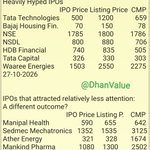
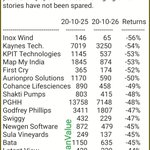
IPO HYPE vs REALITY: The Price Investors Paid for Popularity
Do heavily hyped IPOs really create wealth, or do they sometimes leave investors holding expensive stocks?
India's IPO market has repeatedly demonstrated one important lesson: enormous publicity, strong subscription numbers and spectacular listing-day premiums do not guarantee sustained wealth creation.
Many investors get attracted to IPOs because of brand names, market excitement, grey-market premiums (GMPs), oversubscription figures and the fear of missing out (FOMO). But once the initial excitement fades, the stock market starts judging businesses on valuations, earnings growth, execution and future prospects.
The biggest mistake IPO investors make
Many investors focus on three things:
How many times an IPO has been subscribed.
What premium the stock commands in the grey market.
How much the stock gains on listing day.
But these factors do not establish whether the IPO is attractively valued.
A popular company can be an expensive investment. An ordinary-looking listing can turn into a wealth creator if the business grows consistently and the original valuation leaves room for appreciation.
The more important questions are:
Is the business model strong and sustainable?
Are earnings and cash flows likely to grow?
Is the management capable and trustworthy?
Is the IPO valuation reasonable compared with future prospects?
How much growth is already priced into the share?
Investors who ignore these questions and chase excitement may end up buying at prices that leave little margin for error.
Therefore, IPO investors should distinguish between returns earned by allotment holders and returns earned by investors who purchase shares after listing.
What does this comparison really teach us?
The objective is not to label all hyped IPOs as bad investments or all less-publicised IPOs as good ones.
These are selected examples, not a complete statistical study of the IPO market. Subscription levels, holding periods, business models and market conditions differ, so the comparison does not establish that less-hyped IPOs consistently outperform.
Nevertheless, it reinforces a valuable investing principle:
Popularity attracts attention. Valuation determines the price you pay. Business performance ultimately determines whether that price proves rewarding.
The smartest IPO investor is not necessarily the one who receives an allotment in the most popular issue. It is the one who understands what the business is worth and refuses to confuse market excitement with investment value.
Final takeaway: Do not invest merely because everyone is applying. Do not reject an IPO merely because listing gains are modest. Study the business, assess the valuation and make your own decision.

13 STOCKS BREAK BELOW THEIR PREVIOUS 52-WEEK LOWS!
🔻Indosolar
🔻HDFC Bank
🔻Dalmia Bharat
🔻Welcast Steels
🔻VST Industries
🔻Mazagon Dock
🔻Waaree Energies
🔻Bayer CropScience
🔻ICICI Life Insurance
🔻Sumitomo Chemicals
🔻Shree Digvijay Cement
🔻Bannari Amman Sugar
🔻M&M Financial Services
27-10-2026
ALL-TIME HIGH BREAKOUT ALERT
3 Stocks Closed at Fresh Lifetime Highs Today! 🔥
💠Laurus Labs
💠Acutaas Chemicals
💠Sona BLW Precision Forgings
27-10-2026
The market is often hardest to understand at the peak of pessimism. Just when fear is at its extreme, markets may begin to outperform as investors start believing that the worst is behind them. While most investors remain fearful, experienced investors look for fundamentally strong, tailwind-driven stocks available at attractive valuations. That is where opportunity often emerges—but timing the turnaround is never easy.
Pankaj Parekh retweeted
𝗠𝗮𝗻𝗸𝗶𝗻𝗱 𝗣𝗵𝗮𝗿𝗺𝗮 :
𝗧𝗮𝗸𝗶𝗻𝗴 𝗮 𝗖𝗼𝗻𝘁𝗿𝗮𝗿𝗶𝗮𝗻 𝗥𝗼𝘂𝘁𝗲 𝗶𝗻 𝘁𝗵𝗲 𝗚𝗟𝗣-𝟭 𝗥𝗮𝗰𝗲
While most pharma companies are rushing aggressively into the GLP-1 / Semaglutide opportunity after patent expiry, Mankind Pharma is choosing a different path.
Management clearly stated that the current GLP-1 market in India is witnessing a “mad rush” with dozens of brands entering the segment and intense price competition already bringing prices down sharply.
Instead of participating in an early price war, Mankind has adopted a disciplined and contrarian strategy.
🔹 Launched its Semaglutide brand “Semaglu” in pre-filled pen format
🔹 Avoiding aggressive price cuts and not rushing into vial launches
🔹 Waiting for the current frenzy and overcrowding to settle
🔹 Focusing on long-term profitability rather than short-term market share
Management believes only a few serious players will survive in this segment because success depends not only on pricing but also on:
• Product efficacy
• Cold-chain logistics
• Doctor recall and trust
• Complete obesity-care ecosystem
Interestingly, Mankind is also building adjacent therapies like proteins, nutrients and vitamins, believing obesity management will eventually become a complete-care business rather than just a single drug opportunity.
𝗥𝗼𝘂𝘁𝗲 𝗶𝗻 𝘁𝗵𝗲 𝗚𝗟𝗣-𝟭 𝗥𝗮𝗰𝗲
While most pharma companies are rushing aggressively into the GLP-1 / Semaglutide opportunity after patent expiry, Mankind Pharma is choosing a different path.
Management clearly stated that the current GLP-1 market in India is witnessing a “mad rush” with dozens of brands entering the segment and intense price competition already bringing prices down sharply.
Instead of participating in an early price war, Mankind has adopted a disciplined and contrarian strategy:
🔹 Launched its Semaglutide brand “Semaglu” in pre-filled pen format
🔹 Avoiding aggressive price cuts and not rushing into vial launches
🔹 Waiting for the current frenzy and overcrowding to settle
🔹 Focusing on long-term profitability rather than short-term market share
Management believes only a few serious players will survive in this segment because success depends not only on pricing but also on:
• Product efficacy
• Cold-chain logistics
• Doctor recall and trust
• Complete obesity-care ecosystem
Interestingly, Mankind is also building adjacent therapies like proteins, nutrients and vitamins, believing obesity management will eventually become a complete-care business rather than just a single drug opportunity.
𝗚𝗟𝗣-𝟭 𝗠𝗮𝗿𝗸𝗲𝘁 𝗢𝗽𝗽𝗼𝗿𝘁𝘂𝗻𝗶𝘁𝘆: Current Indian semaglutide injectable market is estimated around ₹90 Cr, but industry estimates suggest it could potentially scale to ₹1,500 Cr over the next 12–18 months.
𝗤𝟰 𝗙𝗬𝟮𝟲 𝗛𝗶𝗴𝗵𝗹𝗶𝗴𝗵𝘁𝘀:
✔ Revenue up 11.8% YoY to ₹3,443 Cr
✔ Net Profit up 30.4% YoY to ₹559 Cr
✔ FY26 Revenue grew 17% to ₹14,278 Cr
✔ Chronic business showing steady momentum
✔ Super specialty business expected to grow in high teens
✔ EBITDA margin guidance maintained at 25.5%–26.5%
The company is also reducing debt steadily after the BSV acquisition while investing ₹500 Cr in a biotech facility in Vadodara.
Mankind Pharma’s approach clearly indicates that management is prioritizing sustainable profitability, execution quality and long-term positioning over short-term excitement in one of the hottest pharma themes currently.
Disclaimer: Info only.
A Fresh Warning Signal for Investors!
The following stocks have closed below their previous 52-week lows, signalling fresh breakdowns, intensifying selling pressure, and a further deterioration in market sentiment.
🔻Atul
🔻JK Tyre
🔻Cholamandalam Financial Holdings
🔻Sumitomo Chemical
🔻Railtel Corporation
🔻Tata Consumer Products
🔻Sundaram Finance
🔻Linde India
🔻United Breweries
🔻Bank of India
🔻NSDL
🔻UTI AMC
🔻EID Parry
🔻KSB
🔻ICICI Life Insurance
🔻Afcons Infrastructure
🔻CreditAccess Grameen
🔻ZEEL
🔻Sammaan Capital
🔻KSolves
🔻Shakti Pumps
🔻Nesco
🔻J Kumar Infra
🔻Ahluwalia Contracts
🔻Fiem Industries
🔻SBFC Finance
🔻Maithan Alloys
🔻Panasonic Carbon
🔻India Pesticides
🔻GM Breweries
🔻Lotus Chocolate
🔻Sula Vineyards
🔻Welcast Steels
🔻Vinati Organics
🔻Aurionpro Solutions
🔻VLS Finance
🔻Symphony
🔻Bajaj Steel
🔻BASF
🔻Metro Brands
🔻Sharda Cropchem
🔻Bharat Rasayan
27-10-2026
The middle class has been paying the price of 12 years of frozen tax-saving limits, rising costs and shrinking incentives to save.
Calling ₹12 lakh tax-free a gift ignores how inflation has silently eroded their benefits.
“Hazam humne nahi kiya, Hazam toh inflation ne kiya!”
#MiddleClass #Taxation
FMCG: THE DEFENSIVE SECTOR IS UNDER PRESSURE!
The Nifty FMCG Index hits a fresh 52-week low at 42,800.75.
13 FMCG stocks have delivered negative returns over the past year. Even so-called defensive stocks have failed to protect investors' wealth.
🔻 Godfrey Phillips: -46.7%
🔻 Patanjali Foods: -40.2%
🔻 United Breweries: -37.9%
🔻 ITC: -37.5%
🔻 Dabur: -29.3%
🔻 Colgate-Palmolive: -27.9%
🔻 HUL: -27.7%
🔻 Godrej Con. Products: -26.3%
🔻 Britannia Industries: -24.3%
🔻 Tata Consumer Products: -19.9%
🔻 Varun Beverages: -11.6%
🔻 United Spirits: -8.7%
🔻 Nestlé India: -8.5%
The reality check: No sector is immune to a prolonged downturn. Strong brands and a defensive label cannot guarantee positive stock returns.
📉 In the stock market, reputation is not protection, and past performance is no guarantee of future returns.
27 October 2026
Info only. Not investment advice.