

I advise and write from inside the intelligence transition. When capability is abundant, standing gets scarce. https://teapawt.org/t.co/m9kfJiM0XB
Arizona, USA
Joined April 2025
- Tweets5K
- Following3.8K
- Followers2.6K
- Likes8.3K







Pinned Tweet
Came back to my X account after 10 years.
It was Twitter back then. Now it’s X. The algorithm, the community, everything has changed.
Looking to connect with people in tech, developers, AI, product, startups, anyone building or learning.
If you have good tech accounts to recommend or just want to say hi, reply below.
Starting again.
This will annoy some people.
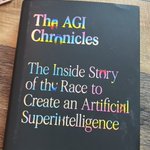
The Eureka Machine doesn’t care about your AI workflow. It cares about whether you still have any judgment left that isn’t rented.
I closed the book this morning.
So answer this without the usual caveats:
Are you still the author of your work, or have you become the editor?
The people who will struggle most with AI aren’t the ones who refuse to use it.
They’re the ones who use it so much they forget how to think without it.
If AI disappeared tomorrow, how much of your current thinking would still hold up?
Doug Standley retweeted

This week on Complex Systems: walking through the Anthropic S-1 (pre-IPO filing) with @TheZvi
complexsystemspodcast.com/ep…

In the age of AI-generated content, reading difficult books is becoming a competitive advantage.
While most people consume summaries and threads, a few still sit with hard ideas.
Be honest:
Are you still reading full books, or mostly summaries and threads now?
If you read deeply, reply with the last book that genuinely changed how you think.
I’ll share mine in the replies.
This morning, finished @RichardSocher The Eureka Machine.
I will post my 5 Star review later.
Doug Standley retweeted

Victoria Mapplebeck’s MOTHERBOARD #controversial #raw #motherhood #rollercoaster #adolescence #breastcancer #unromanticised #unfiltered #unforgettable #womeninfilm #microbudget #nuascannan

The main idea is strong: AI agents are making it possible for a much smaller team, even one person, to handle the full iOS app lifecycle.
I'd keep the practical, step-by-step structure. The original has a lot of useful detail, so I wouldn't flatten it into generic commentary.

Apple just put Xcode inside Claude Code.
It's an official Apple plugin, now in Claude Code's plugin directory:
• Build, run and test your app
• Render SwiftUI previews
• Drive simulators and real iPhones
• Read build logs and errors
• Search Apple's developer docs
Claude can now build your iPhone app, see what it looks like, and fix it without you opening Xcode.
Install in Claude Code:
/plugin install xcode@claude-plugins-official
Needs the latest Xcode on your Mac.
Organizing Intelligence
Who among you will make time to read it?

New paper with Alex Imas (@alexolegimas) and Shane Legg (@ShaneLegg). We build a model of how intelligence is organized into firms, who wins and loses, and when the economy will be transformed: arxiv.org/pdf/2611.05417
Blog post: institute.deepmind.com/essay…

Everyone says AI will replace jobs.
But be real:
Is AI replacing your thinking, or just your tasks?
Which one is it for you?
It
“Nothing in life is to be feared, it is only to be understood. Now is the time to understand more, so that we may fear less.”
— Marie Curie
How useful is X actually for your work?
Is the biggest advantage networking, learning, clients, or something else?
Doug Standley retweeted

I want to risk hitting my head on the ceiling of my talent. I want to really test it out and say, 'Okay, you're not that good. You just reached the level here.' I don't ever want to fail, but I want to risk failure every time out of the gate.
— Quentin Tarantino

99% accuracy sounds impressive until the system makes the 1% mistake that costs you everything.
Capability gets attention.
Reliability earns adoption.
Trust determines whether people let the system handle important work.
I think we're still underestimating how much of the AI race will be decided by trust, permissions, and accountability.
Doug Standley retweeted

I'm Sam, one of Anthropic's co-founders, and I lead much of our safety work. I'm going to have more to share on that work over the coming months.
I thought I'd start by sharing a few thoughts on the latest report from @METR_Evals.
The speed of progress in model capabilities is one of the most important questions in AI safety, and METR’s work here provides the public with an independent, external view into how this is happening inside Anthropic. I’ll talk more about some of the details below, but first some context for those new to this work.
How quickly AI progress is accelerating has many important safety implications, since it determines how quickly the risks from advanced models increase. But, because most research happens within the frontier labs, it’s difficult for external observers and policy makers to get a strong sense of what that rate is. We kicked off the process with METR that led to this report earlier in the year, in anticipation of progress continuing to accelerate.
For this report, we gave METR access to a range of sensitive internal data, including benchmark scores for unreleased models, estimates of how models are progressing, and interviews with our researchers. They had complete independence to form their own conclusions.
Many of their conclusions match my own. AI is speeding up our research, but it’s hard to say exactly how much. While they conclude AI can't yet make the most important contributions to model training on its own, they think the pace of development could, by default, accelerate further.
This work began well before and is separate from the embedded third-party evaluators that are part of our commitment to pacing the frontier, but it’s a good illustration of why we think evaluators are a good idea. The more access reviewers have, the clearer a picture they can form of the situation and the better-positioned they are to highlight situations like this one.
We redacted a lot, and I accept that this makes it harder for others to check METR’s work. But we determined that sharing exactly what is driving the speedup isn’t the right thing to do, both because it’s commercially sensitive and because it risks handing out a roadmap for others to go faster. That would make the risks METR is worried about worse. That’s a tradeoff. I think we made the right call, though we’re continuing to assess the pros and cons here.
In the coming weeks, we plan to share a report with our own analysis of the speed of AI progress within Anthropic, including where we stand against our Responsible Scaling Policy, plus new steps we’re taking to strengthen our safety and security practices as AI keeps improving quickly.

It's been a while, but I just received @thinkwithmark, a reimagining of a bookmark, scan, and voice memo in a mobile app— all in one super thoughtful design. It looks amazing.
Congratulations to the founding team!
I'm Doug Standley, based in Arizona, USA.
I believe some of the most interesting conversations begin when people with different backgrounds and experiences come together.
I'd enjoy connecting with people interested in:
▪ AI and the future of intelligence
▪ Technology and innovation
▪ Entrepreneurship and leadership
▪ Human potential, identity, and agency
▪ Philosophy, research, and new ideas
▪ The future of work and society
I'm always open to thoughtful conversations and fresh perspectives.
Where are you joining from? What do you do, and what topics are you most passionate about?
As we approach 2027, which professions do you think AI has yet to significantly impact?
Is there still any field where human expertise remains largely untouched by AI? I'd love to hear your perspective.
Signal!
From inside the enterprise #AI dilemma.

A CFO told our team: "At any point in time, we have 20 of those ideas that we just can't execute as a company."
A head of innovation at another firm said it differently: "I can't even tell you how many different use cases and opportunities there exist." They have about two weeks to rank them with the board, and a lot of their performance rides on what gets saved.
Neither of them needs more ideas. A list of 20 doesn't move anything, and there is no sexy menu that fits your business. You have to cut your own list down, and four questions will do it:
1. Would a customer notice? Start where the customer experience gets better. I'd pick that over internal efficiency almost every time.
2. Will somebody in the business put their name on one number? If nobody will, it comes off.
3. Can you run it as a one-month pilot? If it needs a new data platform first, it comes off for now.
4. What happens when it's wrong? Start where a person can catch the mistake before it reaches money, a patient or a customer.
You'll end up with two or three. Pick one, get it live, and watch how it changes the process before you touch the next. The first one also leaves you the scaffolding for the others.
The most important thing is to move the ship forward, and one workflow in production does that.