

evidence-based longevity. cofounder @Span_health (acquired by Eight Sleep). oncology specialist registrar. MD, MSc, MRCP
Joined April 2020
- Tweets5.2K
- Following2.3K
- Followers42.3K
- Likes16K
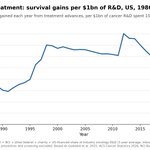


The returns on cancer research are stagnating. Years of life gained per research dollar dropped by about a fifth in the most recent period in the US, and by more than a quarter in the UK.
Treatment was not where most of the progress came from. In the five biggest cancers, about 80% of the lives saved came from tobacco control and screening.
The cheapest years of life came from publicly funded clinical trials (about $125–330 each), prevention research (about $600) and screening research (about $1,200)
Treatment research overall cost about $4,000 per year of life

Heart disease is the #1 killer worldwide. With the right tools it is mostly preventable. Yet, it seems so complicated
Absolutely love what Patrick and team have built at @HalePrevention

Today, we’re officially launching @HalePrevention with a film called “Grow Old With Them”.
You won’t see us founders in it. We wanted you to meet one of our customers, and hear his story in his own words.
It captures why we built Hale better than any founder introduction could.
Everyone’s sleeping on urolithin a
The actual next creatine. Lots of money to be made in it (i dont make anything on it myself)

Glycine will likely be the "next creatine"
Although glycine imho is way more effective
And all my favorite peptides have glycine residues
"Either glycine or DT-109-treatment provides an athero-protective effect evidenced by reduced atherosclerosis in the whole aorta and aortic sinus concomitant with reduced superoxide formation. DT-109 activity was superior compared to that of glycine."
Exactly. Why do younger people heal faster/bounce back from insults quicker?
This is the true measure of “biological age” that we dont have yet
The are no interventions that can help with this other than exercise atm
The biggest bottleneck for aging data is time itself. Ultimately, we need to measure how every organ changes over a lifetime to truly understand how we age

Human brain organoids record the passage of time over multiple years
nature.com/articles/s41586-0…

This is a good example of the limitation of biowearable data for actionable insights
I hear variations of this this all the time. Doctors dont look at my data or dont have the time to go through my data
In reality its mostly because the data from wearable are just not that useful outside of personal accountability and gamification of habits

Fascinating model of how hair grows
Outer layer of hair mechanically pulls the hair upward, triggering the root to produce more cells - making the hair grow longer
I wonder what an aging model of this would look like. How does this mechanism change with aging


Growth and movement of cells in a human hair follicle. From this paper:
Mapping cell dynamics in human ex vivo hair follicles suggests pulling mechanism of hair growth nature.com/articles/s41467-0…
Adam Bataineh MD retweeted

longevity clinic in europe: illegal soon


longevity clinic in america: minimalist waiting room, $1,200/month subscription, 47 page protocol, a nutritionist named Sage explains your "cellular wellness journey," biological age comes back the same as last quarter
longevity clinic in an unmarked building in Shenzhen: guy named Wei doesn't smile once, hands you a vial, says "come back in 6 weeks," charges you $80, biological age actually drops by 4years wtf
If you’re not getting enough protein its even more important to workout. Definitely worthwhile

Adam Bataineh MD retweeted

No, we're not on the brink of ending aging. More clickbait, even from prestigious scientific magazines that should know better.
Why not? A short 🧵
1) The strongest lifespan-extending intervention in mice is caloric restriction, discovered nearly a century ago. So even in animals we haven't truly made much progress on how to slow (much less reverse) aging.
2) Our understanding of the aging process and its cellular and molecular drivers is still poor - which helps explain 1).
3) There is no proven intervention that retards human aging itself.
Cellular reprogramming is an exciting technology with many companies* and labs now working on it. It may have important clinical applications, including the current clinical trial for glaucoma - fingers crossed!
But while reprogramming allows cells to be rejuvenated in vitro, we don't yet understand whether or how it can be used safely and effectively in whole organisms.
And rejuvenating cells isn't the same as rejuvenating an organism. Remember that an immortal cell is a cancer cell, so rejuvenating a cell may or may not be beneficial in an organism made of many different types of cells. We know from mouse experiments that reprogramming can induce cancer, so it needs to be carefully controlled and tailored to the tissue and context.
*Disclosure: I'm CSO of YouthBio, a company developing rejuvenation gene therapies based on cellular reprogramming.
Are We on the Brink of Ending Aging?
nationalgeographic.com/healt…

Updated my supplements based on this study for maximum muscle longevity
Urolithin A 500mg targeting mitophagy+clearing failed mitochondria (mitopore sofgel)
Creatine 5g for phosphocreatine buffer
NAD precursor when not training much (NR 1g) - not as important if training well because this boosts NAD without need for precursors

Most exercise and aging studies can't answer a basic question: is muscle deterioration from aging itself, or just from decades of moving less? A new Nature Aging study solved this by recruiting older adults who moved as much as people in their twenties.
The researchers from Amsterdam UMC and Maastricht University recruited four distinct groups: young adults in their twenties, older adults whose daily step counts and high-intensity activity matched the young group, older adults who had trained consistently for years (three structured hour-long sessions per week for over a year), and older adults with early physical impairment.
They took muscle biopsies before and after a one-hour cycling session, then measured over 24,000 gene transcripts, 135 metabolites, and 1,383 lipid species.
By matching activity levels between young and older groups, any molecular differences couldn't be blamed on the older adults simply moving less. This isolated aging from inactivity for the first time at this molecular depth.
Key findings:
• The defining molecular signature of muscle aging is an energy crisis. Comparing young adults to activity-matched older adults, 1,106 genes were downregulated with age. These genes build the mitochondrial machinery that produces cellular energy: ATP synthase, cytochrome c oxidase, and NADH dehydrogenase subunits. Mitochondria are the power plants of cells, converting nutrients into ATP, the energy currency cells use to function. When these genes decline, cells lose their ability to generate energy efficiently.
• NAD+ levels declined and triglycerides accumulated inside aging muscle. NAD+ is a molecule required for energy production and cellular repair. Lower NAD+ means less capacity to convert fuel into usable energy. Triglycerides are stored fats, their accumulation inside muscle indicates unburned fuel piling up as the tissue loses its ability to process it.
• More than half the molecular signature of muscle aging was absent in trained older adults. Specifically, 57.1% of age-related gene downregulation and 55.9% of upregulation were missing in the trained group. Their muscle resembled young adults far more than their chronological age would predict.
• The changes training preserved were specifically the energy metabolism ones. Genes like NDUFS1 and COX5A, which were depleted in normally active and impaired older adults, sat at youthful levels in the trained group across all five mitochondrial respiratory complexes. The single most prominent feature of muscle aging turned out to be the single most preventable.
• Being generally active was not enough. Structured training was the difference. The normally active older adults walked as much as young adults, and their energy metabolism genes declined anyway. What preserved the youthful molecular profile was structured, sustained training. Filling a step counter and being genuinely trained are not equivalent at the molecular level.
• Roughly half of muscle aging persisted regardless of training. Changes in genes controlling synaptic transmission (how nerves communicate with muscle) and WNT signaling (a pathway regulating tissue maintenance and stem cell function) appeared in all older adults, trained or not. This unavoidable half is where drugs will have to work.
• The fittest muscle mounted the largest inflammatory response to exercise. All groups activated stress and immune genes after exercise, including IL6, IL1B, and TNF. But the magnitude scaled with fitness. Trained older adults most closely resembled young adults in their response, followed by normally active, with impaired older adults showing the most blunted response. The stress response to exercise appears to be the mechanism of adaptation, not damage to be minimized.
This raises a concern about anti-inflammatory longevity strategies. If the inflammatory stress response is how exercise produces its benefits, chronically suppressing inflammation may blunt the adaptation that exercise depends on. It doesn't mean inflammation is beneficial in general, but the timing and context matter.
A separate discovery: the proteasome appears to regulate NAD+. The proteasome is the cellular machinery that breaks down damaged proteins. When researchers inhibited it, NAD+ levels rose in both muscle and liver cells to a degree comparable to NAD+ precursor supplements. This opens a new route to understanding NAD+ decline that operates through protein turnover rather than just supplying more raw material.
The study draws a clear line between what lifestyle can address and what will require therapeutics. The energy metabolism decline, mitochondrial deterioration, and NAD+ depletion that define muscle aging are largely preventable through structured training. The synaptic and signaling changes that persist in all older adults represent the unavoidable half where drugs will need to work.
The decisions made about structured training in midlife determine which molecular trajectory muscle follows in later decades. Half of muscle aging is optional. The other half isn't. Knowing which changes belong to each category is knowing where behavior ends and biology takes over.

Progressive muscle relaxation also works well

Andrew Huberman shares a simple, science-backed trick to fall asleep faster when your mind races or you can't stop noticing your body position:
Close your eyes and do slow, deliberate eye movements to shut down proprioception (body awareness) and signal your brain it's time to transition into sleep.
Try this tonight (takes ~1–2 minutes):
- Slowly move eyes left → right (a few times)
- Then counterclockwise circle → clockwise circle
Look up → down
- Gently attempt to look toward the bridge of your nose (faux cross-eyed)
- Finish with a long exhale to slow heart rate
Why it works: Eye movements coordinate with your vestibular system & cerebellum to mimic the natural forgetting of body position that happens at sleep onset (similar to slow rocking or boat motion calming the brain). It gives your racing mind something active to focus on instead of "just relax."
Huberman: "Many people find it helps them fall asleep quickly—it's not kooky; it's physiology."
No apps, no gadgets—just your eyes. Game-changer for insomniacs or restless nights. Try it & report back.
Big standout from this world cup is how much older players are dominating
I remember when 32 meant you get subbed at half time
Some interesting research on this. Main factors for player longevity seem to be:
- better adaptation of exercise regime with age to be more focused on injury prevention (balance, core strength, flexibility, functional movement)
- early detection of physical stress and early intervention before frank injury
- maximizing cardiovascular capacity building
- recovery methods
- ?better PEDs (is the the world cup the real enhanced games?)
What a beautiful paper
Read the whole thing. It reads like a novel
Great example of human creativity + ai in early drug discovery


HUGE breakthrough out today, in arguably the single most neglected aspect of aging, extracellular matrix damage. Top researchers have tried & failed for decades to do this. Massive kudos to Aaron and his team! (Proud to note that Revel is a SENS spinout.) revelpharmaceuticals.com/new…

The gym bro PPL split still undefeated

Most people have no idea how long it actually takes to build muscle after a workout. The biology runs on a much slower clock than many realize.
A single resistance session raises muscle protein synthesis fast, and synthesis is the process that lays down new contractile protein. MacDougall measured it directly: it climbed about 50 percent by 4 hours after exercise and peaked near 109 percent above baseline at 24 hours. Phillips found the same arc, still elevated at 48 hours before returning to rest. The response is large, it is brief, and within 36 to 48 hours the muscle is back to baseline. That is one full cycle from a single workout.
Damas and colleagues tracked untrained men through ten weeks and measured synthesis and muscle damage at the same time points. In week one the synthesis response was highest, but so was muscle damage, the structural disruption that unaccustomed training causes. Early synthesis was being spent repairing that damage rather than adding new tissue, and the magnitude of the early response did not predict who gained the most muscle later.
By around week three the damage response had attenuated, and by week ten, with damage minimal, synthesis finally correlated with actual hypertrophy. The same group showed that the apparent size increase in the first few sessions is largely swelling and edema, not growth. Durable muscle is built over months, not hours.
What you measure should follow that timeline. The acute spike is necessary but not sufficient, so a supplement or technique that raises synthesis acutely has not demonstrated it builds muscle. Judge a program or a product by the trend across two to three months, not by how the session felt or what the scale did the next morning. The first weeks of scale weight overstate real tissue because some of it is water, so do not over-read it when it moves. The synthesis response is the fast part. Adding muscle is the slow part, and it only shows up with consistency.
References:
MacDougall et al., Canadian Journal of Applied Physiology, 1995
Phillips et al., American Journal of Physiology, 1997
Damas et al., Journal of Physiology, 2016
Damas et al., European Journal of Applied Physiology, 2018

Tech founders: here’s a useful new technology we spent our own money and time on. It’s still new and will need improvement. If it doesn’t work we lose our money
Doctors: this doesn’t look like the technology i use every day (and have no idea how it actually works). Also, how dare you make a nice launch video?


I keep hearing that benign incidental findings cause so much anxiety they’re not worth it
This is often from people who are otherwise evidence-based
Turns out if you want to follow the evidence.. it’s just not true!
and may even be the opposite!


Whole body scans in asymptomatic people won't save lives overall. They will mostly find benign incidentalomas that cause anxiety for otherwise healthy people. Many of us have benign growths that mimic cancer but are harmless. These will be discovered leading to unnecessary panic and additional testing that causes harm.
If you want to live a long healthy life, skip the scan and instead go the gym and eat a salad.