






June M retweeted

We didn't know about the role of alternative RNA splicing for response to cancer immunotherapy. Discovery of STAT2 introns that influence non-small cell lung cancer response and survival (PSI=percent spliced in) @ScienceMagazine
science.org/doi/10.1126/scie…

June M retweeted
How a poor diet affects adverse effects to cancer immunotherapy via T reg cell fragility and promoting inflammation
Deconvoluting what can be fatal reactions to ICI via the experimental model
@CellCellPress
cell.com/cell/fulltext/S0092…

June M retweeted

Congratulations and welcome to the 100 new members elected today to the National Academy of Medicine's class of 2026!
Read the full announcement: nam.edu/classof2026
#NAMmtg #NAMedicine

Congratulations, Dr Shilatifard @ShilatifardLab Very proud of you and the accomplishments that you have had to date. A well deserved honour! @DrJuneJD

Deeply honored to be elected to the National Academy of Medicine and grateful for all of the kind notes I have been getting from colleagues! news.feinberg.northwestern.e… This recognition belongs to the extraordinary people who made this journey possible—my laboratory members, past and present, my colleagues at Northwestern, National Cancer Institute for funding my work for the past thirty-plus years, the visionary philanthropists who believed in our science, and my wife and our four children, whose love, patience, and unwavering support have made everything possible. Science is a team endeavor, and I feel enormously fortunate and grateful. I truly am one of the luckiest people alive. @NU_BMG_SQE @NUFeinbergMed @NorthwesternMed @theNASciences @theNAMedicine @NIH @theNCI

June M retweeted

#ScienceSaturday
🧬 What if we could help the immune system’s cancer-fighting T cells regain their ability to attack tumors, even after they become exhausted?
🔬 New research published in Nature identifies a potential way to do just that. Scientists found that targeting a protein called ZMYND8 can restore signaling pathways that help CD8+ T cells maintain their cancer-killing abilities, rather than progressing toward a more dysfunctional state.
🛡️ Why does this matter? T-cell exhaustion is a major challenge in cancer #immunotherapy. When T cells are exposed to persistent signals from cancer cells, they can gradually lose their ability to mount an effective attack. Researchers found that removing ZMYND8’s inhibitory influence strengthened IL-2 signaling, which helps support T-cell activity and function.
💡 The findings are especially promising because targeting ZMYND8 enhanced antitumor activity in preclinical models, particularly when combined with IL-2 therapy or immune checkpoint blockade. The researchers also observed improvements in human T cells in laboratory studies, offering insight into the potential relevance of this approach.
🚀 Although more research is needed before this strategy can be translated into patient care, the study offers a new avenue for investigating how we might strengthen the immune system’s response to #cancer.
📖 Read the full study in Nature:
nature.com/articles/s41586-0…
@hongbo_chi @StJudeResearch @StJude

June M retweeted

New clinical insights from the #ASCOQLTY26 rapid oral session! 💡 Presenters are revealing how AI scribes support clinics, why screening adherence matters, and how tailored tools improve life post-treatment. Session: bit.ly/4rTeJOI

Important findings that warrant policy changes. @DrJuneJD

Trends in Insurance Coverage and Stage at Cancer Diagnosis Among Disaggregated Asian American and Native Hawaiian/Pacific Islanders
Excited to present this work with the @AmericanCancer today at the ASCO Quality Care Symposium. Come find us at Poster Board F2 (Abstract 204) in Hall D (Level 2): Poster Session B runs 7:20–8:20 AM EDT, and we're back for the continued session with lunch from 11:40 AM to 1:00 PM EDT.
We looked at 20 years of National Cancer Database data (6.65 million adults under 65 with cancer) to ask a simple question: what happens to insurance coverage and stage at diagnosis among Asian American, Native Hawaiian, and Pacific Islander patients when you stop treating "AANHPI" as one group?
Aggregated, AANHPI patients look a lot like non-Hispanic White patients: similar uninsurance (5% vs 4%), similar late-stage diagnosis (30% vs 30%).
Disaggregated into 15 groups, a different picture emerges:
• In raw numbers, 43% of Hmong, 36% of Kampuchean, and 31% of Pakistani patients with cancer rely on Medicaid alone (NHW: 10%)
• After adjustment, uninsurance fell in every group post-ACA, but Medicaid-only coverage rose or stayed high, reaching 25–28% among Pacific Islander, Chinese, and Laotian patients in 2020–23 (NHW: 12%)
• Adjusted late-stage diagnosis among privately insured patients: 49% for Laotian vs 31% for NHW patients, so insurance alone doesn't close the gap
• Male patients have a 17–26 point higher adjusted late-stage probability than female patients in nearly every subgroup
The policy point is hard to miss: for several of these communities, Medicaid is the insurer, and cuts to Medicaid will land on patients who already face the highest late-stage rates.
Thank you to @HanXuesong @DrRobinYabroff @jingxuan_zhao @EChrisDee, and to the @AmericanCancer for making this work possible.
Stop by and say hello!
#ASCOQLTY26 #HealthEquity #AANHPI #CancerDisparities #Medicaid #HealthPolicy

June M retweeted
The personalized neonantigen vaccines to treat cancer, already shown to work in malignant melanoma, and in trials of pancreatic cancer, glioblastoma, renal cell cancer, and triple-negative breast cancer.....now ovarian cancer. Results from a Phase 1 trial
nature.com/articles/s41591-0…

So heart-breaking! Funding for cancer research must increase @DrJuneJD

A juxtaposition of grief and gratitude. 💔❤️ Ran the Chicago Marathon Sunday for Rachna, with her memory engraved on my medal. She lived with such light, vivacity, and tenacity, even facing her own mortality. Ran for you, Rach. We will carry your light always. 🙏🏽❤️ #TeamShroff


June M retweeted

Deepest condolences to @Rachna Shroff, MD, FASCO family !! This is a profound loss for her patients, colleagues, and the entire oncology community. There are simply no words to express the sadness of this loss. May her memory be a blessing and her legacy continue to inspire us all!! @ASCO @OncoAlert
medicine.arizona.edu/news/20…
Kudos to @MedicalCollege and @Froedtert Hospital! These institutions provide cutting edge patient centric cancer care. I envision @theNCI “comprehensive” status following soon! @DrJuneJD

On October 12, we unveiled the Michels Center for Cancer Discovery, honoring the Michels family's extraordinary $27 million gift to advance cancer research at MCW. Inspired by their daughter’s brain cancer journey, this transformational investment will accelerate discoveries, drive innovation, and bring hope to patients and families facing cancer for generations to come.
Congratulations @JamesFanWu @DrJuneJD
Honored to be selected as a Featured Voice for the @ASCO Quality Care Symposium coming up this weekend!
With abstracts being released today, I’m excited to dive into the latest research and highlight important findings, discussions, and takeaways from the conference!
Follow along here on X and LinkedIn as I share research highlights, key insights, and updates throughout the meeting!
Looking forward to connecting with the oncology community and advancing conversations around improving cancer care!
And make sure to follow the other featured voices @YAbdouMD @AndreaAnampaG @asfeen_ummul @crisbergerot @DarcyBurbage @RyanNipp @ZunairahShah
#ASCOQLTY26 #CancerCare #Oncology

June M retweeted
It was an honor to chat with @MarcelaMaus (@MassGenBrigham) about the exciting things happening in the field of T-Cell Therapy while at the 2026 Cell Coast Conference today! #CellCoast2026 @MoffittNews


June M retweeted

TP53 alterations are common in advanced breast cancer, but the rare, potentially targetable Y220C mutation highlights emerging opportunities for precision oncology @JCOOA_ASCO @maryam_lustberg @ncasasanta @AdrianaKahnMD
ascopubs.org/doi/pdf/10.1200…

Clearly, we need to be less myopic. Coronary artery disease is now recognized as a multi-driver process, extending well beyond traditional lipid-centric models @DrJuneJD

Unfortunately, the medical community has a singular view of the basis of coronary artery disease—lipids. But we keep seeing ways that heart attacks can occur independent of any lipid abnormality, like this one
New @CellCellPress
cell.com/cell/fulltext/S0092…

June M retweeted
How has teamwork transformed patient outcomes in your practice? Bring Dr. Elizabeth Mittendorf’s @ASCOPres theme—Intentional Teams. Exceptional Care.—to life on the #ASCO27 stage during the ASCO Voices session.
🎙️ Submit your audition by November 13: bit.ly/4ALUHts
June M retweeted
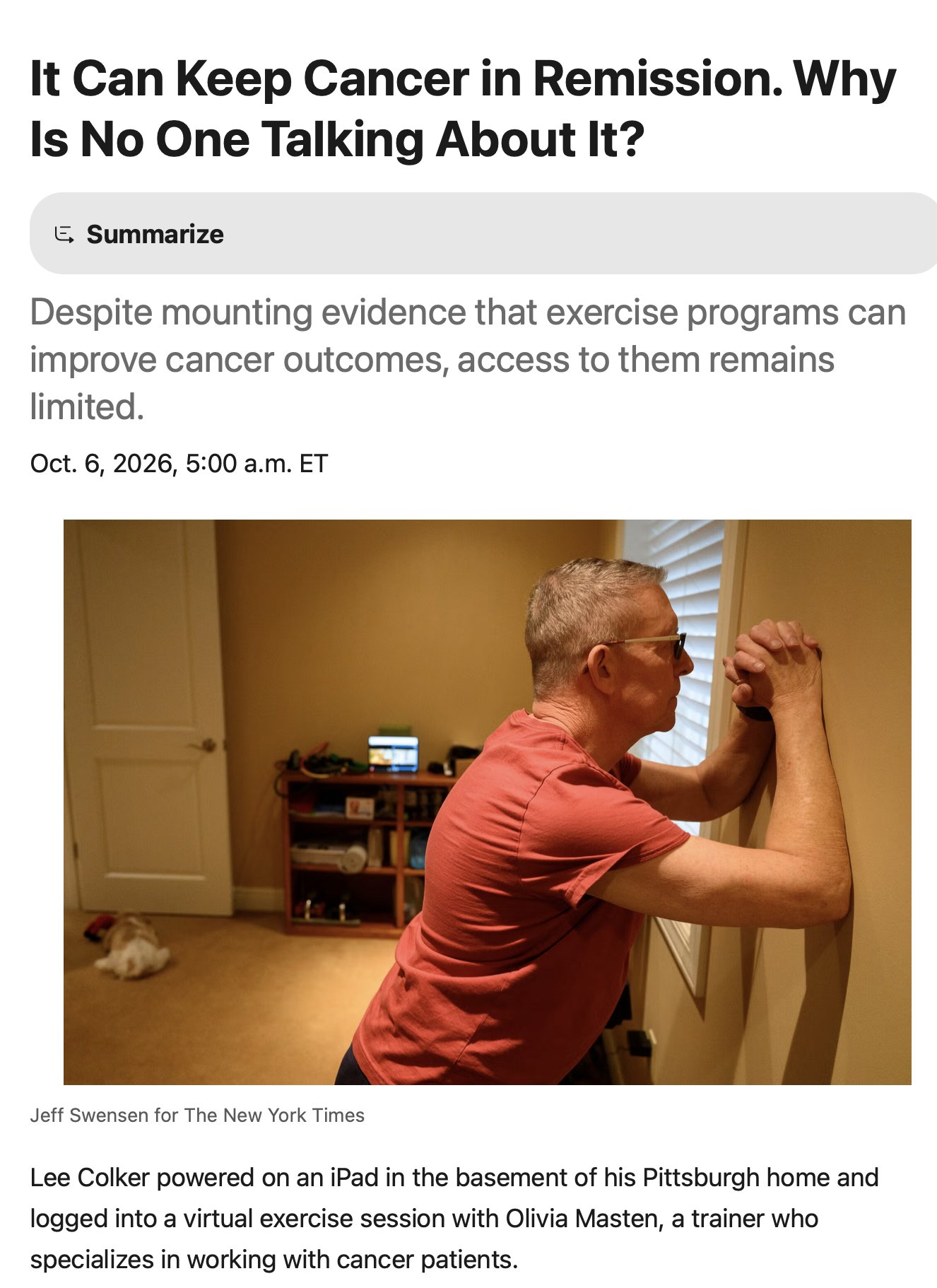
Exercise and remission from cancer: A randomized trial found 37% improved survival, 28% disease-free survival. But little is being done to incorporate in practice except @UPMC 1st health system covering "exercise oncology" program.
gift link, by @AgrawalNina
nytimes.com/2026/10/06/well/…

June M retweeted

20 years ago, I graduated from medical school.
This week, I graduated from #IntegrativeMedicine fellowship (!)
Having reflected deeply on what “integrative medicine” means - to me, the philosophy is simple: health must be understood—and addressed—across body, mind, AND spirit.
Each shapes the others. Each deserves our attention.
I am deeply indebted to this experience for giving me both the tools & the permission to bring more of myself into my work & life.
20 years into medicine, I feel blessed with more authenticity, knowledge, curiosity, & more of an open heart than ever before. 🙏 💫 💚
Many thanks to leadership, family & friends for support.
@DLBHATTMD @MountSinaiHeart @robmentz @AzCIM @arvind_trindade

June M retweeted
Late cancer risk is subtype-specific: recurrence remains particularly relevant in luminal breast cancer, while second primary cancers account for a larger share of late events in TNBC and HER2+ disease @JCOOA_ASCO @anaelisalohman1
ascopubs.org/doi/pdf/10.1200…
