

Former director, @pricedoutuk | geeky liberal | YIMBY
Oxford, Oxford-Cambridge Arc
Joined April 2009
- Tweets112K
- Following2.6K
- Followers5.4K
- Likes16.3K




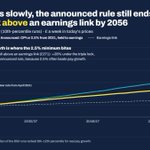

Pensions policy ought to help 60 something's gradually transition into retirement. Reduce hours or switch to a part-time job, rather than go straight to fully retired in one moment.
This horrible fudge on income tax incentivises the opposite.

One issue we face when we begin to draw down from our pensions is that we probably want to still keep them in medium-risk investments. We might live for many decades, plenty of time for long-term growth. But a bad sequence of returns early into retirement can be ruinous.
Duncan Stott 🏗️🔰🇺🇦 retweeted

This was Wigmore Street at 4pm. Regent Street was running fine too. We don’t always need to dial up the drama to 11.


Duncan Stott 🏗️🔰🇺🇦 retweeted

Considering pensioners also don’t pay NI, this makes pensioners at the new limit ~£130 a year better off than people who work for exactly the same money.

Exclusive:
The chancellor will use his budget this week to protect pensioners and those saving for their retirement as he announces plans to shield nearly one million people from paying income tax
John Healey is expected to confirm on Wednesday that the full state pension will rise by £489 to £13,036 - equivalent to 3.9%
However, the rise will push about one million people on low incomes who rely on the state pension above the £12,570 personal allowance threshold, meaning they would be dragged into paying income tax
To retain the principle that the state pension is not taxable, Healey is expected to announce a rise in the tax-free allowance for low-income pensioners to £13,036. The move will cost taxpayers £200m a year by 2030
It will rise in line with increases in the state pension over the course of this parliament. However, millions of pensioners with higher incomes - such as those who have private pensions - will still pay income tax
The Times has also been told that the chancellor has decided not to reduce the tax-free pension lump sum. Pension savers can take 25 per cent of their pension tax-free from the age of 55 up to a maximum of £268,275
There were suggestions that Healey could reduce the tax-free amount to £100,000, but he has chosen to retain the current level
The moves to protect pensioners and those saving for their retirement come after Andy Burnham announced plans to end the pensions triple lock - under which the state pension rises in line with inflation, wages or 2.5 per cent - in 2030 to help fund social care
thetimes.com/article/47291ec…

Duncan Stott 🏗️🔰🇺🇦 retweeted

A wee stat ahead of Wednesday's budget, on a policy that almost certainly won't change:
In 2021, roughly 1 in 10 full-time nurses paid 40% income tax. In 2026, it's closer to 1 in 3.
That's the power of the "fiscal drag" tax. The term "high earner" has been quietly redefined.
Duncan Stott 🏗️🔰🇺🇦 retweeted

I've been saying this for months and it gets people really mad for some reason.
The thing you must understand about NIMBYs is that they do not actually care about the things they say they do. No matter the specifics of the project, they will always find some excuse to oppose it.


Duncan Stott 🏗️🔰🇺🇦 retweeted

Unfortunately not, and this is the problem. The average pensioner receives substantially more in pensions, health and other benefits than they contributed in tax/NI during their working lives. (Difficult to calculate but some estimates put the average difference at around £200K). The reasons for this underfunding are 1. the ‘contributions’ were not saved - they have already been spent and 2. the level of contribution was calculated when life expectancy was 65 and people died after short illnesses, rather than spending 20 years or more receiving pensions and increasingly expensive healthcare. The fact that we can’t afford the current pension arrangements is not a moral issue; it’s a mathematical one.


Duncan Stott 🏗️🔰🇺🇦 retweeted

If it's as reported, the 'quadruple lock' creates a new and nasty cliff edge in the tax system. If you earn £1 extra as a pensioner, you'll get taxed on the proportion of the state pension above the income tax threshold (currently £466). So £1 in earnings -> £93 in tax.
Duncan Stott 🏗️🔰🇺🇦 retweeted
Interestingly, this only works as a hard-luck story because it's a house. If she owned an impressionist painting or owned a stable of Bugattis, everyone would just shrug and tell her to sell. @larsiusprime

We use benefit-cost analysis to help decide what infrastructure to fund. The Treasury requires an optimism bias is added to the cost calculation. But we should also add a pessimism bias to the benefit calculation!

It was predicted 290,000-390,000 passengers would use the new station which opened a year ago today. Instead, more than 800,000 have used the @greateranglia station.
Duncan Stott 🏗️🔰🇺🇦 retweeted

We seem to have a problem with chronically under predicting rail ridership and while it does make for some good news stories it does risk leaving completely viable projects unfunded.
It was predicted 290,000-390,000 passengers would use the new station which opened a year ago today. Instead, more than 800,000 have used the @greateranglia station.


Duncan Stott 🏗️🔰🇺🇦 retweeted

Why is the PM talking about free movement of workers? I suspect that the latest potential output forecasts from the OBR will have had a role. The most recent population forecasts from the ONS now see 1m fewer people aged 16+ in the UK by the end of the decade than expected back in March. Quite the hit to potential output growth for any given participation rate. For all the enthusiasm about recent productivity methods for the UK, this is a fresh headwind to potential output.


Andy Burnham has said he would welcome an "honest discussion" about the prospect of returning to free movement between the UK and European Union.
Political correspondent Jack Fenwick told #BBCBreakfast about the latest comments from the PM
bbc.co.uk/news/articles/c8e3…
Duncan Stott 🏗️🔰🇺🇦 retweeted

There is no defending this.
A two-tier tax allowance with relief for pensioners paid for by fiscal drag on working people.
And before the boomer brigade starts foaming at the mouth: I'm not interested. The allowance should rise - or freeze - equally for everyone.


Duncan Stott 🏗️🔰🇺🇦 retweeted

The ugly truth about France and some of the other European countries currently in turmoil - and which none of the politicians want to admit because it'd be political suicide - is that you can't solve the problem by going after immigrants (as the right asserts) or the rich (as the left asserts), but you could solve it by going after the old.
One extraordinary statistic for you: people over 60 in France, a quarter of the population, own 60% of France's wealth, non-financial and financial (ofce.fr/pdf/revue/2025/3-192…).
And here is another crazy statistic:
that same quarter of the population, those above 60, receive nearly two-thirds of all social spending by the French government (previssima.fr/actualite/prot…) - which is famously among the highest in the world (France's government spending is an insane 57.3% of GDP).
Last statistic: they make up about 40% of voters because they're a third of registered voters (insee.fr/fr/statistiques/266…), and they turn out far more than anyone else (franceinfo.fr/elections/sond…).
Put our 3 statistics together and there's almost a bit of an apartheid situation here: the old own most of the country's wealth, collect most of the social spending and have the political power to keep it that way.
Which makes them a de-facto rentier class, living off assets and transfers paid for by younger generations.
And, of course, at the risk of stating a truism, the future is built by the young. Yet France keeps effectively taking money away from them to give it to those whose working lives are already behind them - and need the money far less since they already own the country's wealth.
What about inheritance, I hear you ask? That's the funniest/saddest aspect: given that life expectancy has kept rising, the French now inherit a home at 54 on average. The most common case is someone in their 80s leaving it to heirs in their 50s, in effect the very old transferring wealth to the about-to-be old (insee.fr/fr/statistiques/fic…).
You can add this to our earlier apartheid statement: on top of all the rest, even when the old finally let go of their wealth, it stays within their own "camp".
That's my personal situation, incidentally: I'm 42, my father is 71 and he is starting to look at ways to pass things on to me and my siblings, when our professional lives are already well settled, so it'll arrive when it changes things the least, which is pretty much the French system in a nutshell.
Now, I get that there'd be some unfairness in going after them: they paid into the system their entire working lives, playing by the rules of a social contract that told them if they paid up they'd collect at the end. Changing the rules now means breaking that promise, which is admittedly unfair.
But there's no magic wealth tree in any society: you can only take it where it is. That's the way most major societal transformations end up happening. They're often triggered by a catastrophic event (the so-called "four horsemen": mass-mobilisation war, revolution, state collapse, plague) BUT what really drives change is a transfer: wealth gets pried from the privileged class who've been sitting on it and handed to those who'll build what comes next.
So, in theory and in an ideal world, you can do without the catastrophic event and directly proceed with the transfer...
The fact that in France, and elsewhere in Europe, it's the youth protesting is probably no coincidence - even though they don't frame it as a generational fight. And even though, cruel irony, the left politicians many of them march behind promise to bring the retirement age back to 60 (lcp.fr/actualites/legislativ…), which would make the situation even worse.
Let's say they understand intuitively that the system is stacked against them, even if they haven't yet figured out how. And politicians are obviously doing what politicians do, meaning pandering to the people who actually vote, while pointing the young towards easier - and politically convenient - scapegoats.
To be clear I'm not saying it's the only problem in France, VERY far from it. I'm also not saying that all old people in France live a lavish lifestyle at the expense of younger generations: there are also plenty of very poor retirees who, if anything, would deserve more.
What I am saying is that it's probably the biggest elephant in the room: everyone can see it, nobody dares mention it - no politician, from any side, wants to run on cutting grandma's pension - and it makes every other problem harder to fix.