

Our goal is to make ECG interpretation simple, practical, and fun for acute providers; and we believe that mastery of this simple skill will save lives.
Joined September 2017
- Tweets572
- Following4
- Followers21.7K
- Likes24







62M with chest pain. The computer sees ST depression and suggests ischemia—but another clue is hiding in the tracing: the check mark, or BAM, sign.
What is this ECG warning you about?
ecgweekly.com/weekly-workout…
ecgweekly.com/weekly-workout…
MYTH VS. REALITY? 🤔
Sgarbossa and modified Sgarbossa are accepted in the 2022 ACC/AHA chest pain guidelines.
24%Myth
76%Reality
34 votes • Final resultsA 36-year-old man, previously healthy and physically fit, develops sudden severe chest pain while getting into bed. Paramedics find him awake, flushed, diaphoretic, and clutching his chest. The following 12-lead ECG is obtained.....ecgweekly.com/weekly-workout…


Electrical alternans: the QRS changes size beat to beat. 🫀
In T-wave alternans, what changes from one beat to the next?
81%The T-wave size
19%The QRS axis
0%The PR interval
0%The heart rate
16 votes • Final results
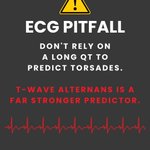
T-wave alternans can be an ominous warning: bigger, smaller, bigger, smaller from beat to beat. ⚠️
Dr. Mattu explains why this pattern deserves serious attention when you’re worried about impending torsades.
Would you recognize it in time?
ecgweekly.com/weekly-workout…
TRUE OR FALSE? 🤔
The Aslanger pattern is part of the formal ACC/AHA STEMI guidelines.
28%TRUE
72%FALSE
36 votes • Final resultsA 45 yo m presents to the emergency department with palpitations. He has no known history of coronary artery disease. He is alert, with a systolic blood pressure of approximately 120 mm Hg and a heart rate near 180 beats/min. The following ECG shows.......ecgweekly.com/weekly-workout…

ST elevation in lead III. None in II or aVF. 🫀
The computer reads it as nonspecific.
Why might it miss this?
73%Needs 2 contiguous leads
3%Lead III is unreliable
3%The rate is too fast
22%ST change is too small
37 votes • Final results
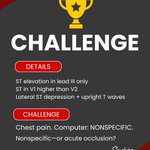
Chest pain. ST elevation in lead III only. ST in V1 higher than V2. Lateral ST depression with upright T waves. 🔎
Computer: nonspecific.
Nonspecific—or acute occlusion?

71M with chest pain. Lead III has ST elevation—but II and aVF don’t. 👀
The computer called it nonspecific. Cardiology: not a STEMI.
But the ED physician recognized a subtle high-risk pattern.
What did he see?
ecgweekly.com/weekly-workout…
MYTH OR REALITY? 👀
Any irregular rhythm without obvious P waves is atrial fibrillation.
61%MYTH
39%REALITY
41 votes • Final resultsA 76-year-old man presents with chest pain suggestive of acute coronary syndrome. An initial 12-lead ECG is obtained and shown below, but does not meet conventional STEMI criteria......ecgweekly.com/weekly-workout…

