
Official @ESA feed for James #Webb Space Telescope – an international partnership between NASA, ESA and CSA #WebbSeesFarther #BFFinSpace with @Hubble_Space
- Tweets4.9K
- Following188
- Followers262K
- Likes778






ALT Halloween landscape with houses added on top of an astronomical image. In the image a small portion of the Horsehead Nebula is seen close-in, as a curved wall of thick, smoky gas and dust. Above the nebula various distant stars and galaxies can be seen up to the top of the image.

ALT Maddie Moate looking at a Webb image together with a child. In the background another child is looking at a book.


ALT At left is the main image: a wide-field view of the galaxy from the Digitized Sky Survey. Many yellow, blue-white, and white stars are dispersed across the black background of space. A faint brown oval surrounds the central area of the image. Within this area are two small graphic overlays: a square and a diamond. These two small overlays correspond to the two magnified views at right, as seen by the Hubble Space Telescope. The small square in the main image corresponds to the top right square. The small diamond in the main image corresponds to the bottom right square. The magnified view at top right shows a large white circle with four diffraction spikes in the top left. Small white specks and orange dots are scattered across the black background. A large spiral galaxy is seen face-on at top right. The magnified view at bottom right shows small white specks and orange dots scattered across the black background.


ALT A collage of three images of the Horsehead Nebula. In the left image labelled “Euclid (Visible-Infrared)”, the Nebula is seen amongst its surroundings. A small box around it connects to the second image labelled “Hubble (Infrared)”, where the Nebula is zoomed in on. A portion of the Nebula’s head has another box, which leads with a callout to the third image, labelled “Webb (Infrared)”, of that area.


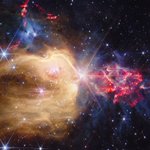
ALT An image of a young star-forming region filled with wispy blue, grey, green, and red nebulosity that is brightest towards the centre and fainter towards the edges, especially in the top left corner and on the right side. Thousands of stars are seen sprinkled across the field, concentrated towards the centre, and the brightest stars show the eight spikes due to diffraction that are characteristic of Webb images.

ALT An image of a young star-forming region filled with with wispy purple, green, and red nebulosity. The purple ionised gas is seen mostly towards the centre, with browns, greens, and reds behind, while the periphery is mostly bright green and darker brown to the left. There is a large spray of yellow, orange, red, and purple towards the top centre, and the nebula fades to near black to the right. There are thousands of stars sprinkled across the field, concentrated towards the centre, but they generally appear fainter at longer wavelengths, with some exceptions. The brightest sources in the field have extensive diffraction spikes characteristic of Webb.

ALT A blue-and-white sphere against a black background is somewhat reminiscent of the famous “Blue Marble” picture of Earth from space. With fuzzy, diffuse edges, this sphere features darker blue patches in most of the northern hemisphere facing the viewer. One, large, crescent-shaped, white patch extends along the left side of the southern hemisphere facing the viewer, and a larger, blobby, white patch covers the middle latitudes of the right side of the southern hemisphere. Lighter blue regions border these white patches in the south.

ALT The ESA Space-Science Fellowships Programme poster shows a collage of planets, stars, galaxies and cosmic web to suggest the different research topics of the programme.

ALT Person standing at a desk, working on a laptop connected to two screens.


ALT This image shows concentric rings in purple, blue, green and yellow (arbitrary colours). These dust clouds in our galaxy, illuminated by X-rays from the gamma-ray burst, as seen by XMM-Newton. Dark stripes indicate gaps between the detectors. The widest ring visible here, comparable to the apparent size of a full moon, came from dust clouds located about 1300 light-years away. The innermost ring arose from dust at a distance of 61 000 light-years – on the other side of our galaxy.

ALT Person standing at a desk, working on a laptop connected to two screens.


ALT Artist's impression of Cheops, ESA's Characterising Exoplanet Satellite, in orbit above Earth. In this view the satellite's telescope cover is open.



ALT A crowded field of galaxies is interspersed with bright 8-pointed stars on a dark background. The galaxies and stars come in a variety of sizes and colors, ranging from bluish white to orange. Some galaxies are large enough to make out spiral arms, while others look like faint smudges or pinpricks. The most prominent feature is a large, detailed spiral galaxy called LEDA 2046648, seen at an oblique angle towards the bottom of the frame. A smaller spiral galaxy is just below it. About one-quarter the size of its larger companion, this small galaxy looks like a miniature version of LEDA 2046648. Both of these spiral galaxies have glowing cores and areas of star formation lighting up their pale pink arms.

