

Evolutionary biologist and doctoral researcher at the ANU | Investigating reptile morphology, ecology, and evolution by means of µCT.
Canberra, Australia
Joined October 2020
- Tweets102
- Following328
- Followers220
- Likes258


This may be the most argued-over origin story in animal evolution. What are your thoughts? Here are some answers: theconversation.com/80-milli…

AN EXCEPTIONAL NEW FOSSIL IS REFRAMING SNAKE EVOLUTION! Meet 𝘛𝘢𝘮𝘦𝘵𝘢𝘳𝘢 𝘮𝘪𝘳𝘪𝘮, an 80-million-year-old burrower from Brazil. New in Nature, led by Tiago Simões. A privilege to have been part of this. theconversation.com/80-milli…

Huge congratulations to my dear friend and colleague Jane Melville on the publication of her book, For Her Love of Birds! I've heard wonderful things about it from everyone who's read it. I'm so happy for you and so proud of you — you've absolutely earned this.

Including these glass lizards, several distantly related ‘worm lizards’ have skin bone plates covering their bodies. We just found that these evolved independently. For the full story: doi.org/10.64628/AA.4m75kv59…
CT data provided by S Decker (2025, CMC 27120, OSUM R685, MorphoSource)

Reptile body armour has a wild back story. Find out here: doi.org/10.64628/AA.4m75kv59…

Roy Ebel retweeted

Lizards in chain mail: reconstructing the enigmatic past of dermal armour in squamate reptiles academic.oup.com/biolinnean/…
Our new paper is out! By reconstructing 320 million years of reptile body armour evolution, we settled a century-old debate. Along the way, we found that monitor lizards broke Dollo’s Law in an unparalleled comeback. Read more in The Conversation: doi.org/10.64628/AA.4m75kv59…

This is it, folks! Your one and only Halloween decoration for the year. It is the creepiest thing I have seen in a while. Watch it in full, with sound on. You won’t regret it. Every frame is volume-rendered from real scientific CT scans.
youtu.be/L_D_iCex16o?si=KEMq…
It was the greatest of all honours to be featured as Museums Victoria's flagship speaker at the Royal Society of Victoria's launch event for National Science Week. Many thanks to the organisers and the wonderful audience.


Roy Ebel retweeted

Osteoderms may form through mechanotransduction, where tension in collagen fibers triggers bone growth. In alligators, ossification aligns w/stressed fascia/tendon attachments, suggesting parallels w/trauma-induced heterotopic ossification.
Dubansky et al anatomypubs.onlinelibrary.wi…

Monitor lizards, also known in Australia as goannas, are some of the most iconic reptiles on the continent. In our new study, we look beneath their skin with cutting-edge imaging – and we may just have found the key to their evolutionary success. youtu.be/RfOK2wWYjLo
Not only may we just have found the key to an untold chapter in the goanna story, our findings may also improve our understanding of the forces of evolution that shaped Australia’s unique reptile fauna. theconversation.com/new-stud…

Scientists have been studying these creatures for more than 200 years, but only now did we discover that they wear ‘chainmail’ in their skin. We found these previously unreported skin bone plates in no less than 29 Australo-Papuan monitor lizard species. doi.org/10.1093/zoolinnean/z…


Osteoderms occur in virtually all major vertebrate clades. Much has been speculated about their function, but many questions remain unanswered. Check out or review for the current state of knowledge and future research directions in this field: doi.org/10.1111/jzo.13224

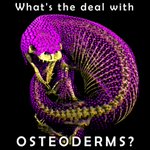
I acknowledge the wonderful inspiration provided by Daniel T. Baldassarre. What’s the Deal with Birds?. Sci J Research & Rev. 2(3): 2020. SJRR.MS.ID.000540. DOI: 10.33552/ SJRR.2020.02.000540.

Roy Ebel retweeted

Ha! You think you get the function of a thing (duh, boney scales are for protection against bad guys) and then you see an image like this.
Yep, some mice (of the genus Acomys, not Mus) have them in their tails for some reason!


Osteoderms, body armor in the skin, occur in many unrelated species, from tiny worm lizards to massive dinosaurs. But what are they actually good for? Is the term “body armor” even deserved? For an answer, check out our latest article hot of the press: doi.org/10.1111/jzo.13224

Osteoderms, body armor in the skin, occur in many unrelated species, from tiny worm lizards to massive dinosaurs. But what are they actually good for? Is the term “body armor” even deserved? For an answer, check out our latest article hot of the press: doi.org/10.1111/jzo.13224
...and many thanks to my wonderful co-authors @AnthonyHerrel, Torsten Scheyer, and @Keogh_Lab. It was a great joy collaborating on this with you.