

Conservation Scientist at the Department of Aquatic Resources (@SLU_aqua), Sweden | PhD, James Cook University, Australia
Joined May 2018
- Tweets78
- Following211
- Followers114
- Likes334




Pinned Tweet
What if I told you that some of the most threatened land is also cheap to protect? Our new paper in @ConLetters shows that conservation landscapes are full of bargains: doi.org/10.1111/conl.12663.
@bode_e @BobPressey @CoralCoE @ConsPlanGroup
We have a fully funded PhD position open for applications!
The PhD will be in Uppsala, Sweden at @SLU_aqua.
Please apply if you're interested in marine ecology, habitat and connectivity modelling, conservation, and climate change.
#phd #science
slu.se/en/about-slu/work-at-…
Dr. Edmond Sacre retweeted

🌊 We’ve gone live with our brand new website for #ProtectBaltic (protectbaltic.eu) – the most ambitious protection project in @HELCOM’s history. Explore the new site, follow and join us as we aim to secure a healthier and resilient Baltic Sea for future generations. 🌏💙

ALT Autumn coastline view with Baltic Sea waves swaying against the shore.
If you're at #ICCB2023 and want to see our new tool for mapping human impacts on the ocean, join me in room MH 2 @ 12:00!

3
112


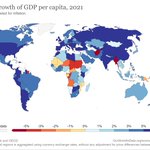
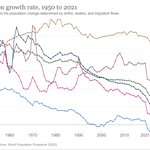
(3) Concurrent with this demographic and economic growth, habitat loss is putting many species at risk, especially in Kenya and Tanzania.

1
64

How do we determine if conservation measures are effective? Catch this symposium at #ICCB2023 to find out!

Join us at #ICCB2023 on Thurs. July 27th 12 - 13:30 for our symposium "Bridging the Impact Evaluation Research-Implementation Gap in Conservation" in room AD1. Plus, join our networking event on the evening of the 26th! See the full program here: tinyurl.com/akadvsuh


Stoked to be presenting the new WIO Symphony tool at @Society4ConBio's #ICCB2023! In building the tool we've made 89 maps of ecosystems, species, and pressures in the Western Indian Ocean.
A huge effort by @NCSecretariat, @havochvatten, @SLU_aqua, @sguSverige, and many more.

Here is a quick R #rstats tip that might save you some time!🤓
If you hold down alt you can spread the cursor over multiple rows of code and edit multiple lines at the same time. On some systems you may need to press alt again after highlighting.
That scale hurts my brain

What impact have national greenhouse gas emissions had on global warming?
A new paper by @Jones_MattW & team at @gcarbonproject quantifies each country's contribution to global mean surface temperature rise.
I've added this data to @OurWorldInData. Here are some highlights 👇

A striking figure: a cleared hectare of the Amazon is worth ~$1,200, on average. The released CO2 costs ~$25,000, in terms of harm from #climate change, according to @TheEconomist.
I’m curious, where does this harm cost estimate come from? economist.com/leaders/2023/0…
65
The issue is not climate warming itself, but rather the rate of warming. The pace is too rapid for species to adapt and evolve, hence the fear of widespread extinctions.

“It's kind of obvious, if you have a warmer world with more CO2, it's a more tropical world with more life. It's a more green world in the life sense of green, and yet the green movement hates it because we caused it”
With @jordanbpeterson
116
The Great Barrier Reef with #rayshader in #rstats. How magnificent. The GBR is in danger from mass coral bleaching, which has occurred in 1998, 2002, 2016, 2017, 2020 and 2022. In 2022, mass bleaching occurred for the first time in La Niña conditions.

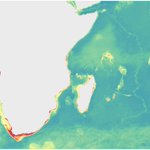
The Western Indian Ocean in all its glory. More fun with #rayshader in #rstats. To the south-east of Madagascar you see the Southwest Indian Ridge. To the north-east you see the Mascarene Plateau, which emerges in a few spots, such as Seychelles, Mauritius and Reunion.

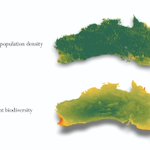
(1) Playing around with #rayshader in #rstats to explore some interesting natural relationships. Humans tend to inhabit areas of high biodiversity. This seems intuitive because these areas have natural resources. But, in #conservation we tend to protect areas far from people.

(2) Such "far away" areas 𝘨𝘦𝘯𝘦𝘳𝘢𝘭𝘭𝘺 have lower biodiversity and are under lower pressure from human activities. Yet they receive disproportionately high protection compared to areas close to people. The consequence is low impact #conservation.
3
93
Dr. Edmond Sacre retweeted

My first paper! : The effects of eutrophication and browning on prey availability and bo... sciencedirect.com/science/ar…
As #30x30 is agreed at #COP15 we enter a risky time for nature conservation. Big area targets will likely lead to large reserves in areas under little pressure, thereby redundant. We are then stuck with what’s there in 2030. We must must push hard for #teamcounterfactual thinking
2
4
747