

core contributor @InverseFinance @MonolithMarket
Joined May 2021
- Tweets1.7K
- Following456
- Followers439
- Likes9.1K


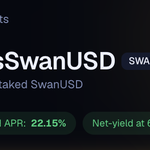


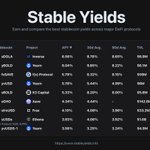
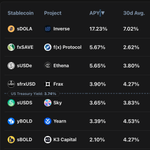


Someone could take on ~$7m debt at perfect peg and 0.6% interest right now on @MonolithMarket #swanUSD





.@MonolithMarket is by far the cheapest venue to borrow against your wstETH.
source: firm.inverse.finance/compara…


edo🍑 retweeted

It's day 14 and the results of the SwanUSD experiment are more than incredible. They're ridiculous.
Look at these juicy numbers:
- 33% to 199% APY on SwanUSD deposits, depending on how much leverage you're using
- Over 83% APY going to SWAN gov token stakers from protocol revenue, paid in SwanUSD
- 1.14% borrow rate on wrapped stETH, the cheapest rate in DeFi (in addition to the 0% rate redeemable mode)
- SWAN token up 60% since launch. Market cap nearly half of INV already.
Here's the fun part:
SwanUSD was added to FiRM last night and only $1m of the $5m cap was borrowed so far due to daily limits.
An additional $4m is waiting to be borrowed and deposited into Swan over the coming days. This will 3x the current supply from about $2m to $6m, and in return 3x the protocol revenue (until the cap is raised again). 100% of that revenue goes to SWAN stakers. You can do your own math.


Monolith has been up only since the launch of SWAN DAO and $SwanUSD! What stablecoin and/or DAO will launch next? 👀

5
108
edo🍑 retweeted

I came across $ysyBOLD market on @InverseFinance , and its approach to combining yield-bearing collateral with $DOLA borrowing is worth examining.
Current dashboard figures show:
☞ Underlying vault APY: 5.58%
☞ Estimated net APY at 6.67x leverage: 10.81%
☞ Market TVL: approximately $1.15M
The leveraged estimate is particularly interesting, but it needs to be considered alongside borrowing expenses and liquidation exposure.
Jake Brukhman, founder and managing director of @coinfund, once observed:
“Most of the returns come from exuberance or inefficiency of these early protocols.”
His observation about early DeFi yield farming provides useful context when assessing whether a strategy’s returns are sustainable.


This guy gets it 🧠

Some people buy a token and wait for the price to go up. Others trade with leverage, chasing the next big move.
I’m fascinated by a third path: building an actual onchain business.
Imagine starting with a tiny portfolio. You gradually accumulate productive positions in veCRV, vlCVX, sAERO, veFXN and other DeFi systems.
These aren’t just tokens on a price chart. Depending on the protocol, they can earn fees, collect incentives, carry voting rights, or help decide which liquidity pools receive rewards.
Now imagine placing those assets in a treasury, using a Safe multisig to protect it, and eventually bringing in partners. Add a DAO so decisions can be proposed, debated and voted on.
Suddenly, it’s not just “my crypto wallet.”
It’s an onchain company with capital, rules, economic rights and cash flows.
The treasury could reinvest rewards, accumulate more voting power, fund development, or support liquidity for its own token – where the protocol’s rules allow it.
And then comes the really fun part: you can build your own financial products on top.
Even a crypto-backed stablecoin.
That once sounded like a project requiring an entire engineering team. Now @MonolithMarket lets people deploy collateral-backed stablecoins and optionally launch a DAO to govern their market.
I’ve been exploring SwanDAO and swanUSD, a live example built on Monolith. Real collateral. Real borrowing. Staking. Governance. An entire financial economy you can actually examine and learn from.
I’d love to try launching my own small experimental stablecoin and DAO, then share the journey here: the transactions, the decisions, the mistakes, the lessons. Starting small, learning in public.
Of course, this isn’t a money printer. Token prices fall, yields change, smart contracts carry risk, and a stablecoin needs genuine demand and liquidity.
But look at what’s now possible.
A few DeFi Lego pieces can grow into a treasury. A treasury can become an organization. And that organization can one day launch products of its own.
That’s why I spend so much time digging into the machinery behind the numbers. I want to understand complex finance well enough to explain it simply – and show it with small, real experiments.
We’re learning to build on the internet of money.
edo🍑 retweeted

Agree with @EthanDeFi_ Strong claims on yield are important. That's why SWAN tokens give you real yield earned from borrowers borrowing SwanUSD, and staking SwanUSD gives you immediately liquid SWAN.
All of which in turn is designed to be hard to rug by the operator.


edo🍑 retweeted

Love seeing this! 🦢
Happy to support @MonolithMarket and be part of this new DeFi experiment.
Saw the announcement from Convex, checked my wallet and found myself on the SWAN airdrop snapshot list thanks to my vlCVX and veCRV positions. Nice surprise!
So I decided to give it a try.
Swapped $1,000 into swanUSD, deposited it to receive sSwanUSD, and staked that for additional SWAN rewards.
👀 Now I'm farming SWAN while working toward the seven-day holding requirement. Already watching the rewards accumulate.
But honestly, the airdrop isn't even the most interesting part.
I've been digging into Monolith, and I love the idea behind it.
Imagine launching your own crypto-backed stablecoin, creating a DAO with its own governance token, treasury, voting system and revenue sharing.
Basically, building your own little onchain financial system. Pretty wild!
And there's some great history here.
Monolith was developed with support from @InverseFinance, the ecosystem behind DOLA, sDOLA and the legendary INV airdrop in 2021, when some early participants saw six-figure allocations.
Does that mean SWAN will deliver anything similar? Absolutely not.
I'm going into this with zero expectations. I simply enjoy supporting builders, experimenting with new protocols and understanding the economics behind them.
I already use DOLA and sDOLA in my stablecoin cash-flow strategies, so exploring Monolith feels like a natural next step.
And I'm especially interested in the DAO-building side. I have a few ideas of my own that could eventually benefit from this kind of infrastructure.
There's something exciting about watching tools that once required entire development teams become accessible to almost anyone.
Of course, it's still early, and the capital is exposed to real risks.
But that's part of why I enjoy exploring DeFi. Not just hunting for rewards, but discovering what people are building and where finance might be heading.
I'll keep experimenting and sharing what I find.
Love this stuff! 🦢


Airdrop activated!
vlCVX holders, @MonolithMarket has launched swanUSD with a SWAN airdrop for eligible wallets.
Check the post below for details:
SWAN DAO 🦢🦢🦢
swanUSD is live.
A DAO-governed stablecoin backed by wstETH, built on Monolith.
Stake swanUSD as sSwanUSD to earn protocol revenue.
Participation in the shared 100,000 SWAN launch airdrop opens today.
swanusd.com

This is true
Ramses blacklisted our veRAM NFT from migration, leaving it essentially worthless. I was involved in these discussions, so here’s what happened:
Ramses ran incentive programs encouraging partners to spend more. Depending on the program, they would match our spending with RAM added to voting incentives, sent to us, or deposited directly into our NFT. They explicitly encouraged us to grow that position.
For Inverse, Curve and Aerodrome delivered far better liquidity ROI. The RAM subsidies were a major reason we continued spending on Ramses: they compensated for poor liquidity results while growing our long-term veRAM position. We would not have committed those amounts without them.
DOG keeps pointing to approximately 240k RAM bought on the market as though that captures our investment. It doesn’t. Our wallets paid roughly $180k in voting incentives on Ramses, valued at the time of payment. The growth from 3.25m to around 8.6m included purchases, incentive matches, reinvested rewards and rebases. Spending money to earn locked RAM under their programs was still an investment. Those earned matches were not unconditional gifts.
Return demands were already underway by May 2024, initially offering a replacement NFT of 1.25m, later offering to let us keep 1.5m.
We explained that returning a DAO-owned asset required governance and invited them to submit a proposal. We explicitly told them we believed the DAO would very likely support returning the original 3.25m. Looking back, I think the DAO would also have been happy to return the rebases attributable to that 3.25m, keeping the rest. During those discussions, they repeatedly threatened to freeze the NFT.
Our reading is that the position had become too large for their liking: too much voting power available for DOLA rather than the higher-volume ETH/USDC pools they wanted supported.
We subsequently agreed to a temporary compromise directing at least 6m votes to ETH/USDC, with fees ours to harvest or recycle. We made that change, pending the planned sINV/sDOLA deployment.
We were genuinely excited about those pools and thought they could be a big success on Ramses. Unfortunately, substantial delays getting the bridge infrastructure ready meant they never materialised, particularly on sDOLA’s side, as we were planning to use its yield to fund incentives.
The migration then blacklisted the entire NFT, including purchased RAM and incentive-earned additions. Ramses’ decision left that accumulated position essentially worthless to us: no useful liquidity, no ongoing income. Pure value destruction. Saying “all partner NFTs were excluded” does nothing to justify it.
And spare us the “focus on repaying bad debt” jabs. Inverse has already repaid over $14.4m valued at historical repayment prices (approximately $16.2m at current market prices). There is still work to do. That does not excuse Ramses’ conduct.
Encourage partners to spend, reward that spending with locked tokens, demand the accumulated position back under threat of a freeze, then blacklist the whole thing from migration.
That is why we call it a rug.
45
I should also add that while every protocol may have gotten the same treatment, Inverse were the only partner (or one of very few) who'd actually invested, grew and contributed. We were fully behind the team and got burnt.
teapawt.org/EdoInv/status/17636495…

Two month update here and good to remind the folks in the back that @InverseFinance has continued to grow its veNFT bags💰💰💰
➕ 2,116,407 $veAERO (7.3MM)
➕ 1,266,576 $veVELO (17.3MM)
➕ 477,928 $veRAM (8MM)
➕ 195,055 $veTHE (1.6MM)
🟰 $6.75MM ( ⬆️$4.4MM ~200% in 2 months🤯)

8
440