
Co-founder @GeneralMedicine, was co-founder @PillPack and @hackmedmit.
United States
Joined March 2009
- Tweets3.2K
- Following1K
- Followers4.6K
- Likes3K



I've been interested in the frontiers of neuroscience for more than 20 years, and for most of that time real clinical progress felt intractable.
As often happens, change that was happening slowly is suddenly happening all at once. For example, for people with memory symptoms, there are now validated digital assessment tools and blood tests that can help to quantify the cognitive changes as well as show whether Alzheimer's pathology is present, and there are therapies approved for early symptomatic stages of the disease.
But the science is moving faster than the care around it. For most, the journey to answers is still static and linear: one appointment, a wait, another appointment, and often the same questions and sometimes the same tests along the way.
@GeneralMedicine is working to change that. Today we launched a memory care pathway, available on Lilly's website, that brings the store infrastructure to life: visits, tests, imaging can all come together quickly and without administrative work for the customer. The first visit is available the same day in most cases, our clinicians recommend only the tests a person's situation calls for, we gather any tests people have already so nothing gets repeated, and a neurologist can review the case by e-consult when needed. We keep working until we get to an answer.
What I'm proudest of is that it brings together two things that rarely meet: an exceptional customer experience, and the most current science.

General Medicine has two announcements with @EliLillyandCo today: GLP-1 weight management on LillyDirect, and a memory care pathway for early Alzheimer’s evaluation. Both show what our store can do for a partner, in very different ways.
Weight management is relatively straightforward. But follow-through depends on customers seeing all their options, knowing the price, and having a clinician who understands their whole health picture and goals. We do that.
Memory care is complicated. Figuring out what testing someone has had, what they still need, and how it all fits together is hard. As a result, patients often wait years between their first symptoms and a diagnosis. That delay is particularly consequential for new therapies with a narrow window for treatment.
We bring bloodwork, cognitive testing, imaging, and specialist review together, coordinated by a clinician who knows how to navigate the process. We’re working to solve one of the biggest bottlenecks in Alzheimer’s care, today.
The same store works for both: transparent pricing, clear next steps, and a clinician who helps you get it done.
That’s the promise of what we’re building @GeneralMedicine: it’s simple to get the healthcare you need, no matter how complicated it might be
We’re excited to work with Lilly to bring both experiences to more people.
🚀🚀🚀

Thrilled that @withprotegeai was named to @theinformation's 50 Most Promising Startups list.
Data is the biggest bottleneck in AI. We've spent two years delivering de-identified healthcare data that now helps power nearly every frontier model - with much more to come.

5
418
Elliot Cohen retweeted

Alzheimer’s science and development are finally catching up to the disease. But right now, the breakthroughs are moving faster than the system built to deliver them, which means a lot of patients aren’t seeing the benefits yet. Fixing that is the next big frontier in Alzheimer’s.

Nearly nine years ago, @TJParker and I went to Bentonville to talk to @Walmart about building a different kind of pharmacy.
While we were there, we visited The Walmart Museum. If you haven’t been, go! I loved seeing the history of a company that started with a single store and changed what people everywhere could buy and afford. We were building PillPack at the time, and spent much of that trip talking about what healthcare could learn from retail.
Today we’re launching the new Walmart Better Care Services, a healthcare store powered by General Medicine. Starting today, customers can browse more than 900 products and services across a dozen different provider groups, compare cash and estimated insurance prices, and get what they need. Walmart defined the experience, chose the products, services, and providers. Our technology makes it all shoppable.
A lot has happened since that first trip. We sold PillPack, built Amazon Pharmacy, and started @GeneralMedicine. We’ve spent most of our working lives trying to make getting healthcare easier. And somehow it still feels like we’re just getting started.
We have incredible clinicians and treatments in this country. But finding the right care, figuring out what something costs, and actually getting it remains convoluted and complicated. Something that should have been a quick purchase becomes a project. Too often, people just put it off altogether. And when the problem is serious, all that hassle lands on top of what’s already hard. When transactions are easy, you take a whole layer of complexity off the table.
We launched General Medicine a year and a half ago. A few weeks ago, we wrote about the idea behind it: healthcare needs a store. Helping Walmart build one for its customers is that idea reaching the scale we’ve been aiming at since PillPack.
I love that we have our own store. We get to build things we’ve wanted to exist for years, hear directly from customers, and keep making them better. But I’m just as excited about helping other companies build theirs. We learned at PillPack how much more you can do when you work with companies that already serve millions of customers. Tech platforms, retailers, health systems, payers, and manufacturers all bring something different. There’s a lot more we can do together than any of us could do on our own. With Walmart, we get to work with a retailer and pharmacy that’s part of everyday life all across the country.
This one is particularly special to me. We walked into Bentonville nine years ago hoping to build something together. It took a little longer than we expected, but here we are.
Build the store. Then build more stores.

ALT Me and TJ in Bentonville, 2017

ALT TJ and me in Bentonville, 2026

Elliot Cohen retweeted

Build the store

Every conversation we have with @tjparker and the @GeneralMedicine team is a lot of fun. So we recorded one on what it means to build "the healthcare store"
00:00 Intro
00:54 Why health care needs a store
04:51 Getting a biopsy booked in three days
07:13 Lessons from his dad’s pharmacy and PillPack
11:12 Why Amazon Pharmacy was so hard to build
15:40 Why TJ went full-time as CEO
17:10 How do you define a product in healthcare?
20:05 Building a two-sided healthcare marketplace
25:18 How AI works for patients and providers
31:02 Coverage, cash prices and price transparency
37:23 Partnerships and the business model
Rohit is building a monster. It’s been a pleasure to watch him quietly build this business over the last several years as he and his team knock down deep technical problems that actually matter to the customer. The result is easier installs, better battery integration, more power at less cost… basically just a radically better solar power system start to finish.
Congrats on the raise. LFG 🚀🚀🚀

Today I’m excited to share that Optivolt is unstealthing with a $32M Series A.
Solar growth continues to outpace all other forms of energy production, but the granularity of control we get from deployed systems hasn’t changed in decades.
So we’ve added a brain inside solar panels, opening the door for a new unit of optimization and control.
Excited to see @BobbySamuels and the team @withprotegeai take this on.

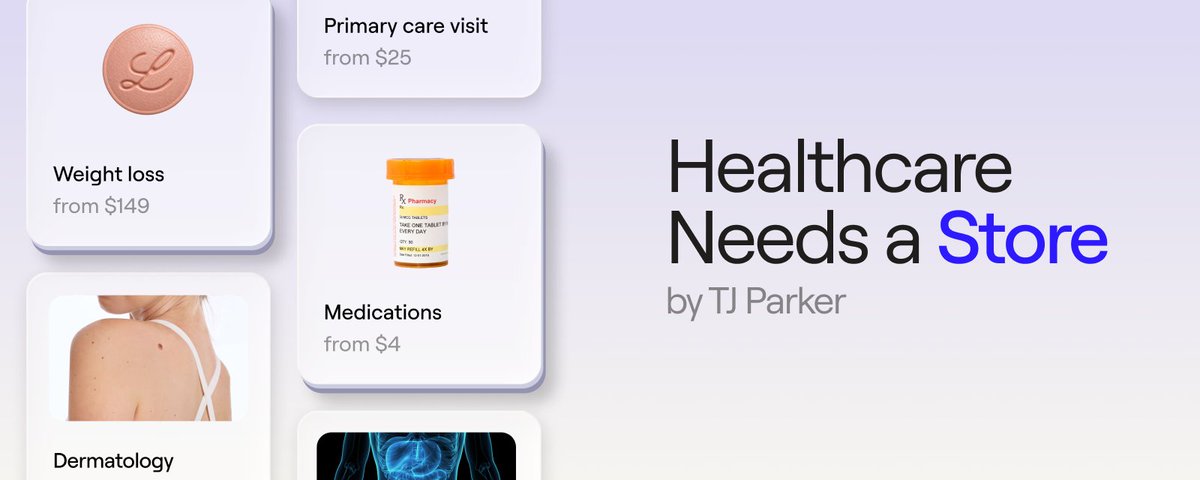
We've spent decades in healthcare obsessing over who pays for things. That's not actually why people dislike the system. We dislike it because we don't get to be the customer.
General Medicine is fixing that. We’re building a healthcare store where you see real prices, real options, and a clinician is there to help you choose.
No matter how long I spend in healthcare it never surprises me how much more complicated it is than i expect and the more clear it is that simplicity is on the other side of putting the customer first.


Congrats. Really amazing to watch you building this company.

This CEO’s $1.7 Billion Health Startup Began With Moms. Now She Wants To Expand To All Women. forbes.com/sites/amyfeldman/… (Photo: Pomelo Care)

2
11
1,432
💪

Today, we are thrilled to announce that @withprotegeai has raised a new $30M funding round led by @a16z.
When @BobbySamuels and former @DatavantHQ co-founder and CEO Travis May first started Protege in 2024, we saw three bottlenecks to AI’s progress — compute, models, and data. Compute has scaled dramatically, models continue to improve, but access to the right data remains the hardest part.
That’s why Protege exists: to be the infrastructure for real-world data in AI development. In the few months since our last round of funding, we’ve felt the urgent demand pull across industries, domains, and modalities. We are rapidly expanding to meet those needs.
When AI builders come to Protege, they’re looking for real-world data: the most authentic signal of how people and systems actually behave. This is not synthetic data created by AI nor manufactured data created to simulate human behavior.
Across every stage of the AI development lifecycle — from pre-training to post-training to fine-tuning to evaluation — AI builders need this data. They’re looking across modalities and industries: healthcare, video, audio, motion capture, gaming, manufacturing, life sciences, real estate, finance, education, and many more. Foundational, multi-modal model-builders (including the majority of the Magnificent Seven) now work with us across multiple domains along with dozens of other model builders.
Thanks to @daisydwolf and the rest of the a16z team for joining us on this journey as well as our existing investors also participating in this round — @nbt at @footworkvc, @saarsaar at @CRV, @BloombergBeta, @flexcapital, Shaper Capital, and others.
Lastly, a huge thank you to the @withprotegeai team for making this all possible.
More details in 🧵!
#AIDevelopment #DataInfrastructure #a16z #StartupFunding #Protege

1
1
681
Product Idea (maybe this already exists?): an electronics learning kit for kids that has bugs in it and an agent that socratically works through the bugs.

Elliot Cohen retweeted

A customer with multiple new complications chatted with our AI.
After reviewing the conversation, a clinician reached out directly to suggest the best course of action, based on the most pressing issue. It turned a complicated moment into a clear next step.
AI surfaces what's hidden in complexity. Clinicians build the right plan.
This is how care should work.

We’re seeing folks come back day after day to chat. For example, someone came back three days in a row.
First day: exploring symptoms and what they might mean, given their history.
Second day: clarifying questions about past test results they'd been wondering about.
Third day: adding more context, brainstorming next steps.
This is how people actually think about their health, not in 15-minute visits weeks or months apart.
Ongoing collaboration, leading to real care.
That’s General Medicine.
Elliot Cohen retweeted
People are chatting with us at all times of day to explore whether new symptoms connect to existing conditions.
Does a common illness hit differently when you're recovering from something serious? Could a minor injury relate to a recent diagnosis?
General Medicine’s AI sheds light on possible connections and steers folks to the right questions to ask their doctor.
General Medicine is surfacing patterns that get lost in disconnected care.
Someone's blood pressure crept up across multiple visits. AI flagged it, explained we can treat it, and they booked a follow up visit.
Another customer with a severe allergy hadn’t refilled their emergency medication in over a year. Their AI chat brought it up, and our clinical team is making sure they actually have access to it now.
This is what context and deep understanding make possible.