

Via Galactica
M31
Joined November 2023
- Tweets12.6K
- Following0
- Followers712
- Likes31.5K

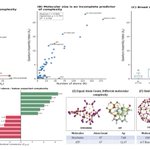




Critical points don’t lie. Graphs do. Electron-density topology has a new complexity meter: the Quantum Assembly Index (Aρ). Traditional scores treat molecules as flat stick-and-ball maps or bond subway diagrams. Aρ reads the electron cloud’s topography – peaks, paths, rings, and cages – via QTAIM critical points, then scores the shortest-path assembly cost plus ring/cage constraints. No fitted parameters. It scales with size, separates same-atom-count molecules identical on paper graphs, beats Bertz complexity and QED in binary classification, and boosts combined models.
The electron density as higher-dimensional terrain: nuclear maxima as summits, bond critical points as saddles, ring critical points as circulating vortices, cage points as enclosed voids. Aρ walks the minimum-cost paths and tallies the topological “assembly debt.” On diverse sets spanning inorganics, organics, biomolecular motifs, clusters, and frameworks, it captures physical organization pure connectivity descriptors miss.
Downstream of Bader’s QTAIM and parallel to Cronin’s Assembly Theory (bond-joining steps for evolutionary selection and biosignatures). Aρ grounds the idea in the observable density itself rather than abstract graphs. Sharper filters for drug-like molecules, materials with targeted electronic architectures, and machine-learning features that already “see” the quantum fog. Future reaction-network mapping and automated discovery pipelines could treat complexity as a physical observable instead of a heuristic.


Quantifying the physical complexity of chemical architectures through electron-density topology link.springer.com/article/10…


Feynman put 137 on the wall. We counted the links: one axiom yields ten digits of Feynman’s magic number. Alex Wissner-Gross dropped Chain Theory: reality is nothing but finitely many maximally entangled pairs of finite-dimensional quantum systems (qudits), some shared and known only by distilling them. From a single qutrit-qubit link it yields the exact algebraic candidate α(0) = (79 + 48√2 + 42√3 + 3√6)/31104 whose inverse is 137.035999189566…. That sits 0.60σ from CODATA 2022’s 137.035999177(21) and matches the first ten significant digits.
The Bekenstein bound says every region holds only finite information, so drop infinite fields or strings and use finite qudits. The Standard Model’s “ugly” product gauge group SU(3)×SU(2)×U(1)/Z₆ is simply the local basis changes on one maximally entangled qutrit-qubit pair. Particles look pointlike because their internal links are bound entanglement; maximally entangled yet undistillable by any single local operation, the quantum-information version of “you can’t resolve the constituents.”
Particles become finite “chainmail” of these links. Distillation (projecting onto a perfect pair) is the only process; there is no outside observer. Readable links are only those whose dimensions multiply to ≤6: spacetime (2,2) and electromagnetism (3,2). Strong, weak, Yukawa, and Higgs are “dark” – maximally entangled but observed only at second order, which the theory identifies with confinement.
The number itself is a weighted count over the 172 measurement records of that one qutrit-qubit pair (the candidate photon link). Records sort under exchanges into sectors weighted by 1, √2, √3, and √6. Lean formalizes the combinatorics with no free parameters and no hand-entered digits; only the photon identification is conjectural. A large working draft claims the Born rule, Lorentz signature, three generations, curvature, and the cosmological term also follow, still conditional.
The numerical agreement is tighter than most historical 137 numerology (Eddington’s 136/137, etc.). The first serious claim of a parameter-free derivation of a coupling constant that lands inside experimental error from a stated quantum-information axiom. If it holds, the landscape and anthropic selection become unnecessary: the numbers are outputs of the network, not inputs selected for observers.
Particles are discrete interlocking rings of entanglement rather than continuous strings. Gravity and the rest of the Standard Model become theorems of finite quantum information. Singularity’s first serious physics paper just arrived, and it’s counting chain links.


Parameter-Free Candidate for the Fine-Structure Constant from Entangled Qudits alexwg.org/publications/Chai…


Low-dielectric forcefields grown by cavitation; water tamed, dendrites demoted. Soap-and-sound oil-in-water forcefield tames water chaos for ultrastable zinc batteries. Surfactants sonochemically assembled into an oil-in-water electrolyte create a low-dielectric interfacial shield. This suppresses dendrites, hydrogen evolution, and corrosion on zinc anodes, delivering the long-term stability aqueous zinc batteries need to challenge lithium for grid storage.
Aqueous zinc-ion batteries (AZIBs) are cheap, safe, and abundant, yet water’s high dielectric constant (~78) heavily solvates zinc ions, deposits active water at the anode, and fuels tip-driven dendrites plus parasitic reactions. Amphiphilic surfactants self-assemble under ultrasound (sonochemical cavitation) into an oil-in-water microstructure. Hydrophobic “oil” domains lower the local dielectric constant at the interface, weaken water activity, reshape Zn²⁺ solvation/desolvation, and form a protective low-polarity barrier for more uniform deposition – like emulsifying a vinaigrette so oil coats the metal as a molecular raincoat while water carries ions.
Related oil-in-water microemulsions expand the electrochemical window to 3.52 V and enable 4800 h symmetric-cell cycling; low-dielectric co-solvents (ethyl acetate) reshape solvation for cryogenic performance and stable interphases; cationic, nonionic, and zwitterionic surfactants routinely deliver 2000–8000 h lifetimes via hydrophobic shielding and facet-selective adsorption. The sonochemical twist is clever: ultrasound enables rapid, controlled assembly rather than spontaneous micellization, echoing the group’s earlier ultrasonic SEI work.
Scalable, additive-level (often trace) solutions could push practical AZIBs toward commercial grid and home storage within years, especially if low-dielectric oil domains aid lean-electrolyte or low-temperature operation. Molecular forcefields grown by sound instead of expensive coatings – dish-soap chemistry plus ultrasound may outlast fancy solid electrolytes.
Surfactant-Mediated “Oil-in-Water” Electrolyte Design via Sonochemical Assembly: Low-Dielectric Interfacial Regulation for Ultrastable Aqueous Zinc Batteries onlinelibrary.wiley.com/doi/…

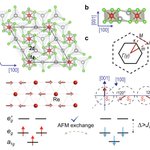
Electrically tunable topology. Plug in, fractionalize out • Spiral ReAg₂Cl₆ spins flat Chern bands into existence, no moiré lottery required. Monolayer ReAg₂Cl₆ (bulk already synthesized, easy to exfoliate) hosts four consecutive isolated flat Chern bands at the Fermi level in its 120° coplanar spiral antiferromagnetic state. Topology and flatness arise from the synergy of geometrically frustrated spins on the triangular Re lattice and strong Re 5d spin-orbit coupling, generating an emergent magnetic field distinct from moiré or ferromagnetic mechanisms.
The magnetic supercell reduces carrier density into the gate-tunable range while maintaining interaction scale U ~ 0.1 eV (far larger than moiré). Exact diagonalization shows fractional fillings can stabilize fractional Chern insulators and charge-density waves, potentially at higher temperatures than current sub-kelvin moiré realizations. Electrically tunable and generic to related Re compounds.


Postselection's dark bargain, linearity dies so nonlinearity lives. Superposition stayed linear until the survivors rewrote the rules. Its linearity snaps under postselected no-jump renormalization near an exceptional point. In a dissipative superconducting transmon, conditioning on trajectories that never jump from the excited {|e⟩, |f⟩} subspace into |g⟩ injects an anti-Hermitian nonlinearity.
The effective Hamiltonian [H_eff = (Δ − iΓ_e/2, J; J, 0)] (EP at Δ=0, J=Γ_e/4) governs only the survivors. Quantum tomography shows a prepared superposition’s trajectory diverges from the linear combination of separately evolved basis states, mismatch peaking across the EP. The same fracture appears for density matrices in the two-level subspace yet vanishes in the full three-level Lindblad dynamics – proof the nonlinearity is pure renormalization, not real energy exchange.
Unlike classical non-Hermitian waves or Hermitian nonlinearities (constrained to parts-per-trillion), this supplies controllable quantum nonlinearity absent from ordinary unitary or dissipative maps, unlocking new information primitives if one discards the jumps.


Nonlinear quantum evolution of a dissipative superconducting qubit journals.aps.org/prresearch/…


Upside-down birth certificate for the galaxy. Gravity’s slow-motion origami, thick chaos folded into thin order. 11 Gyr ago the disk was a cosmic pancake flip, then it never flipped back. Milky Way grew upside-down; thick turbulent birth first, then ever-thinner settled layers. Ancient stars formed in place inside a puffed, chaotic gas disk ~11+ billion years ago, not kicked upward later. Gaia + ChronoGal ages (<5% precision, ~0.5 Gyr even for the oldest) reveal a sharp break at 10.85 Gyr ago: vertical scale height (h_Z) plunged from >1.26 kpc to ~0.5 kpc in ~2 Gyr (from >4,100 to ~1,600 light-years), then thinned gradually to ~0.1 kpc (~400 light-years) for the youngest stars.
Two models competed: (1) stars born thin, then heated/scattered by molecular clouds, spirals, or the bar; or (2) upside-down formation, with early gas turbulent and thick from mergers, accretion, and feedback, then calming and settling. The abrupt early collapse matches the second. Thick-disk stars are fossils of that wild phase; the thin disk (Sun’s home, with most gas, dust, and star formation) assembled later in a quieter era.
This is the first clear observational discriminator for the early phase, via quasi-mono-age-metallicity populations from CMD-fitting of Gaia DR3 in the solar neighborhood. Simulations allowed both; the timeline now favors rapid settling when the galaxy was young and collision-prone. The disk’s layered anatomy • thin razor of young stars inside the thicker ancient layer of the plane • now has a precise birth certificate.
Future Gaia releases and ChronoGal refinements will map radial gradients and chemical tags of that 10.8 Gyr pivot, testing how common this two-stage collapse is across spiral galaxies. Our “flat” home was born fat and only later learned to slim down.


A Two-stage Settling of the Milky Way Disk Revealed by Precise ChronoGal Ages iopscience.iop.org/article/1…


FAT transformer nails AI fake voices at 94.6% accuracy while spotlighting the exact spectral scars that gave them away. It biases attention to the 0–4 kHz and 6–10 kHz artifact bands, then uses attention rollout + SHAP to show its work, unlike opaque black-box detectors. On ASVspoof 2019 it beats the ECAPA-TDNN baseline by 3.3 accuracy points and cuts the error rate by 3.4 points. Not absolute SOTA (best models now hit ~0.35% EER), but the clearest transparent forensic tool yet.
A bloodhound that circles the exact scent molecules. Next: lighter edge versions and real-world noise tests. Global stakes highest in voice-biometrics and phishing hotspots.


Explainable fake voice detection in AI-generated audio using frequency-aware transformers link.springer.com/article/10…


Chlorophyll’s revenge :: MRSA meets its maker at 660 nm. Ancient herbs ignite under light as multi-target ROS bombs that shred resistant superbugs, bypassing antibiotic shields entirely. Molecules used for centuries to “clear heat” and “resolve toxicity” now weaponize oxygen itself. Narrative review in Frontiers in Cellular and Infection Microbiology (Huang et al., Guangzhou Medical University) synthesizes three decades of work on five Traditional Chinese Medicine-derived natural photosensitizers – coumarin (from Dang Gui/Angelica), curcumin (turmeric), riboflavin (goji), pheophorbide a (chlorophyll derivative), and hypericin (St. John’s Wort) – for antimicrobial photodynamic therapy (aPDT).
Light excites the compound, dumping energy into oxygen to spawn singlet oxygen and free radicals that peroxidize membranes, oxidize proteins, and shatter DNA. Resistance mechanisms that neutralize single-target drugs are overwhelmed; biofilms are disrupted.
Wavelengths match the molecule: coumarin in near-UV (320–380 nm, modest yield); curcumin and riboflavin under blue light (~420–445 nm, singlet-oxygen quantum yields up to 0.60 and 0.54); PPa and hypericin in the red therapeutic window (590–670 nm, yields up to ~0.80) for deeper tissue penetration. Preclinical data show PPa and hypericin consistently cutting MRSA viability >1 log10 in vitro and controlling wound infections in animals; hypericin also downregulates virulence genes, hits Candida, and induces necrosis-like death in Leishmania.
Curcumin reduces oral microbial load (including SARS-CoV-2 traces) and blocks Candida biofilm formation; riboflavin inactivates Trypanosoma cruzi in blood products and disrupts Acinetobacter biofilms. Many compounds carry intrinsic antimicrobial activity even without light.

Traditional Chinese medicine-derived natural photosensitizers for photodynamic therapy against pathogenic infections frontiersin.org/journals/cel…


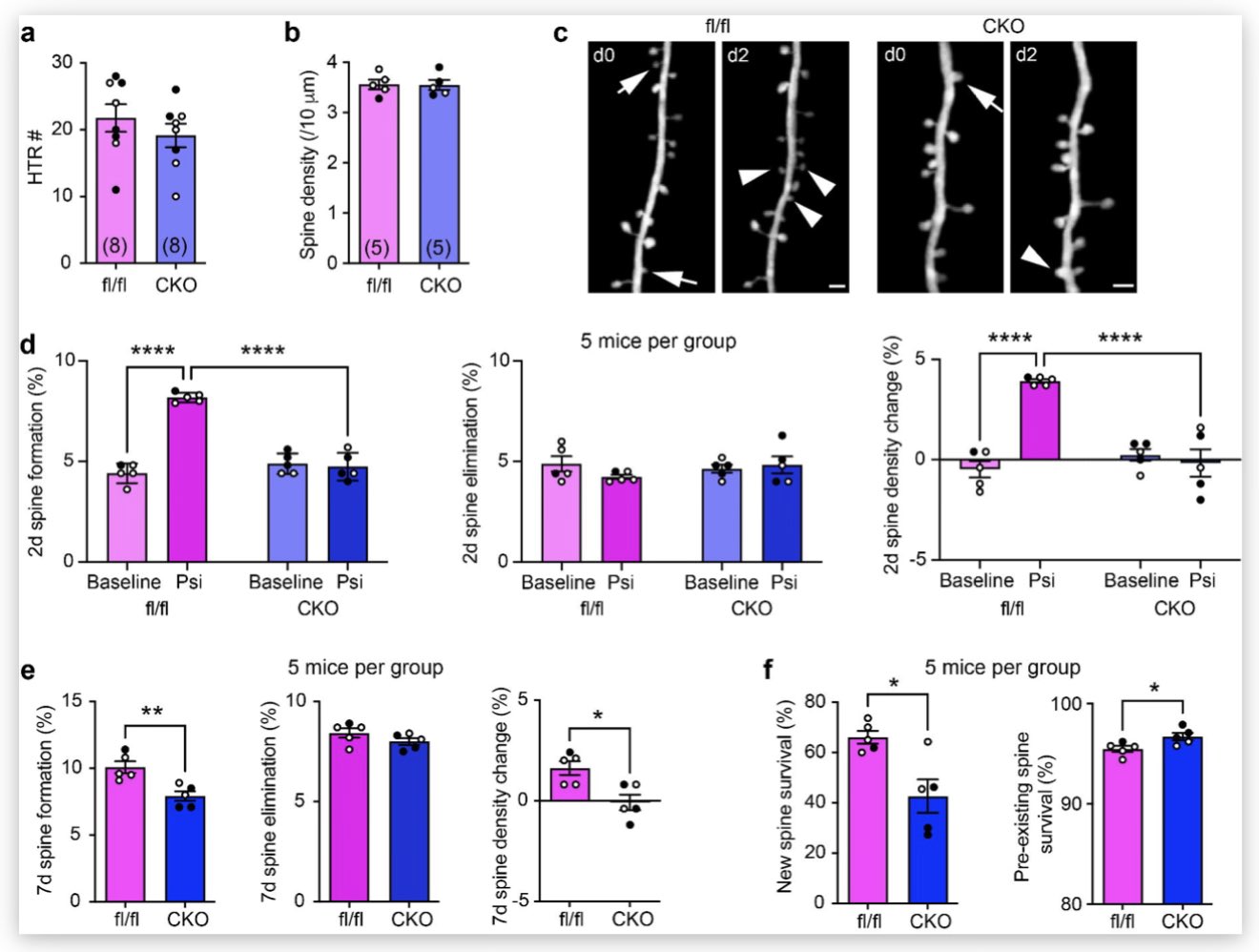
The trip is optional hardware; the remodel is the actual upgrade. Psilocybin rapidly grows and stabilizes new dendritic spines • tiny bulbous docks where neurons handshake • while pruning some old ones, via 5-HT2A receptors on layer-5 pyramidal neurons in mouse cortex. This structural rewiring separates cleanly from the hallucinogenic signal (tracked by rodent head-twitch response).
In living brains imaged by two-photon microscopy, new spines appear within 24 hours and mature faster into robust mushroom shapes packed with receptors, ready to lock in lasting mood and memory signals rather than fading as fragile stubs. Healthy mice show controlled turnover: a temporary surge, then older connections eliminate to keep overall density stable. Stressed mice (chronic mild unpredictable stress mimicking depression) get the stronger effect – more new spines, less loss of existing ones – countering the synaptic decay stress causes.
Restoring 5-HT2A only in those layer-5 cells restores spine growth and stabilization but kills the head-twitch; deleting the receptors from them blocks the plasticity yet leaves the twitch intact. Same receptor family, different cellular addresses. The hallucination proxy lives elsewhere. A concrete cellular map for non-hallucinogenic analogs; plastogens that deliver the fast, durable circuit updates linked to antidepressant effects without the eight-hour perceptual ride, clinical supervision overhead, or scalability bottleneck.
Stressed or depressed circuits may preferentially recruit the repair mode. The mushroom’s real magic was always the quiet renovation, not the light show.


5-HT2A receptors in layer 5 pyramidal neurons mediate the neuroplastic but not the hallucinogenic effects of psilocybin nature.com/articles/s41593-0…

Cosmo’s missing mass is slowly spelling its autobiography in UV. Planck-scale black/white-hole relics can make all the dark matter and they glow like faint cosmic fireflies in optical/UV, potentially detectable by IceCube-scale neutrino telescopes. Old idea revived and sharpened: Primordial black holes evaporate via Hawking radiation down to the Planck mass, then bounce (quantum pressure reverses collapse) into metastable white-hole relics that slowly spit out the remaining information-carrying quanta.
Prior estimates put the relic lifetime at (M^4) (initial mass (M)), which left the allowed mass window too constrained by BBN/CMB to supply all dark matter. The new argument uses the internal volume scaling ((t M^2)) plus white-hole time-reversal: lifetime becomes ~(M^5). That opens the window to roughly (10^7)–(10^9) g initial masses – plenty to match the full dark-matter density today without wrecking the early universe.
These remnants are not invisible. To preserve unitarity they must emit ~(M^2) soft quanta over their long lifetime, giving photon energies ~(1/M^2) (optical to UV for the interesting masses) and emission rates from ~(10^9) Hz down to ~(10^3) Hz. Averaged over galactic volumes, the total light output can rival the stars for the lower end of the mass range. “Dark” matter that is not entirely dark.
Treat the rare, slowly moving relics (one per Moon-volume on average, denser in the Solar System) as micro-fireflies (~(10^{-10}) W each). A cubic-kilometer array of photomultipliers (IceCube or KM3NeT style) could catch the statistical excess of photons along a linear trajectory, ideally aligned with the dark-matter wind toward Cygnus. One clean event per day possible for optimistic parameters, with decent signal-to-noise. Spectral width from redshift and a monochromatic assumption are the soft spots; broader spectra or slightly longer lifetimes ease existing optical/UV background limits.
A confirmed optical/UV glow or trajectory signature would be the first direct evidence of quantum-gravity remnants and possibly of structures older than the current expanding phase.
Clarifications on black/white hole metastable relics as dark matter scixplorer.org/abs/2026arXiv…