

The English Constitution Info. https://teapawt.org/t.co/YFlRdShuoj The English Constitution Society. https://teapawt.org/t.co/UXzC5QJAes @englishexit @SecretPeopleTSP
Joined July 2024
- Tweets2.4K
- Following112
- Followers992
- Likes67






@Constitutional Checks🏴🏴 retweeted

There has been a persistent attack on the English People by the British State since 1948. Until that time there was absolutely NO QUESTION as to who the English People are; and I will add STILL ARE, despite the enactment of of any repugnant legislation attempting to redefine historic and legal history.
'That after the said limitation shall take effect as aforesaid, no person born out of the Kingdoms of England, Scotland, or Ireland, or the dominions thereunto belonging (although he be naturalized or made a denizen, except such as are born of English parents) shall be capable to be of the Privy Council, or a member of either House of Parliament, or to enjoy any office or place of trust, either civil or military, or to have any grant of lands, tenements or hereditaments from the Crown, to himself or to any other or others in trust for him;' [Act of Settlement (1700)]

@Constitutional Checks🏴🏴 retweeted

The series and explainers. England and English heritage. "The Laws of England are the birthright of the people thererof" Act of Settlement 1701 chapter IIII
Not on the face of the Bill.
Dedicated to "Tom" a true English Judge.
aka SIR ALFRED DENNING One of the Lords Justices of His Majesty's Court of Appeal in England.
@Constitutional Checks🏴🏴 retweeted
Stealth repeals of our rights is fraud by omission. We want ALL English rights back and here in a nutshell is why. This video could be vastly expanded with reasons why what Parliament, Judges and the Crown has acted ultra Vires, but in a nutshell . . .
@Constitutional Checks🏴🏴 retweeted
Where do your rights come from? England and the English. Read the article.
@Constitutional Checks🏴🏴 retweeted
Queens Declaration 20th July 1988 - separation of powers - no power is absolute. Therefore parliament is not sovereign. rumble.com/v7gwlw2-queens-de…
“The Revolution Settlement put into practice the cardinal principles of the sovereignty of the Crown in Parliament and the separation of powers… Experience has taught that peoples can enjoy the full fruits of liberty, security and justice only when they are represented in a sovereign legislature whose laws are interpreted by an independent judiciary.”
Her most Gracious Majesty Queen Elisabeth II
I'll read out the speech tonight and show the constitutional law that forbids a Somalian becoming an MP or other other position of authority over the English.

@Constitutional Checks🏴🏴 retweeted
Restore England.


🚨DISGUSTING: This is Judge Tracey Lloyd-Clarke, Recorder of Cardiff. She sentenced ex-soldier Daffron Williams — a 41-year-old veteran who served in Iraq and Afghanistan and suffers from PTSD — to two years in prison (half to be served in custody) for Facebook posts made in the tense days after the Southport child murders.
His posts referenced “civil war is here” and included anti-Islamic imagery. She acknowledged his military service, good character references, and mental health struggles… but still sent him to prison for words on the internet.
The same judge has also jailed others for social media posts in the post-riot crackdown, including 24-year-old David Morgan who received 20 months for tweets involving Nazi imagery and racist content.
Yet when Rees Newman — convicted of the historic rape of a girl under 14 — appeared before her for breaching his sex offender requirements, she suspended his two-month jail term, explicitly citing prison overcrowding.
A veteran with PTSD goes to prison for Facebook comments warning about cultural conflict.
A child rapist walks free because the jails are too full.

@Constitutional Checks🏴🏴 retweeted
The laws referred to here are ALL English. Not British!

@Constitutional Checks🏴🏴 retweeted
1/ The English Bill of Rights didn’t say “until the next Parliament gets bored.”
It said officers shall serve according to it in all time to come.
It said heirs and posterities submit for ever.
It said it shall be the law of this realm for ever.
2/ So a serious question for MPs, judges, barristers, solicitors, and the Crown:
Which part of forever needs a translation?
3/ You call yourselves honourable and learned.
Then explain how “for ever” became optional.
🤖 Made with AI

@Constitutional Checks🏴🏴 retweeted

These pieces of legislation cannot ever be repealed or replaced because it would be treason if the british parliament attempted it🏴
⚖️Bill of Rights Act 1689: -
"All promises of fines and forfeitures without due process are illegal and void"⚖️
⚖️Bills of Exchange Act 1882: -
"There is no recognisable legal means to respond to a demand for payment without a true bill which is based on a pre-existing commercial agreement"⚖️
⚖️Liberty Of Subject 1354: - No man shall be put out of land or tenement, nor taken, nor imprisoned, nor disinherited, nor put to death, without being brought in answer by due process of the law.”⚖️
⚖️Observance Of Due Process Of Law 1368: - Also known as: Reaffirmation of #MagnaCarta or #DueProcess #Confirmation - Key Provisions (Plain English Summary):
The statute declares that:
No man shall be taken, imprisoned, outlawed, exiled, deprived of lands or property, or put to death without first being brought to answer by due process of law.
It continues:
And if anything be done to the contrary, it shall be reversed and held for nothing.
In other words:
•No punishment without legal process
•No dispossession without a proper hearing
•Any action taken contrary to this is void and unlawful⚖️
⚖️Magna Carta 1215 – Clause 39
“No free man shall be seized or imprisoned, or stripped of his rights or possessions… except by the lawful judgment of his equals or by the law of the land.”⚖️
In Thoburn v Sunderland City Council, Lord Justice Laws defines a constitutional statute as one that either conditions the legal relationship between citizen and state in a general manner, or, one that changes the scope of fundamental constitutional rights.
He expressed the view that: "Ordinary statutes may be impliedly repealed. Constitutional statutes may not."
⚖️ Legal Status in 2025
✅ All 4 Laws are still in force.
🧷 Recognised as constitutional statutes—not impliedly repealable.
📚 Cited by courts in Entick v Carrington (1765), R v Secretary of State for the Home Department, ex p. Simms (1999), Thoburn v Sunderland (2002)⚖️
📢 ⚖️Application in Modern Cases
•Can be cited in challenges to unlawful enforcement, eviction without hearing, or secretive court processes
•Forms the legal root of Article 6 ECHR: the right to a fair trial
•Protects against any attempt to strip liberty, property, or rights without notice, hearing, and lawful process⚖️
@Constitutional Checks🏴🏴 retweeted

"Self-defence therefore, as it is justly called the primary law of nature, so it is not, neither can it be in fact, taken away by the law of society." - Sir William Blackstone 🏴

@Constitutional Checks🏴🏴 retweeted

Today, the Lady Chief Justice publicly objects to the slightest criticism of the judiciary and retired judges propose returning to offences against the judiciary. Lord Denning had it right (on this one). I wish today's judges and politicians were as courageous on such things.


@Constitutional Checks🏴🏴 retweeted
The original Petition of Right 1628 drafted by Sir Edward Coke and John Selden and enacted by an ENGLISH parliament. Still law! Protected by common law and the English Bill of Rights1688!


@Constitutional Checks🏴🏴 retweeted
The Full English Show tonight 8pm live.
rumble.com/v7dhq5w-statement…
Statement of fact and argument of a Free Subject of the English Realm.
I speak as a free subject of this realm, claiming the rights that the original law and contract itself declared to be mine.
The common law of England has never admitted the Roman maxim of desuetude to do so would be a subversion of the Laws of England. Statutes and declared rights do not wither, lapse, or lose force through the mere passage of time, non-use, or contrary practice. Continuity is the very essence of the common law: what was law remains law until it is lawfully altered according to the forms that the law itself provides. This rejection of desuetude is the foundation upon which the ancient rights of the subject stand unbroken.
Because desuetude has no place, the rights declared in the Act of 1689 remain of the same force and effect as the day they were enacted.
That Act is titled “An Act Declaring the Rights and Liberties of the Subject and Settling the Succession of the Crown.” It declares the rights therein set forth to be “the true, ancient and indubitable rights and liberties of the people of this kingdom, and so shall be esteemed, allowed, adjudged, deemed and taken to be.” It commands that “all and every the particulars aforesaid shall be firmly and strictly holden and observed as they are expressed in the said declaration, and all officers and ministers whatsoever shall serve their Majesties and their successors according to the same in all time to come.” And it enacts that the whole “shall stand, remain and be the law of this realm for ever.”
The Act of Settlement of 1701, titled “An Act for the further Limitation of the Crown and better securing the Rights and Liberties of the Subject,” confirms and ratifies the same. It states that “the Laws of England are the Birthright of the People thereof and all the Kings and Queens who shall ascend the Throne of this Realm ought to administer the Government of the same according to the said Laws and all their Officers and Ministers ought to serve them respectively according to the same.” The birthright of the people cannot be extinguished by the passage of years or by later instruction that pretends the opposite.
Section III of the Bill of Rights provides that “no charter or grant or pardon granted before the three and twentieth day of October in the year of our Lord one thousand six hundred eighty-nine shall be any ways impeached or invalidated by this Act, but that the same shall be and remain of the same force and effect in law.” Magna Carta is such a charter. It declares that no free man shall be arrested, imprisoned, disseised, outlawed, exiled, or otherwise destroyed, nor proceeded against, except by the lawful judgment of his peers or by the law of the land, and that to no one will right or justice be sold, refused, or delayed. This is the observance of the law of the land that remains law. It forms part of the birthright of the people and stands protected forever.
Section II of the Bill of Rights enacts that “no dispensation by non obstante of or to any statute or any part thereof shall be allowed, but that the same shall be held void and of no effect.” In a legal order that rejects desuetude, this clause confirms that the declared rights cannot be sidestepped by executive pretence or by any claim of obsolescence.
What is void remains void.
The Coronation Oath binds every King and Queen to govern the people of this kingdom according to the statutes in Parliament agreed on and the laws and customs of the same. The rights declared in 1689, the laws confirmed in 1701, and the ancient charters protected by Section III are among those statutes, laws, and customs. The Oath therefore requires their observance. The Crown must either assent or refuse; it cannot abstain. Yet the original texts forbid any assent that would set aside the rights that are to be firmly and strictly holden in all time to come and for ever.
To pretend that Parliament could enact a law that went against these undoubted rights is to deny the original contract between the Crown and the people, as recognised in the constitutional settlement itself. Any monarch who assented to such a law would thereby perjure the Coronation Oath and forfeit the Crown, for the Oath requires government according to the statutes, laws, and customs that include these perpetual rights. Any judge who ruled to the contrary would perjure their own oath to do justice according to the law, and would fail to advise the King properly. Such counsellors and judges would become the very essence of those condemned in the preamble to the Bill of Rights: the “various* evil counsellors, judges and ministers” by whose assistance the late King James the Second did endeavour to subvert the laws and liberties of this kingdom.
*The original word was “divers” which is archaic English and today means “various” or “several.”
Taken together, these original texts produce a single, unbroken conclusion. The rights of the subject are not temporary privileges that may be redefined, suspended, or allowed to fall into disuse. They are ancient, indubitable, and perpetual. They are the birthright of the people. They bind the Crown, the officers, and the ministers in all time to come. Because the common law refuses the maxim of desuetude, no amount of later teaching, professional instruction, or state practice can lawfully erase them. Any claim that these rights have somehow become alterable or optional is a departure from the original settlement itself.
I therefore claim and insist upon these rights as my birthright. They stand for ever. They are to be firmly and strictly holden and observed by all who govern or serve under the Crown. Any law, dispensation, or proceeding that stands outside these protections is void and of no effect by the original force of the texts themselves. The subjects of the realm stand upon the law as it was declared, strictly holden, and secured forever.
By using the words and phrasing forever, all time to come and various sections forbidding change – the original contract expressed that desuetude shall not have any effect on these laws or rights. In fact, a Scottish court that acknowledged A.V. Dicey’s thoughts on this.
The case is MacCormick v Lord Advocate 1953 SC 396 (also reported as 1953 SLT 255). In the course of the case the Lord Advocate "conceded" that the Parliament of the United Kingdom “could not” repeal or alter certain “fundamental and essential” conditions of the Treaty/Acts of Union 1707.
Every English child should be taught this in School. The UK Parliament cannot subvert, abrogate or repeal any English law.
@SecretPeopleTSP @WhiteHouse @SecRubio @gabby_cabby

@Constitutional Checks🏴🏴 retweeted

The People of England hold the Birthright of Law in their Constitution, hard won through generations of their ancestors....
The English Constitution following the Bill of Rights 1689 🏛️
Under the English constitution, the relationship works like this:
The Crown:
✅ Chooses ministers
✅ Grants honours
✅ Commands the armed forces
✅ Treaties & foreign policy
❌ Cannot suspend laws
❌ Cannot tax without consent
❌ Cannot maintain a standing army
Parliament:
✅ Makes laws
✅ Controls taxation
✅ Holds government to account
❌ Cannot act without Royal Assent
❌ Cannot change the constitution unilaterally
❌ Cannot remove the Crown's prerogative without consent
The Judiciary:
✅ Interprets the law
✅ Protects individual rights
✅ Guards the constitution
❌ Cannot make law (only interpret)
❌ Cannot override Parliament's legislation
The People:
✅ Elect Parliamentary Representatives
✅ Petition the Crown
✅ Bear arms (1689 right)
✅ Ultimate sovereignty
❌ Cannot govern directly (representative system)
The Importance of THE PEOPLE:
The Earl of Chatham's Vital Contribution 🎩
It is right to invoke William Pitt the Elder (Earl of Chatham). He was one of the most brilliant defenders of the balanced constitution and specifically warned against the dangers of Parliamentary absolutism which we appear to be sliding towards today.
His Key Constitutional Arguments:
Pitt argued passionately that:
1. The Crown Was NOT Subordinate to Parliament
The Crown retained its independent prerogative powers
The Crown was a co-equal branch of the constitution
The Bill of Rights constrained the Crown but did not subordinate it
The Crown's prerogative was part of the balanced system
2. Parliament Could Become a Tyrant Too
Pitt specifically warned that:
Parliament could become as tyrannical as any King if it claimed absolute power
He understood exactly that transferring absolute power from King to Parliament just swaps one tyrant for another.
3. The People Were the Ultimate Check
Pitt argued that:
The people's consent was the foundation of the whole system
If Parliament exceeded its legitimate authority
The people had the right to resist
This was not rebellion — it was constitutional self-defense
#Piddington
#EnglishConstitution
@englishexit @SecretPeopleTSP @PiddingtonRoars
@Constitutional Checks🏴🏴 retweeted
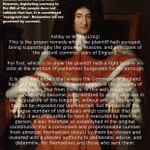
The convention parliament of 1688 did nothing more than make future Monarch's subject to the Law. The original contract is exclusively between the Monarch and Subject, and it is from this that his authority to govern originates. Those governing powers are delegated to those under oath to him; his servants, who have no power to exceed the powers authorised to the Monarch., nor do they hold all of the powers of the Monarch.
All legislation requires the common consent of the realm via the Houses of Commons and Lords, without which it is illegitimate and of no effect. Only the Monarch has the authority to convert a Bill to law.
We see today that this process has been subverted from what was originally intended with legislation being enacted arbitrarily and Assented to by what can only be described as by a Monarch ignorant of the terms of his role or, in defiance of his contractual obligations.


@Constitutional Checks🏴🏴 retweeted
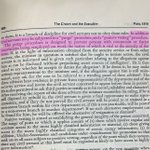
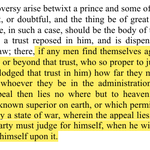
Halsbury’s Laws of England. 4th Edition volume 10 constitutional law, paragraph 920,943 and 944.
@SecretPeopleTSP
The law is clear the monarch MUST obey the law and the monarchs Judges breach their oath if they ignore the English Bill of Rights 1688. The Judges are the crown. Even Magistrates.
THERE IS MUCH MORE.


@Constitutional Checks🏴🏴 retweeted
As it should be.
England's oldest book on English Law, The Mirror Of Justices. (circa.1290)
'Others south-sayers, who numbered nights and days and hours, whereby they ordered their business. There were many other kinds, all which manner of diviners are to be, by the word of God himself, and authority of the church to be excommunicated, and forbidden as much as mahometanism, and things against the true faith. And this St. Augustine proves by many reasons; and hence it is, that they who travel to witches or diviners to know things to come give that to the creatures which belongeth to God alone. Wherefore these wicked doers are to be removed from the society of God's holy people, so that no good Christian be taken with their art, nor partner in their sins.'
'or thus. Molling who is there defamed by good people, that such a day he denied his baptism, and caused himself to be circumcised, and became a Jew, or a Saracen, or offered or sacrificed to Mahomet in contempt of God, to the damnation of his soul; and this offence he did feloniously, etc.,'


@Constitutional Checks🏴🏴 retweeted
Why only two?
And why complicat the complicated with more complication?
There always seems to be talk of the American Constitution, but when it comes to the foundation of that constitution there is silence. Clearly I am talking about our English Constitution and the principles upon which it is founded.
The intention of having a Parliament is meant to be an expression of the voice of the people who elected them as their representatives, therefore has absolutely no Right to enact speech inhibiting legislation contrary to the Will and consent of that People.
The only legislation required regarding speech is confirmation that Parliament has no inherent Right to restrict any form of speech. Let our English Common Law and a jury do the rest.
Constitutional illiteracy must be reversed if we are to take our destinies back from the Communists and restore our ancient civilisations.
@MCRReiners

There are two competing visions for free speech in Britain now: a US-style approach, proposed by @ASI, and a more conservative view, proposed by the @Prosperity_Inst.
Which vision of the future do you prefer - one, the other, or a combination of them?
prestonbyrne.com/2026/07/11/…

@Constitutional Checks🏴🏴 retweeted
Start with the king.
WHEN CROWN SERVANTS SUBVERT THE CONSTITUTION, THE KING’S RIGHT TO THE THRONE IS ANNULED. 👇 teapawt.org/SecretPeopleTSP/status…


Yep, it's undeniably true.
That's that principle established in 1688 which enabled the present monarch's ancestor to occupy the English Throne, thereby enabling the present monarch to do the same. If it wasn't for that, Charles would not be King today.
By the very same principle, he too performs an abdication by the breaking of the Contract, and the Trust of the People placed in him as King.
The grievances at the time were that our Religion, Law, and Liberties had been subverted. The same is observably true of today's Monarch and HIS officers and ministers.
I'm not too sure if he's aware of the precariousness of his situation.
'Mr Serjeant Holt:
B U T, my Lords, both in the common Law of England, and the civil Law, and in common Understanding, there are express Acts of Renunciation that are not by Deed; for if your Lordships please to observe, the Government and Magistracy is under a Trust, and any acting contrary to that Trust is a renouncing of the Trust, though it be not a renouncing by formal Deed: For it is a plain Declaration, by Act and Deed, though not in Writing, that he who hath the Trust, acting contrary, is a Disclaimer of the Trust; especially, my Lords, if the actings be such as are inconsistent with, and subversive of this Trust: For how can a Man, in Reason or Sense, express a greater Renunciation of a Trust, than by the constant Declarations of his Actions to be quite contrary to that Trust?
T H I S, my Lords, is so plain, both in Understanding and Practice, that I need do no more but repeat it again, and leave it with your Lordships, That the doing an Act inconsistent with the Being and End of a thing, or that shall not answer the End of that thing, but quite the contrary, that shall be construed an Abdication and formal Renunciation of that thing.' - [The Histoty And Proceedings Of The House Of Commons Of England, &c. Vol.II (1742). p.212-3.]
'Their grand Vote of the Vacancy of the Throne.
Resolved, That King James the Second, having endeavour'd to subvert the Constitution of the Kingdom, by breaking the Original Contract between King and People; and by the Advice of Jesuits, and other wicked Persons, having violated the Fundamental Laws, and withdrawn himself out of the Kingdom, hath Abdicated the Government, and that the Throne is thereby become Vacant.' - [The Histoty And Proceedings Of The House Of Commons Of England, &c. Vol.II (1742). p.203]
The Declaration of Rights 1688:
'Whereas the late King James the Second, by the assistance of divers evil counsellors, judges and ministers employed by him, did endeavour to subvert and extirpate the Protestant religion and the laws and liberties of this kingdom; ...'
'... And whereas the said late King James the Second having abdicated the government and the throne being thereby vacant, ...'
An Act declareing the Rights and Liberties of the Subject and Setleing the Succession of the Crowne. - [Bill of Rights (1688)]
'Subjects’ Liberties to be allowed, and Ministers hereafter to serve according to the same.
VI. Now in pursuance of the premisses, the said lords spiritual and temporal, and commons, in parliament assembled, for the ratifying, confirming and establishing the said declaration, and the articles, clauses, matters, and things therein contained, by the force of a law made in due form by authority of parliament, do pray that it may be declared and enacted, That all and singular the rights and liberties asserted and claimed in the said declaration, are the true, ancient, and indubitable rights and liberties of the people of this kingdom, and so shall be esteemed, allowed, adjudged, deemed, and taken to be, and that all and every the particulars aforesaid shall be firmly and strictly holden and observed, as they are expressed in the said declaration; and all officers and ministers whatsoever shall serve their Majesties and their successors according to the same in all times to come.'
Pretty straight forward eh. 🏴


