

Battlefield Tour Guide for Leger Battlefield Tours , ex Soldier , ex Cop ,Lead WW2 Researcher for the DLI Archive and Writing a book on the DLI in Normandy !!
The DS General Office .
Joined November 2010
- Tweets5.9K
- Following565
- Followers782
- Likes38.4K





Pinned Tweet
A Return to the Ostfront in September next year , i'm looking forward to being back in Stalingrad teapawt.org/LegerHolidays/status/1…


You might even get to meet the delightful Lady Barnard.

Raby Castle at Christmas in a whole new light 🏰🕯️✨
🗓️ 4th, 11th, 12th, 18th, & 19th December
⏰ 4:00 - 6:00pm
➡️ Book now | raby.co.uk/events/castle-by-…
📸 Chris Parkinson


42
Paul Errington retweeted

Raby Castle at Christmas in a whole new light 🏰🕯️✨
🗓️ 4th, 11th, 12th, 18th, & 19th December
⏰ 4:00 - 6:00pm
➡️ Book now | raby.co.uk/events/castle-by-…
📸 Chris Parkinson
Paul Errington retweeted

Today we remember PC Sharon Beshenivsky of @WestYorksPolice who was shot & murdered on this day in 2005 as she responded to an armed robbery.She was 38,married with 3 young children. In 2009 we placed our memorial to her service & sacrifice
#HonouringThoseWhoServe #PoliceFamily


Paul Errington retweeted

Scenes from El Alamein 85 years ago: glimpses of the Egyptian railways, the historic El Alamein station, the coastal road, the route toward the Qattara Depression, landmines, and the graves of those who fell in the war.
@MmarianneJoseph @ww2research
#ww2 #ww1

Paul Errington retweeted

On November 9, 1914, many British battalions had been reduced from 1,000 men to just a handful of surviving officers and troops. The BEF was effectively sacrificing its pre-war professional core to stabilize the front line.

Paul Errington retweeted

Sadly, the last known surviving WW2 veteran of the SAS, Matthew "Matt/Jock" Mackinnon-Pattison died on Thursday 5th November aged 102years. We remember Matthew. Here is a summary of Matthew's wartime service. Please share widely: Matt MacKinnon Pattison was among hundreds of thousands of Allied soldiers who fought Germans in Italy in the spring of 1944.
Sometimes remembered as the "D-Day Dodgers", in reference to their role away from Normandy, men in Italy faced brutal conditions as they battled to take Monte Cassino and dislodge enemy soldiers.
"We came back from Italy having flogged ourselves to pieces, nervous wrecks, and people say 'where were you on D-Day?'" said Matt, from Penrith, Cumbria.
"We just say we were busy bloody well fighting."
British Prime Minister Winston Churchill thought of Italy as the "soft underbelly" of Nazi-dominated Europe, but the campaign there proved difficult and costly.
With perhaps typical military irony, the men in Italy adopted the "D-Day Dodgers" moniker, even creating a song to the tune of Lili Marleen, a famous wartime melody.
"We are the D-Day Dodgers in sunny Italy," rang the chorus.
But this was no sojourn in the sun and the Allied forces knew it.
Enemy soldiers were dug in on defensive lines across the country, and at Monte Cassino it took four separate attacks from US, British, Polish and Commonwealth forces to destroy and take the hilltop monastery.
Matt still has razor-sharp memories of the battles he fought, and the comrades he lost.
He fled agricultural service in Kilmarnock as a teenager to get to Glasgow to enlist as an infantryman before ending up "right in the forefront" of the battle for Monte Cassino.
Advancing up the slopes amid the fog of deadly artillery bomb blasts and the continual crackle of gunfire, the soldier saw many of his comrades fall.
But, he said, there was no time to be frightened.
"You don’t look upon it as bravery, you just look at it as part of your life," he told the BBC.
"When the officers told you to advance, that was what you had to do.
"Every battle is the same. You get pounded to death, whether it was Normandy, Burma or anywhere."
Matt was recruited for the SAS after being injured and taken to a Naples hospital to recover.
From 100 candidates, he was just one of 10 that made it. He was dropped behind enemy lines near Genoa, tasked with finding Italian dictator Mussolini who by then had been captured by partisans.
Once the war was over, he was sent to Germany as part of the War Crimes Unit to find Nazi suspects who had executed captured members of the SAS.
There, he said, he saw a broken nation, but people "just like us".
Eight decades on, he can clearly recall the claustrophobic horror of war, from German soldiers playing dead to entice Allied soldiers into shooting range, to landmines and enormous loss.
"I lost a lot of my mates, especially one called Ginger," he said.
"And when he died he was sitting in a trench with his head down. There was a smile on his face."
"Still a smile on his face that marked the place where he and his maker met.
"And that was Ginger. He was a good lad."
Dodging D-Day was no pass, and so many thousands paid the ultimate price in Italy.
In his flat, Matt still has his SAS beret, his medals and his memories.
He also has his nation’s thanks.
(Source: bbc.co.uk/news/articles/ce99…)


Paul Errington retweeted

Remember this former @WestYorksPolice PCSO, he fell as a PARA in Afghanistan

Paul Errington retweeted

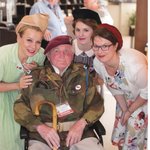
The Trust is delighted to announce that Normandy Veteran Richard Brock has been appointed Memorial Ambassador!
He is pictured at events in Preston's Lancashire Infantry Museum earlier this week where he shared his story with young people and was interviewed by our Youth Ambassador, Alexander Churchill.
Richard, aged 102, served with the 1st Battalion, East Lancashire Regiment. Richard sailed aboard the Ocean Vigil and landed in Normandy on 8 June 1944, amid naval bombardment and German artillery fire.
He went on to operate a Universal Carrier during the campaign through north-west Europe, including the Battle of Normandy, the Battle of the Bulge, the liberation of Holland and the crossing of the Rhine.
Of his appointment as Ambassador he said:
"I am proud and humbled to accept the position of Ambassador for the British Normandy Memorial. Over the past four years I have been flying the flag for all the men and women who didn't make it back home. Also for my dear pals of my company of 130 lads who landed with me on Gold Beach. After nearly a year of bitter fighting, travelling over 2,000 miles, only 19 made it back. I am the last one alive today.
They are always in my thoughts. I have always said that they are the heroes and I am honoured to carry on their memory." ❤️
📷 Florence Marsac / British Normandy Memorial


Paul Errington retweeted

🎥Remarkable footage of Tiger I tanks from schwere Panzer-Abteilung 502 (Otto Cairus' unit) operating in the northern sector of the Eastern Front in 1943, filmed for Die Deutsche Wochenschau.
▶️These are early-production Tigers, with S-Minenwerfer antipersonnel mine launchers visible at the rear. The system consisted of five launchers: two at the front, two at the rear, and one on the left side of the hull. Electrically fired from inside the tank, they launched fragmentation mines to repel enemy infantry approaching at close range. The two rear launchers sat on brackets extending beyond the hull.
Paul Errington retweeted

Lance Corporal Sarah Jane Warke was assigned to the Military Reaction Force, a special unit which operated in Northern Ireland in small teams of plainclothes personnel.
Jane was originally from Derry in Northern Ireland, before joining the British Army, where she served in the Women’s Royal Army Corps.
Jane used the alias ‘Kate’ while working for the Four Square Laundry, a front company targeting the homes of suspected IRA members in the Twinbrook estate in West Belfast. When the dirty clothing was picked up, it was forensically examined for gunpowder and explosive residue before being washed, folded, and returned. Jane was friendly, attractive, and her local accent allowed her to easily blend in.
In the fall of 1972, the IRA discovered two double agents named Kevin McKee and Séamus Wright in their ranks who gave up details of the laundry van and other front companies run by the Military Reaction Force. The IRA executed the two double agents and buried them in unmarked graves.
On October 2nd, 1972, the IRA conducted two attacks against known MRF personnel. Jane was speaking to a housewife at her front door while the MRF driver, a Sapper from the Royal Engineers named Corporal Ted Stuart stayed in the delivery van. Four IRA gunmen pulled up near the van and opened fire.
Corporal Stuart was shot at least five times and died on the scene. The IRA claimed they also killed two more intelligence officers conducting surveillance from a hidden space inside the roof of the van, although British forces denied this.
There are varying accounts of Jane’s actions during the attack. Some reports indicate she survived by hiding inside a house until the danger had passed. Others say she was wounded but managed to draw her concealed Browning Hi-Power and shoot back. The IRA gunmen fled the scene in the face of her determined fire and Jane survived. An hour later, they attacked the Gemini Massage Parlour on Antrim Road, injuring one man inside.
In September 1973 Jane was awarded the Military Medal for this and other covert operations in Northern Ireland.
#northernireland #covert #clandestine #troubles #britisharmy

Paul Errington retweeted

General Sir Peter Edgar de la Cour de la Billière KCB KBE DSO MC & Bar DL
On 6 October 1990, a soldier who had joined the British Army as a private thirty-eight years earlier landed in Riyadh to take command of every British serviceman in the Middle East. Lieutenant-General Sir Peter de la Billière inherited a force that was still building, and would become Britain's largest deployment since the Second World War, and with it the task of making British arms count inside an American-led coalition under General Norman Schwarzkopf. It completed one of the most improbable rises in the modern Army. Born in Plymouth on 29 April 1934, he had lost his father, a naval surgeon, when HMS Fiji was sunk by German bombers off Crete in May 1941; he enlisted in the King's Shropshire Light Infantry as a private in 1952, was commissioned into the Durham Light Infantry in 1955, and joined the Special Air Service the following year. What followed was three decades of undeclared wars: Malaya, where he was mentioned in despatches; Oman in 1959, where he led a troop in the assault on the Jebel Akhdar and won the Military Cross; the Radfan and Borneo from 1964 to 1966, which brought the Bar to the MC; and Dhofar in the early 1970s, for which he was appointed to the Distinguished Service Order. He commanded 22 SAS from 1972 to 1974, and from 1979 to 1983 he commanded the SAS Group, the officer in overall command in May 1980 when the SAS stormed the Iranian Embassy at Princes Gate.
The Gulf command tested everything those small wars had taught him. As Commander British Forces Middle East he was Schwarzkopf's British counterpart, and he forged the close working relationship with the American commander on which the British contribution depended. He deployed his old regiment deep into western Iraq in patrols hunting the Scud launchers that were threatening Israel and the coalition, and when the ground offensive began on 24 February 1991 his forces formed part of the coalition's great "left hook" through the Iraqi desert. The 1st Armoured Division under Major General Rupert Smith passed through the minefield breach cut by the Americans and, in a hundred hours of fighting, covered 170 miles and took the surrender of thousands of Iraqi troops, in the largest British armoured operation since the Second World War. Kuwait was liberated and the ceasefire came on 28 February; 47 British servicemen had been killed. De la Billière's war had been the headquarters' war, the briefings and the coalition politics, and he had played it as a soldier who had spent his career on the other side of such rooms, in the deserts where the plans met the enemy.
He was appointed a Knight Commander of the Order of the British Empire, promoted to full general, and made a special adviser to the Ministry of Defence on Middle East affairs before retiring in June 1992 after forty years in uniform. In 1992 he published Storm Command, his personal account of the Gulf War, and in 1994 Looking for Trouble, his autobiography; both were bestsellers, though his willingness to write about special forces drew sharp criticism from within the regiment he had once commanded. His documented contribution is the arc itself: a private soldier who won gallantry medals across three decades of the Empire's last small wars, and who rose to command Britain's last victorious large-scale conventional campaign, becoming the public face of a war that was fought by a coalition, won in a hundred hours, and ended with its objectives intact. Few careers have spanned the full distance between the troop commander on the Jebel Akhdar and the general who sat beside Schwarzkopf in Riyadh, and that distance is the measure of him.

Paul Errington retweeted

The CWGC cemetery at #Ballangen, Norway: a quiet resting place for Commonwealth servicemen who died in the fighting around Narvik in 1940. Far from home, beneath Norwegian skies, they lie in immaculate graves, their sacrifice remembered. Rather poignantly, someone has left a Union flag here.
More than 80 years later, we still remember. 🇬🇧🇳🇴 #WW2 #CWGC


Paul Errington retweeted

The best general of WW2 might be a man most people have never heard of: William Slim.
No famous pistols. No riding crop. No glamorous desert duels. Just a stocky, square-jawed Englishman his troops called "Uncle Bill." And he pulled off what might be the greatest turnaround of the entire war.
Slim wasn't supposed to be a general at all. He grew up in a family that had fallen on hard times. He worked as a clerk and a schoolteacher. He got into the army through a university officer training corps he wasn't even enrolled at. He was badly wounded at Gallipoli in WW1, then worked his way up the Indian Army with no money and no connections.
In 1942, he was handed a disaster.
The Japanese were steamrolling through Burma. Slim took command of the British forces there and led them on the longest retreat in British military history. Around 900 miles, through jungle and mountains, all the way back to India. They arrived starving, sick, beaten, and with almost nothing left.
Slim later wrote openly about his own mistakes in that campaign. Generals almost never do that.
In 1943, he was given command of the new 14th Army. On paper, it was a mess.
It was the most diverse army Britain fielded in the war. Indians, Gurkhas, Britons, East and West Africans, Burmese. Dozens of languages. It got the worst equipment and the lowest priority, because Europe came first. Its men called it "the Forgotten Army."
And it was being destroyed by disease. At one point, for every man wounded in battle, about 120 were falling sick, mostly from malaria.
Slim's fix was simple and ruthless. Anti-malaria pills became an order, not a suggestion. Officers were held personally responsible. If too many men in a unit got sick, the commander got sacked. Sickness rates collapsed.
Then he fixed the fear. The Japanese had won in 1942 by slipping around British units in the jungle and cutting them off, which caused panic and retreat. Slim's new rule: if you're surrounded, you don't run. You dig in, form a defensive "box," and the air force will supply you from the sky.
In February 1944, it worked. At the "Admin Box" in Arakan, a Japanese attack surrounded a British-Indian force. The force held. Planes dropped supplies. The Japanese ran out of food and broke. It was the first major Japanese defeat on land in Burma.
A month later, the Japanese launched their big gamble: an invasion of India itself, aimed at Imphal and Kohima.
Slim did something that terrified London. He pulled his forces back onto the Imphal plain and let the Japanese come to him. They had brought only a few weeks of supplies, betting they could capture British stockpiles.
They never did. At Kohima, the two sides fought across a tennis court at a few yards' distance. At Imphal, the British held for months while being supplied by air. The Japanese army starved in the hills. Out of roughly 85,000 men, tens of thousands died, many from hunger and disease. It was the worst defeat the Japanese army had ever suffered up to that point.
Then Slim went on the offensive.
In early 1945, he crossed the Irrawaddy River and made the Japanese believe his main attack was aimed at Mandalay. They rushed their forces there to defend it.
Meanwhile, he had quietly sent an entire corps south through jungle trails, under radio silence, using fake signals traffic to hide the move. It burst out and seized Meiktila, the Japanese supply and communications hub, far behind their lines.
The Japanese army in Burma was cut in two and collapsed. By May 1945, Rangoon was back in Allied hands. The army that had fled 900 miles in defeat had marched all the way back.
And even then, Slim almost got fired. That same month, his superior tried to push him out. When word got around, the backlash was so severe that the superior was the one who ended up being replaced.
Slim later became a field marshal, head of the British Army, and Governor-General of Australia.
He called his memoir "Defeat into Victory." No title has ever been more honest.

Paul Errington retweeted

Read this powerful article by @thetimes , and reflect on what has been shared..
This is not just “persecution by (extremely clumsy) process” imposed upon active-duty SAS operators fighting to detain vicious ISIS thugs in an active war zone, but also an example of performative self-immolation initiated by the most senior UK Special Forces officer at the time (G Jenkins) as self-serving exercise in what HE calls ‘transparency’……
So, if someone, anyone (quite possibly an enemy) within an active war zone says the SAS killed an unarmed man, then the so-called ‘senior leaders’ (some, as in this case, with near-zero combat experience) within the Whitehall-based ‘UK system’ desperate to demonstrate something that they call ‘transparency’ (or whatever else floats the MOD’s boat), will automatically launch an aggressive RMP operation to detain the SAS men involved….
Not on the basis of any hard evidence (there is no crime scene, no bodies, no bullets etc), but purely on distant, uncorroborated hearsay and remote, delayed analysis of operational reports; all supported by desk-bound, chinless leaders that seemingly care more about how they will (personally) look in an MOD promotion board than trying to properly understand the circumstances faced by the SAS men and defend them accordingly.
What a gift this utterly pathetic weakness, low threshold investigative process and twisted self-defeating system gives to our many enemies….and what an awful message it sends to those that still volunteer to fight on our all of our behalves….

🔺 EXCLUSIVE: How did a secret mission in Syria lead to a crisis within Britain’s special forces?
Insight, The Sunday Times investigations team, can reveal the full story behind an SAS operation in Syria in 2022 — and its aftermath thetimes.com/uk/defence/arti…
Paul Errington retweeted

After being recovered near St Julien in 2021, the remains of a British soldier have been identified through DNA analysis as Lance-Corporal Claude Stanley Dell of the Yorkshire Regiment.
Today he was laid to rest at Poelcapelle British Cemetery in the presence of his relatives.

ALT (C) agentschap Onroerend Erfgoed

ALT (C) Eric Compernolle

ALT (C) Eric Compernolle

I was fortunate to
Meet Henry on a number of occasions, a real character and a lovely man.

We are so saddened to learn of the death of our great friend, Henry Rice, who has died aged 100.
Normandy Veteran Henry was a Signalman serving on HMS Eastway, which was a Landing Ship used to supply men and equipment to the various beaches. HMS Eastway arrived off Juno Beach on D-Day +5.
Henry was one of the first Veterans to visit the Memorial after its completion in October 2021, and has visited every year since thanks to our partners Spirit of Normandy Trust. His passion for remembrance was truly humbling.
We will miss Henry so very, very much. His beaming smile, infectious warmth and wonderful zest for life brought such joy to everyone fortunate enough to know him.
We send our deepest condolences to the Rice family and all Henry's friends.
Rest in Peace, dear Henry. ❤️
📷 This is Henry at the Memorial a few months ago for the 82nd anniversary commemorations. Credit - Florence Marsac / British Normandy Memorial

3
108
Paul Errington retweeted
Today we remember PC Keith Blakelock QGM who was murdered in 1985 whilst protecting firefighters during a riot. We erected our memorial to Keith’s sacrifice at Muswell Hill, London where today we laid flowers
#PoliceFamily
#PoliceMemorials
#HonouringThoseWhoServe
@metpoliceuk

