

Biotech with the speed of software. Fight aging, love the rest
Tel-Aviv, Israel
Joined October 2022
- Tweets460
- Following202
- Followers826
- Likes357



An innovative hair-loss drug is getting a lot of attention online: +36.4 hairs/cm².
The drug is VDPHL01 from Veradermics. Its Phase 3 trial enrolled 536 men.
After six months, participants taking it twice daily had an average increase of 36.4 non-vellus hairs/cm². The placebo group gained 6.6.
It’s a new extended-release formulation of minoxidil. The idea is to maintain concentrations that stimulate hair growth for longer.
In my own biohacking experiment, I used a combination of:
• minoxidil;
• finasteride;
• dutasteride;
• red light;
• VEGF plasmid gene therapy.
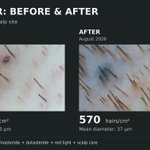
At one measurement site on the back of my scalp, terminal hair density increased from 90 to 327 hairs/cm².
+237 hairs/cm².
There were roughly nine months between my measurements. The diameter threshold for classifying hairs as terminal actually became stricter: from >30 to >35 μm.
Of course, Veradermics reports an average across a large group, while mine is an N-of-1 experiment. These are different types of data. But the comparison illustrates the scale of the results we want to achieve.
If a drug’s entire potential amounts to a marginal improvement that requires an enormous sample to detect with the desired p-value, that drug simply shouldn’t fit our priorities.
We should focus our efforts on approaches capable of delivering a substantial, visible difference.

Can someone explain the point of all these anti-bot systems that block me but happily let ChatGPT through when I ask it to summarize the very same website?
Several people asked to see before and after, rather than just the treated side versus placebo.
The difference looks pretty striking. But this shows the result of the entire regimen: VEGF gene therapy, minoxidil, finasteride, dutasteride, red light and scalp care.
The treated-side vs placebo-side comparison helps assess what VEGF may have added on top of everything else.


Six months ago, I injected VEGF gene therapy into one half of my scalp and a placebo into the other. But the goal was more ambitious than simply outperforming the control.
Across my entire scalp, I was using what I considered the best available hair-growth protocol: minoxidil, dutasteride, finasteride, red light, and additional treatments. Gene therapy had to deliver on top of that combination, not replace it.
Six months later, across two areas without hair transplants, hair density on the VEGF-treated side was, on average, 20% higher than the control, with 62% of hairs in the growth phase versus 50%. At the back of my scalp, average hair diameter increased by 12%, while it decreased by 9% on the control side.
This is a one-person experiment, and the findings need to be confirmed on a bigger population. But for me, it’s a breakthrough. That’s what REAL biohacking and gene therapy are about: taking the best of what’s available—and trying to go beyond it. Not just repeating what’s already been achieved, but expanding human potential.

In a 1957 study, people who had recently bought a car were more likely to read ads for their own car than for models they had considered but rejected. The purchase was already made, but the search for reassurance continued.
I think longevity science has a similar trap. A scientist chooses one mechanism of aging, builds a career around it, and gradually starts looking primarily for evidence that supports their hypothesis. Other areas of research, contradictory findings, and potential combinations fade into the background. People seem to become prisoners of their original research.
The current grant system adds fuel to the fire: most grants support work in areas where a scientist already has an extensive research record. How are we supposed to explore entirely new hypotheses?
You can spend a lifetime defending a favorite idea while overlooking more promising approaches.
We need to be as open as possible to new approaches, bold hypotheses, and ideas that seem impossible. I think one of the most valuable things we could do for the field would be to create a grant or prize to test the wildest idea in aging research. The idea might not work, but the amount of new knowledge gained per dollar could be the highest of all.

They say gene therapies are expensive.
For the first time in history, a drug that inhibits myostatin activation has been approved.
On September 11, the FDA approved for SMA ISEMBYLD — apitegromab, developed by Scholar Rock.
Apitegromab is a monoclonal antibody that binds inactive forms of myostatin and prevents them from becoming activated.
This is a genuinely historic event. After decades of failed development programs, the myostatin pathway has finally produced an approved drug.
At first glance, it may seem that we now have a practical treatment for preserving and growing muscle — one that will almost certainly be explored off-label.
A therapy capable of preserving or increasing functional muscle mass with minimal physical effort and an acceptable safety profile would be a true Holy Grail.
But there is a small catch: the price and the treatment format.
Apitegromab is administered intravenously once every four weeks. For an adult weighing 80 kg, the drug alone would cost approximately:
$70,000 per infusion.
Thirteen infusions per year: nearly $1 million annually.
And that is only the cost of the drug, excluding the infusion center, laboratory testing, and medical supervision.
Antibody-based drugs in their current format are still far too expensive and inconvenient. Monthly intravenous infusions with an annual drug bill approaching $1 million are not a realistic mass-market solution.
Gene therapies would be much affordable
Muscle-growth plateaus: what if the limitation isn’t just the growth signal?
Could further muscle growth be constrained not only by the stimulus to grow, but also by the tissue’s capacity to support that growth? One possibility worth investigating is whether vascular adaptation can become a limiting factor under some conditions.
Our mouse study explored a question: what happens when we combine stimulation of muscle growth with stimulation of vascular development? We administered VEGF plasmid gene therapy before intramuscular AAV-follistatin.
Attached figure shows distinct patterns.
AAV-follistatin alone: mean muscle fiber diameter was 36.2 μm versus 25.8 μm in controls—about 40% larger. CD31+ vessel counts were 35 versus 30 per microscopic field, remaining close to control.
VEGF plasmid alone: vessel counts reached 68 per field, while mean fiber diameter was 24.4 μm, compared with 25.8 μm in controls. The higher vessel count was not accompanied by larger fibers.
The combination showed both: the largest mean fiber diameter: 40.2 μm versus 36.2 μm with follistatin alone, approximately 11% greater. Vessel counts were 70 versus 35 per field—twice as many.
The combination was associated not only with more vessels, but also with larger muscle fibers than follistatin alone. That pattern is consistent with a hypothesis worth testing: vascular adaptation may influence how much growth a muscle can achieve—not merely accompany it

5 steps to make any cancer curable:
1. early complex diagnostics
2. maximize individualization
3. maximize combinations
4. do all of the above fast
5. repeat
The tragedy is that cancer might already be curable, but we fail as a society to address it because we’re too busy optimizing likes and views on social media.
Cancer changes. Measure it, adapt the treatment, hit it again. Repeat until it’s gone. Do it with no delay.
We should start offering individualized combinatory cancer solutions in Próspera.

What accessing frontier cancer care looks like in 2026:
-Go through 1-2 years of standard of care (poison/slash/burn - original poster forgot radiation and hormone suppression). You’re only a good candidate for a vaccine if you are cancer free or have minimal residual disease.
-Hire PhDs / Lawyers to fight with your hospital for your tumor tissue, which is likely stored in a way that makes sequencing it hard / impossible
-Pay $50K+ to sequence your tumor tissue
-Pay $1M+ for a custom immunotherapy / vaccine with no efficacy or safety info
-Find an oncologist and medical setting to sponsor this plan, the biotechs that made you the drug can’t administer it and you’ve likely alienated your actual oncologist by now
-Hire lawyers: Petition the FDA for an n-1 clinical trial or relocate to Germany (or maybe Montana) to take vaccine series
-Take the series. You won’t actually know if it worked (no data) so you monitor all your markers constantly with ctDNA and other testing to search more therapies and to see if the vaccine activated your immune system and worked.
There’s a lot of promise here and people who can access frontier cancer care are so fortunate. Every cancer patient wants every chance they can get. But it’s bs to say we’ve solved cancer in 2026.
Six months ago, I injected VEGF gene therapy into one half of my scalp and a placebo into the other. But the goal was more ambitious than simply outperforming the control.
Across my entire scalp, I was using what I considered the best available hair-growth protocol: minoxidil, dutasteride, finasteride, red light, and additional treatments. Gene therapy had to deliver on top of that combination, not replace it.
Six months later, across two areas without hair transplants, hair density on the VEGF-treated side was, on average, 20% higher than the control, with 62% of hairs in the growth phase versus 50%. At the back of my scalp, average hair diameter increased by 12%, while it decreased by 9% on the control side.
This is a one-person experiment, and the findings need to be confirmed on a bigger population. But for me, it’s a breakthrough. That’s what REAL biohacking and gene therapy are about: taking the best of what’s available—and trying to go beyond it. Not just repeating what’s already been achieved, but expanding human potential.

There’s one organ I’d keep our VEGF plasmid away from: the eye. Naturally, that’s where ER-100 is starting 😅
@davidasinclair, when do human trials move beyond the eye? Maybe our approach could help lower the AAV bill starting with muscle?
We might be close to a breakthrough in the gene therapy field.
Manufacturing AAV vectors is expensive, and gene therapies can cost millions of dollars. Zolgensma, for example, launched in the US at a price of $2.125 million for a one-time treatment.
At the same time AAV therapies carry risks, including serious liver injury.
Our approach is to prepare the muscle before administering AAV: first, stimulate capillary network development using VEGF plasmid gene therapy, then administer AAV-follistatin intramuscularly.
In our mouse study, following this preparation, we observed approximately twice as much follistatin in muscle at the same AAV dose. The muscle-to-liver transgene expression ratio, measured at the mRNA level, was 2.6-fold higher than with AAV monotherapy.
If we can achieve the same therapeutic effect with half the AAV dose in clinical trials, this could be a breakthrough for muscle-targeted gene therapies: less vector per patient, potentially reducing both manufacturing costs and dose-related risks.
Much more to come.
“Again, extraordinary claims require extraordinary evidence.” 100% agree.
Partial reprogramming ≠ rejuvenation.
Failure to recognize this distinction has already led the field to waste billions of dollars on overhyped projects.

Oh dear, even @NatGeo is spreading hype about aging science 🤦♂️
Again, extraordinary claims require extraordinary evidence.
A regularly exercised muscle gradually develops a denser capillary network. This shortens the distance oxygen must travel to the muscle fibers, improves nutrient delivery and the clearance of CO₂, lactate, and other metabolic by-products, increases resistance to fatigue, and is associated with higher VO₂max and insulin sensitivity.
But with age, the signal that drives blood vessel growth weakens: after exercise, the rise in interstitial VEGF is about 50% smaller in older adults, while in a laboratory model, muscle cells from older women secreted about 33% less VEGF.
Exercise still works as we age, but the muscle’s response becomes progressively weaker.
Interval training can raise VEGF and improve muscle capillarization. It is accessible, and at my age I still plan to get these benefits mainly through exercise, rather than rushing to use gene therapies on myself even though my company develops them.
I have said this many times: first, we should get everything we can from exercise, sleep, nutrition, and risk-factor control.
But only while we can.
The fact that exercise is available today does not mean it will always be available. A joint starts hurting, then an injury takes you out for a few weeks, followed by an infection, surgery, or another illness. These breaks add up. You lose muscle and endurance, returning becomes harder, and the risk of another injury rises.
At some point, it is no longer about discipline. A person may want to train, but their body cannot tolerate enough load.
That is why we need exercise mimetics: technologies that preserve some benefits of exercise, such as capillarization and muscle function, when proper training is temporarily or permanently impossible.
Not to replace exercise in healthy people, but to preserve its benefits when the body needs them most.
