

https://xitter.cf/t.co/UNXLi21oix GLADIO in the Eurasian steppe
Joined May 2022
- Tweets5.3K
- Following0
- Followers11.8K
- Likes21.1K





Beatings and mass casualties in the 225th assault regiment.
Soldier Oleg Seryk has been sharing these photos and videos the past 5 days on Instagram. He says that the commanders of the 225th forbid the 'hundreds of bodies' lying in the forests of Huliapole from being retrieved. They are registered as missing in action, meaning that relatives receive no compensation payments for killed soldiers.


The musical initiations for soldiers in the 425th assault regiment.
This unit is famous for mass battlefield casualties in suicide missions and systematic beatings, torture, and killings of their own troops.
The troops are largely forcibly mobilized old men and drug addicts, often mobilized directly in their methadone replacement clinics. In the second video, you can see a 'happily dancing' old man start coughing out of exhaustion. There have been dozens of deaths from tuberculosis in this unit this year.

There has been much talk over the past two months of grand reforms in Ukraine’s army. These reforms have supposedly put an end to the many scandalous cases of beatings, torture, killings, blocking detachments, and mass casualties revealed in the summer.
In reality, the usual practices continue. How else to motivate forcibly mobilized drug addicts and grandfathers to go die at the front? So the beatings continue, in the pits, the trenches, and tied to snowy trees. It’s just that the media has stopped covering it, because the new commander-in-chief of the army, Mikhailo Drapaty, is much-liked by the western-funded press.
Nevertheless, some soldiers still post photos and videos of the abuses to Instagram. Military telegram channels continue to complain about incompetent fighting practices leading to massive losses. The bodies are abandoned, commanders forbidding their retrieval — registered as ‘missing in action’, there is no need to pay relatives.
Meanwhile, we get videos of newly-mobilized troops forced to smile and dance for the camera.
Small wonder there is little information. It can be dangerous bringing attention to certain things. In mid-October, a female soldier mysteriously died at the front right after sharing the sexual abuse she’d been subject to in her unit. Though she voluntarily signed up to the army as a drone operator, she was instead sent to the infantry. Many of her comrades believe that her death was a case of ‘zeroing’ — a punishment whereby one is sent on a mission with no chance of survival.
Besides all this, we’ll also look at Azov’s PR offensive in defense of these infamous units. This involves a rather bizarre mini-film Azov recently released portraying Russia’s soldiers as the kind hobbits of Lord of the Rings, prompting outrage from many Ukrainian patriots.
Full article in reply


EventsInUkraine retweeted

A major achievement of the Armed Forces of Ukraine in 2026 has been stabilizing the frontline, creating the conditions for localized counterattacks while inflicting relatively high rates of attrition on Russian forces. This has been enabled by a more flexible defensive posture under the new commander-in-chief. Unmanned warfare, including mid-range strike systems, has played an important role in all of this, helping degrade Russian combat power. Recent restrictions have reduced the effectiveness of a core element of Ukraine’s defense system. Unless this is resolved quickly, Ukraine risks losing hard-won gains from 2026, not to mention the impact on its cities and critical infrastructure.
A mobilization update. The government plans to intensify recruitment efforts. Manpower will probably be more necessary than ever due to the restriction of US military aid, crucial for Ukrainian drone airpower.
More killings at the Territorial Recruitment Centres (TRC). A half-blind old man mobilized, released due to his infirmities at a distant bridge without a phone, and now missing for 8 days. A psychologist who tried to flee Ukraine by swimming to Moldova rammed and beaten with oars by Ukrainian border guards. The increasing cases of mobilized men opening fire on the TRC and police, wounding many at one go. Men mobilized naked. A grandmother thrown to the ground while trying to protect men from being abducted, leaving her with a broken hip. A pregnant woman who lost consciousness while trying to save her husband. A gypsy community who took on the TRC that abducted their ‘baron’. A shirtless man promising to stab every policeman to death before they mobilize him.
Full article in reply


Militarization has also become necessary for EU political elites.
A good way to justify cutting social spending while possibly creating some employment.
A good excuse to clamp down on dissent.
There's also inertia - 'justified' by the Ukraine war, the EU will spend a trillion euros on the army by 2030. The political class have invested so much into this war, financially and reputationally. Not really an option to just give up on it.

I've been making that point for years now and I don't think I've convinced anyone, but as much as I'm critical of US policy toward Russia/Ukraine in the post-Cold War era, I don't buy the theory that the US is cynically using Ukraine to weaken Russia and that the West's military commitment to Ukraine is the result of such a cynical calculation.
I think what happened is that the US and the West in general expected Ukraine to be defeated pretty quickly if there was a war, which would have led to extensive sanctions but not the full decoupling that happened (Europe would have continued to buy Russian gas in particular), but then Ukraine didn't cooperate by not getting its ass kicked immediately.
Once that didn't happen and the Istanbul talks collapsed, it became politically impossible for the West to let the Ukrainians, who up until then had been resisting with minimal Western military support, to refuse to help them and let them be defeated, not because they were no longer willing to fight, but for a lack of ammunition.
So we sent them ammunition and gradually we developed a commitment to Ukraine's defense that didn't exist initially and was never anticipated. In other words, I don't think Western officials made a commitment to Ukraine's defense because of those arguments, but rather I think they made those arguments because they had made a commitment to Ukraine's defense for other reasons.
I'm not saying that some people in the US foreign policy establishment don't genuinely buy this argument, plenty of them do at this point and some Russia hawks did even before the war (indeed you can see people making this kind of arguments going back to the 1990s), but I think it's mostly geopolitics-pilled rationalizations and I don't think those arguments played the causal role people ascribe to them.
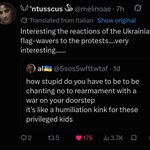
European youth will increasingly directly feel the impact of the war with Russia these types demand (social spending cuts for the admy, conscription, nationalist hysteria, euro-civilizational racism)
Then, there's going to be a big wave of anti-🇺🇦 sentiment among left-liberal youth, who until now felt neutral-positive towards Ukraine

The shrill self-centring, white racism and totally self-unaware hutzpah will also become even more evident

They'll only be satisfied if you chant to increase military spending, send everything to Ukraine, and cut all other spending
Any other position and you're a Russian agent


Did Trump cease US intelligence sharing with Ukraine? Zelensky is contradicting his own foreign minister and advisor.
My conclusion is that Zelensky's strategy is to try and throw as much dirt as possible at Trump so that he loses the midterms. However, Zelensky's own diplomats and other people on his side seem to think that it isn't worth a) lying and b) further damaging relations with the USA.
On October 12, Russian missiles hit Kiev without air alarms going off. Here is the evolution of the narrative.
First, some Ukrainian telegram channels began speculating that this was because Trump had decided to cut off Ukrainian access to US intelIigence about Russian missile launches.
The official statement by Ukraine's air forces was that the reasons behind the lack of an air alert were being investigated.
Zelensky's personal advisor on drone matters, Sergey Bezkrestnov, made a telegram post criticizing the rumours that US intelligence sharing had ceased. He pointed out previous cases of missiles not being detected by Ukrainian air defenses. He also pointed out the difficulty of detecting S-400 missiles.
Bezkrestnov's opinion was echoed by anti-Russian, anti-Trump hawks like Michael Weiss, and by Ukrainian military OSINT channels like 'AFU Carthographer'.
On the morning of October 13, Zelensky made a post blaming Trump ceasing intelligence sharing for the missile strike not being detected. He also made it clear that the civilian deaths that occurred were on Trump.
In a few hours, Zelensky's foreign minister Andrii Sybiha stated the opposite - that intelligence sharing with the US continues, and the missile wasn't detected because of its 'special characteristics'.
Finally, Trump himself said that intelligence sharing continues with Ukraine.


So much western and Russian reporting over the past year claimed Trump had decided to stop worrying and love Zelensky. The US president apparently had a change of heart out of frustration with Moscow and admiration for Ukrainian frontline counteroffensives and long-range strikes on Russia.
But it seems Washington’s grand strategist was misunderstood.
Last Friday, Trump caught the Ukrainian delegation in Miami off guard, forcing them to go home immediately. Russia got sanction relief on diesel exports, while Ukraine was told to stop hitting Russian fuel refineries. Russia doesn’t have to do anything, as Zelensky pointed out, because the ‘fuel refinery ceasefire’ doesn’t apply to it — Ukraine has no fuel refineries left to hit, apart from a weak one on the western border.
Rumours are now swirling that Trump intends to force Ukraine into submission before the mid-terms. The means to do this will be a weapon Trump has always possessed but seemingly never used — the Starlink communications system that Ukraine’s army depends on entirely for battlefield logistics, as well as other intelligence sharing crucial for strikes on Russia and detecting incoming Russian strikes.
Personally, I suspect that Trump won’t completely go through with his (so far supposed) threat to cut Ukraine off from all remaining American military aid. As Zelensky’s advisors point out, Washington is making too much money off the war to really go through with that option. But he might. There are some indications he already has.
The main indication was the fact that an October 12 missile strike on Kiev did not set off any air alert signals. There were plenty of rumours to the effect that the US had intelligence about this incoming strike, but didn’t give it to Ukraine. Zelensky said so, blaming Trump for the resulting civilian deaths. But Zelensky’s own drone advisor and a number of other serious Ukrainian military analysts did not believe the lack of an air alarm had anything to do with a lack of US intelligence, and put it down to the type of Russian rocket used. Even the most rabidly anti-Russian western analysts like Michael Weiss don’t think that the missile went undetected because of Trump. The US president, for his part, said today that the US has not ceased intelligence sharing.
What this rocket mystery seems to show is that Zelensky’s strategy, along that of with his friends in the west, is to maximally weaken Trump in time for the midterms. But even if that works, Trump will remain president, but now even more enraged at Zelensky.
And all this will continue intensifying Zelensky’s dependence on the Europeans. On October 10, the day after Trump’s great ‘betrayal, Ukraine’s presidential website announced meetings between Zelensky and the Finnish, British, Norwegian and French heads of state.
And what do the Europeans want?
The Europeans certainly don’t want Zelensky to end the war, but they do want him to cede de facto power to the compradors the EU and UK have spent the past few decades carefully cultivating. Unlike the populist, strong-willed ‘Servant of the People’ Zelensky, these western-grant-fed networks (so-called ‘Sorosites’) are entirely loyal to their sponsors, will give over all revenue sources they desire (or at least, almost all), and certainly present no risk of ever signing a peace with Russia. Nor does Zelensky present much risk of signing a peace deal, but Euro-American Atlanticists have always feared that Zelensky’s populist instincts could lead him to fulfill his 2019 election promise of ending the war through compromises with Russia. The neoliberal servants the Europeans want to give control of Ukraine are the opposite of populists.
And Ukraine’s Sorosites, naturally, desperately want the EU to pressure Zelensky into letting them take the reigns of power.
In short, Zelensky is being increasingly pushed into a corner — from two fronts. Washington and Brussels. To say nothing of Moscow.
Ultimately, I suspect that the Europeans will leave Zelensky in power. He’s too convenient at the moment, and getting rid of him would risk empowering Russia. A son of a bitch, but our son of a bitch, so to speak.
What about Trump? When his about-face?
All these events might seem strange, as I too have often argued that Trump is not quite so ‘pro-Russian’ as many of his opponents make him out to be. His administration actually encouraged an uptick of Ukrainian strikes on Russian energy infrastructure since early 2025. The main force pushing for and enabling these strikes was CIA chief John Ratcliffe, but no doubt Trump also hoped that this ‘leverage’ would push Russia to accept American demands and give Trump another beautiful victory.
But now, in usual Trump fashion, his actions have come back to bite him. The energy war between Ukraine and Russia hasn’t been great for global energy prices, especially given Trump’s other genius ideas in west Asia. Trump seems no longer in the mood to listen to Ratcliffe’s strategic advice.
And it might not actually matter so much if Russian diesel will lower energy prices in the US. Trump’s calculation seems to be otherwise.
The coming week will be decisive. Trump must decide by October 18 whether he is going to push through the late Lindsey Graham’s super-sanctions against Russian energy. If he does put them through, energy prices will indeed skyrocket. Not so much because Russia is a major source of energy for the states, but because Mr Graham’s sanctions would target any buyer of Russian energy, thereby putting the international economy in chaos, America’s as well. Trump’s remaining popularity would be unlikely to survive, and more importantly, his historic image. But Trump has already put his support behind the laws, and to go against them would likely result in serious backlash against him from the traditionally imperialist sectors of the Republican Party. Quite a bind.
Faced with such enormous personal risks, Trump has been forced to put pressure on the only actor that Washington has leverage over — Ukraine, not Russia. Unable to get Iran to open the Hormuz strait, Trump is looking for the one victory he can get. Maybe it’ll even help him with engineering energy prices, he seems to have had relative success doing so thus far, at least compared with what many analysts were predicting.
In short, whatever happens, things are neither good for Zelensky or the Ukrainian army. For all his talk of not needing Americans, Zelensky was only just pleading for Elon Musk to give Ukraine Starlink access over Russia, as well as for more Patriot interceptor missiles. Now the US seems more likely to cut aid than increase it.
And it doesn’t look like Ukraine has all that many cards to pay in return. Zelensky’s main strategy now is simply to rage at Trump and hope something sticks.
So, will Zelensky wiggle his way out of this latest corner? He’s certainly been quite resourceful in the past. Faced with a world of cowards and backed with hundreds of billions of euros, his chutzpah-based strategy of calling everyone’s bluff and demanding more has been relatively successful. But not always. The Russian ‘nyet’ and the American ‘ok’ might just get the best of him. Meanwhile, the stern Eurocrats seem to be pressuring him to de facto give up power to the Sorosites.
Whatever happens, attention will certainly remain on Mr Zelensky. As usual, Zelensky will be able to distract attention from his just-as-entertaining corruption scandals by playing the plucky patriot resisting big bad Trump.
In showman terms, he’s performing brilliantly.
Full article in reply

