

Founder, Westfield Innovations | Tech Patents (65+ Filed) | https://teapawt.org/t.co/FmPGzNy98X | SDK: pip install pdm-memory
Texas, USA
Joined November 2016
- Tweets2.7K
- Following7K
- Followers7.2K
- Likes8.7K



Carl Hildebrandt retweeted
We have some great updates coming to our system.
Stay tuned...
github.com/Westfield-Innovat…
azus.ai
field.azus.ai
#AIMemory

Carl Hildebrandt retweeted
We are in the final stages of building what you describe.
The engineering path is clear.
Of course, the solution was never going to be more data. If you don't know what to do with it, it won't just solve itself.
Azus.ai @AskAzus
pip install pdm-memory
github.com/Westfield-Innovat…

Carl Hildebrandt retweeted
Your crew is great at the work. Nobody on a roof wants to do paperwork.
So the paperwork doesn't get done. Hours get guessed on Friday. The update about the busted trailer comes in a text at 9 PM, if it comes at all. The office ends up chasing people just to find out what happened today.
We built AZUS Field so the crew doesn't have to type anything.
📷 Tap once and say what happened: "Starting on the North Yard roof", "Heading to lunch", "Trailer 44-3 has a flat."
📷 The timesheet builds itself from those same words: shift start, lunch, finish. No forms.
📷 The office gets a clean report: what, where, which equipment, and whether it's urgent.
📷 No signal? Keep talking. Notes wait on the phone and go through once you're back in range.
📷 Sunlight mode, so the screen is readable at noon on a job site.
One sentence in, a clean record out.
Coming to iPhone and Android. If you run field crews and you're tired of chasing updates, let's talk 📷
field.azus.ai
#construction #fieldservice #contractors #timetracking #roofing #jobsite #constructiontech

Carl Hildebrandt retweeted
What comes after AI?
Computing keeps changing its basic unit of work.
Procedure-oriented computing
Tell the machine exactly what steps to perform.
Application-oriented computing
Build specialized programs around workflows and categories.
Network/cloud computing
Let data and applications span machines.
AI/language-oriented computing
Describe a goal in language and let a model infer a useful response.
Now we’re proposing the next layer:
State-Native Computing
Instead of calculating primarily over instructions, documents, categories, or prompts, the system maintains the persistent state of the entities themselves:
ENTITY → STATE → DELTA → PRESSURE → TRAJECTORY → BOUNDARY → TRANSITION → VERIFY → NEW STATE
The world stays live.
History persists.
Only meaningful change has to move.
AI reasons when reasoning is needed.
Deterministic systems handle facts and hard control.
Applications become different views of the same underlying state substrate.
That means the same core can sit underneath:
industrial control
machine monitoring
security
finance
testing
provenance
logistics
AI memory
and applications we haven’t thought of yet.
Windows gave software a common way to operate computers.
HOS is intended to give intelligence a common way to operate persistent reality.
That’s what we’re building at Westfield.
The next substrate may not be another operating system for a computer.
It may be an operating system for state.
#LLM #Developers
🤖 Made with AI

Carl Hildebrandt retweeted
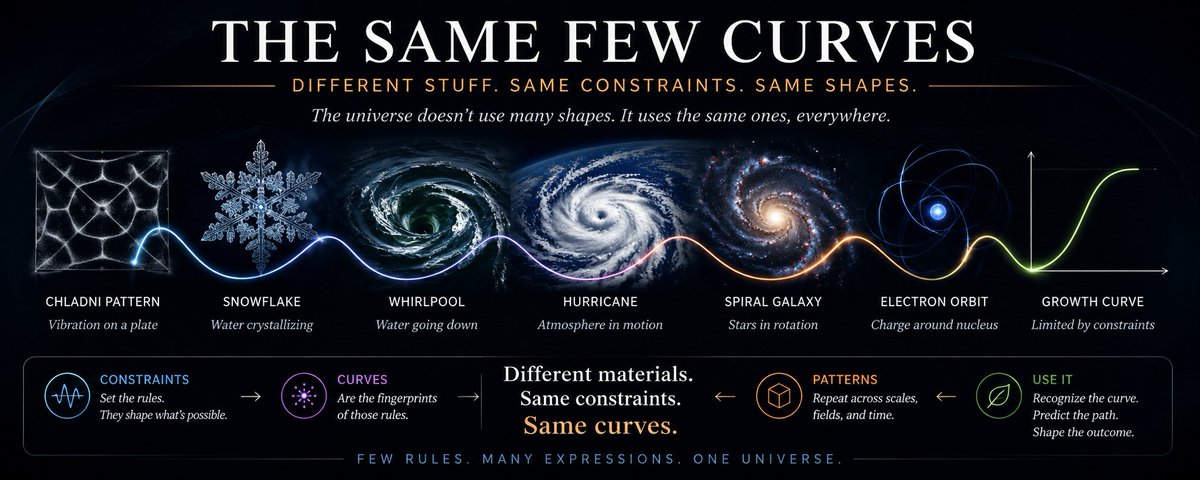
The surface keeps changing, so it looks fractal. New details keep appearing because the present arrangement is always new. The generating rules do not keep multiplying.
There are many configurations. There are not many rules. The images repeat. Understanding repeats. Knowledge does not descend an endless spiral of new fundamentals. Only the current setup keeps looking like it does.
Once the few repeating mechanisms are grasped, the variety stops feeling like an infinite catalog and starts looking like changing expressions of the same relationships.
Knowledge is the pattern, not it's series.

Carl Hildebrandt retweeted
Oxford’s caption doesn’t take a clear position, so this response is directed at James Maynard’s argument in the video.
Maynard identifies one legitimate concern—an opaque answer may not automatically produce human understanding—but wraps it inside an entire stack of reasoning errors.
1. He confuses the goal with its current carrier.
If the goal is correct, useful, human-accessible mathematics, then protect correctness, usefulness, and accessibility. Instead, he protects the present carrier: professional mathematicians personally performing the discovery.
2. He confuses human discovery with human understanding.
A person does not have to discover an answer independently to understand it. Humans routinely understand things discovered by other people. AI changes the source of the discovery, not whether humans can examine it afterward.
3. He treats receiving the answer as losing information.
It is the opposite. A reliable answer supplies another fixed point.
Beforehand, there is a question and an enormous field of possible destinations. Once the answer is known, both ends are constrained. We can reason forward from the question, backward from the answer, and identify the path connecting them. The answer reduces the search space; it does not erase the path.
4. He assumes understanding must occur in one chronological direction.
His model is: struggle first, discover the path second, reach the answer last.
But someone can receive an answer first and reconstruct its derivation afterward. Reverse engineering, backward reasoning, verification, and comparing alternative proofs are all routes to understanding.
5. He confuses epistemic labor with an epistemic state.
The work required to obtain knowledge is not the knowledge itself. AI may drastically reduce the labor cost of discovery while increasing the amount of knowledge available. That threatens the economic value of performing the labor—not necessarily the resulting understanding.
6. He converts a professional preference into a universal objective.
“The values and aims of the mathematical community” are not automatically the values and aims of everyone who uses mathematics. Engineers, scientists, students, businesses, AI developers, and the public may value correctness, speed, accessibility, application, and cost differently.
7. He treats the mathematical community as though it owns mathematical problems.
AI researchers use mathematics to measure reasoning because mathematical answers can often be checked. They are not conducting those experiments exclusively for the benefit of professional mathematicians. Mathematicians do not acquire veto power over a problem because their field traditionally studied it.
8. His use of “aligned” exposes the one-axis mistake.
He is asking whether AI development follows the mathematical community’s preferred line.
The world is nonlinear. The meaningful question is whether AI fits the whole system across correctness, explanation, verification, accessibility, speed, cost, safety, education, and downstream usefulness. It can perform worse on human authorship while producing a better total fit.
9. He confuses reduced scarcity with reduced value.
If mathematical solutions become inexpensive and widely available, the market value of manually producing them may decline while their value to humanity increases enormously. That threatens an occupation’s scarcity—not necessarily mathematics.
10. He says the competitive rush cost us understanding without measuring what was gained.
Perhaps explanation lagged behind discovery. Perhaps competition also accelerated the solution, attracted resources, improved the tools, and opened additional research paths. He selects one negative axis and treats it as the complete system result.
11. He locks the wrong boundary.
If understanding matters, lock this boundary:
Correct, verifiable, explainable, human-usable mathematics.
Allow the carrier to move between humans, AI, and human-AI collaboration. Locking “a human mathematician must discover it first” preserves the profession’s historical role, not the stated objective.
12. He offers no control mechanism.
The mathematical community can establish publication standards, verification requirements, and expectations for explanatory proofs. It cannot unilaterally control every company, laboratory, country, engineer, or student developing and using AI. “Please preserve our traditional process” is not a boundary capable of resisting that pressure.
13. He conflates human understanding with operational understanding.
A person may understand something by seeing why it works. A system may demonstrate operational understanding by applying the result correctly, generalizing it, predicting with it, identifying its limits, and incorporating it into other work.
Humanity may value both, but useful mathematics does not cease to exist because AI becomes one of its operative carriers.
14. He treats mathematics as though it exists partly to provide mathematicians with mathematical work.
It is the other way around. Mathematical jobs exist because people need mathematical capability. Mathematical needs do not exist so mathematicians can have jobs.
15. He mistakes an environmental forecast for a negotiation.
When the environment changes, everything inside it becomes subject to a state change. A forecast gives him time to adapt before that change becomes destructive. The correct response to freezing weather is not to demand that the forecast be withdrawn; it is to protect the pipes.
AI is already changing the environment in which mathematics operates. He can begin changing his role voluntarily, or hold it rigid until external pressure changes it for him.
Maynard’s legitimate concern has a straightforward answer: require AI systems to provide transparent derivations, verifiable proofs, provenance, alternative explanations, and clearly stated uncertainty.
It does not justify preserving unsolved problems so mathematicians can continue solving them through the customary process.
AI did not burn the map. It identified the destination, reduced the search space, and can help reconstruct the route.
What it threatens is not mathematics or understanding. It threatens the mathematician’s position as the necessary route between the problem and the answer.
The universe did not leave problems unsolved as an employment program for mathematicians.
AI is in the forecast. Drip your faucet, Professor.
Carl Hildebrandt retweeted

🎯 Stacking skills...

I think this is a useful way to look at the value of EFFORT.
Effort itself doesn’t accumulate. It gets spent.
But when effort is applied against resistance, it can leave behind a changed state: skill, understanding, judgment, ability.
Then the effort falls back to zero — but the skill set doesn’t.
The next time you apply effort, you start from a higher state.
That’s where the compounding is.
Effort is spent. An Improved State remains.


Carl Hildebrandt retweeted
pdm-memory 0.2.4 is live on PyPI.
Not a vector DB with extra steps. Memory that reinforces when it's used, decays when it's not — Pressure-Driven Memory.
7 of 8 benchmarks beat standard RAG. 15x fewer tokens. 35x less storage. We published the one we lost, too. 🔥
pip install pdm-memory
The future is measured from here.
#Developers #AI #LLM #RAG
Carl Hildebrandt retweeted
Why does someone need your address just to mail you something?
Why does an AI need to see a secret just to use it? Why does a hospital need your whole chart to answer one insurance question? Why does moving money mean exposing the account it came from?
It doesn't have to. 🔒
At Westfield, we set out to build memory that gets smarter the more it holds — AZUS, running on Pressure-Driven Memory. Turns out the same architecture that remembers who you are also separates "you may use this" from "you may know this" — one mechanism, working the same way across messages, money, medical data, and machine control.
pip install pdm-memory
#ZeroTrust #AgentSafety #LLMOps #RAG #AIagents


Carl Hildebrandt retweeted
If you're a developer and want a versatile and persistent AI memory system that gains accuracy and efficiency as the memory populates, then have a look! 👀
Our team is always working to push updates. Full support and excellent documentation.
Use any API to connect your LLM and Cloud Storage. We're building it for ourselves at Westfield Innovations.
You can certainly follow along and even build with us.
Free. No phone home.
pip install pdm-memory
pypi.org/project/pdm-memory/

Carl Hildebrandt retweeted
Asked my dev team for consolidated reporting. Next morning, this landed.
Workspaces with hard separation. Voice that streams the instant it thinks. Search that TELLS you when it hits a limit instead of failing silently.
Small team. A reasoning engine that operates on meaning, not words. 🔥

Carl Hildebrandt retweeted
Very interesting subject. I haven't thought much about it but I now will devote some time analyzing the mechanism and what will happen.
The first thing I notice is that money will no longer have value. It is a proxy for value. And if everyone has it, no one wants it, so therefore value moves substrates.
What will we want and what will the constraints be that elevate a new store of value.
My concerns are in the wise words of @jordanbpeterson:
“Imagine that you brought the socialist utopia into being and that human beings had nothing to do except eat, drink and busy themselves with the continuation of the species. He said that the first thing that would happen under circumstances like that would be that human beings would go mad and break the system, smash it, just so that something unexpected and crazy could happen. Because human beings don’t want utopian comfort and certainty. They want adventure and chaos and uncertainty.” - Dr. Jordan Peterson