

@FAO considers Indigenous Peoples as key allies for a sustainable planet & secure #FutureofFood for all 🌍🌾 #WeAreIndigenous Also follow @FAODG
Joined July 2018
- Tweets4.3K
- Following1.1K
- Followers5.8K
- Likes5K






FAO Indigenous Peoples retweeted

⛺️As part of the 2026 Global-Hub on
#IndigenousPeoples Food & Knowledge Systems
The Commission on Genetic Resources for Food & Agriculture joined a fireside session in the Sámi tent at @FAO HQ, on the role of Biocultural Community Protocols:
👉fao.org/cgrfa/news/news-deta…
#KMGBF

From evidence to policy: at FAO HQ, Member States, Indigenous experts discussed how to preserve, strengthen and promote Indigenous Peoples’ food and knowledge systems ahead of @UN_CFS policy discussions.
Read more here: tinyurl.com/32ckhhy7
#IndigenousPeoples #CFS

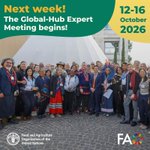
🌍The Global-Hub on Indigenous Peoples’ Food and Knowledge Systems, a strategic and innovative think tank, gathered for the fourth time at FAO headquarters, in the Indigenous Peoples’ Territory, on 12–16 October.
➕More than 300 participants took part, including over 120 Indigenous and non-Indigenous experts and Indigenous Youth, from around 40 Indigenous Peoples’ organizations and 55 universities and research centres, across more than 40 sessions.
The week set out to reverse wrong narratives on Indigenous Peoples and their food and knowledge systems.
🔬Is your science better than others? Indigenous Peoples’ knowledge is real science of sustainability.
⚖️Are you born vulnerable? Neither are Indigenous Peoples. The violation of their rights puts them in situations of vulnerability.
🍃Is mobility really primitive? Indigenous Peoples’ mobile ways of living demonstrate adaptability and sustainability.
The Global-Hub reaffirms that food should never be a means of pressure, division or conflict, but a source of life, dignity, solidarity and peace.
#FAOGlobalHub2026 #IndigenousPeoples

The Global-Hub in-person meeting brings together Indigenous and non-Indigenous experts from the seven socio-cultural regions. There are as many Indigenous Peoples’ food systems as there are Indigenous Peoples in the world.
Together, these different perspectives form a network covering all seven sociocultural regions.
🔜 Next week, members will meet in Rome for five days to continue working on the agenda for Indigenous Peoples' food and knowledge systems.
#FAOGlobalHub2026 #IndigenousPeoples

FAO Indigenous Peoples retweeted

🔴TOMORROW
💡Is it possible to produce while also conserving biodiversity in the #Amazon?
Join the launch of #ProduceAndConserve and discover evidence to advance sustainable economic development📈🌳
📲Register for the event: fao.org/americas/events/even…

FAO Indigenous Peoples retweeted
🌿 Indigenous Peoples' knowledge systems are the backbone of Indigenous Peoples’ food and knowledge systems, and their contribution to biodiversity, climate and other areas of policy.
So, what happens when this knowledge and expertise is meaningfully included in research and policy?
The Global-Hub has contributed to landmark publications with FAO, working together with Indigenous and non-Indigenous experts. Its members have also contributed to international discussions, including climate as well as land and desertification negotiations.
They include peer-reviewed publications co-authored by Indigenous Peoples' experts, which includes Indigenous Peoples’ knowledge and orality at same level of respect than academic knowledge.
Read our flagship publication here: openknowledge.fao.org/handle…
Two weeks to go.
#FAOGlobalHub2026 #IndigenousPeoples
Indigenous Peoples' food and knowledge systems are sometimes described as ancestral yet, they continue feeding communities today thanks to innovation, adaptation, resilience and sustainability. These food and knowledge systems provide unique solutions highly relevant to the challenges we face.
For generations, Indigenous Peoples have developed knowledge through close relationships with land, water, food and the seasons. This knowledge continues to be practiced, shared and strengthened across generations.
The Global-Hub on Indigenous Peoples' Food and Knowledge Systems brings this work together and connects it with policy discussions. Today, the Global-Hub includes 40 members organizations, including research networks, working in all seven sociocultural regions.
Universities, researcher centres, Indigenous Peoples' organizations and UN agencies all contribute to this work.
Next month, we will meet at FAO in Rome for the fourth in-person meeting of the Global-Hub.
Over the coming weeks, we will share more about the Global-Hub, what it has achieved and what will happen in Rome.
#FAOGlobalHub2026

Today is the first-ever International Day of the World's Indigenous Women and Girls. It's a day to honor memory, justice, reparation and dignity, and to recognize the knowledge Indigenous Women carry.
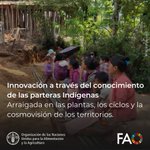
And no one carries that knowledge more intimately than Indigenous Midwives. Across the seven sociocultural regions, they guide mothers from the earliest weeks of pregnancy through a child's first years, weaving together food, territory and family wellbeing in every act of care.
Their knowledge is part of a story our unit has worked to make visible for years: the story of Indigenous Women, Daughters of Mother Earth, as food providers, seed keepers, guardians of biodiversity. Of the Violet Chair, carried by more than 100 organizations and has been passed to every new UNPFII Chair since 2018. Of 13 Leadership Schools that trained more than 300 Indigenous Women now shaping global negotiations. Of the Knowledge Makers Journal, where 21 Indigenous Women researchers from 16 countries publish knowledge long excluded from academia.
Today, we honor them.
Read our web story with the Indigenous Midwives from Brazil and Colombia below.
fao.org/indigenous-peoples/n…

FAO Indigenous Peoples retweeted
At #UNCCDCOP17 in Ulaanbaatar, Mongolia, FAO brought together Indigenous Peoples and Indigenous Peoples nomadic pastoralists from different regions to place mobility, food and knowledge systems, customary governance and territorial rights at the centre of rangeland restoration.
Their experiences showed that mobility is not simply movement: it enables reciprocal access to water and grazing areas, sustains Indigenous Peoples’ food and knowledge systems, and strengthens the resilience of rangelands to drought and degradation.
Effective restoration must therefore build on Indigenous Peoples’ stewardship and leadership, respect and recognize their collective rights, mobility and customary institutions, and strengthen—rather than displace—their authority over their lands, territories and resources.
Read more ⬇️⬇️⬇️
fao.org/indigenous-peoples/n…
#IYRP2026 #IndigenousPeoples #Rangelands #LandRestoration #Pastoralism #Mobility
At #UNCCDCOP17, the Xukuru and Tapeba Peoples showed that restoration is not only about hectares. Through the Indigenous Peoples’ Biocentric Restoration Global Programme, co-led by FAO and Indigenous Peoples, territorial action is restoring relationships, strengthening living territories and contributing to biodiversity, drought resilience and #LDN 🌿
Discover more👉tinyurl.com/ywsjdxu2
#WeAreIndigenous

If you are attending UNCCD COP17 in Mongolia, don't miss this event! It will focus on the contributions of Indigenous Peoples' mobility, knowledge and customary governance systems to reversing land degradation, while also strengthening food systems!
#UNCCDCOP17
#IYRP2026
#WeAreIndigenous

If you are in Ulaanbaatar for the UNCCD COP17, join this event co-organized by the FAO Indigenous Peoples Unit, the Brazilian Ministry of Indigenous Peoples and FUNAI. Discover the role of Indigenous Peoples' Biocentric Restoration in reversing land degradation and biodiversity loss!
#UNCCDCOP17
#WeAreIndigenous

FAO Indigenous Peoples retweeted

Poverty is about more than income.
For #IndigenousPeoples, land and natural resources are central to livelihoods.
How we understand poverty shapes the solutions we design, including #SocialProtection.
Learn more 👇 #WeAreIndigenous

FAO Indigenous Peoples retweeted
Indigenous Peoples' knowledge is the first knowledge.
On #IndigenousPeoplesDay, @Fulanichef, @FAO Regional Goodwill Ambassador for Africa, celebrates Indigenous Peoples' knowledge & the food systems that continue to nourish people & protect biodiversity.
#WeAreIndigenous
FAO Indigenous Peoples retweeted

Indigenous Peoples' knowledge is the first knowledge, rooted in the land & passed down through generations. At @FAO, we recognize & promote their ancestral wisdom & food systems, which nourish people, protect biodiversity & help transform agrifood systems. #IndigenousPeoplesDay
This #IndigenousPeoplesDay, we spoke with Indigenous midwives who carry knowledge passed down for generations , connecting mothers, children and Mother Earth as one. 🌱
Read more about it here ⬇️⬇️⬇️ bit.ly/4weGB0i
