

AI Scientist @ Aleph Alpha | Oxford Postdoc | EPFL PhD Views are my own.
Joined March 2022
- Tweets38
- Following269
- Followers120
- Likes156


Fabio J Fehr retweeted

Here's something I've done with success for years for human reviewers💡: start the appendix with a "Reviewers' FAQ". Essentially a pre-rebuttal for questions you anticipate or that appeared in earlier reviews. It will likely save one round of interaction with the reviewers.

Maybe in the future alongside a paper submission I'll include a repo with an AI-written FAQ that points out why some things flagged by LLMs are not actually issues, so the reviewer's LLM has that.
Like an AI online appendix that dispenses with the false positives while keeping the draft clean and human-readable.
Job update: AI Research Scientist at Aleph Alpha!
Learning how LLMs are built in both industry and open source!
(Kolibri - @Aleph__Alpha)
(OpenEuroLLM - @OpenEuroLLM)
Fabio J Fehr retweeted

Lots of exciting work ahead! How to choose among different forms of abstract data to get specific benefits in specific domains? What's happening at a mechanistic level?
📄 arxiv.org/abs/2609.38764
🌐 zlshinnick.github.io/beyond-…
With @HemanthThe1st @DamienTeney @AntonvdH

Fabio J Fehr retweeted

To me the real message of the bitter lesson was never that ideas don't matter.
A good idea with little resources (compute, parameters, data) may lose to a bad idea with more resources. But the good ideas are the ones that give you the most bang for the buck. Good ideas improve scaling laws. They are the ones worth investing in. Good ideas are the ones that, resources being equal, beat bad ideas.
So a good idea alone won't win you any prizes. It is when you differentiate ideas by resources that you see which ideas are good because they allow for better scaling. For example, rote memorization might lead to similar results as proper study on a single exam; but it will likely scale much worse over the course of an entire degree.
This reminds me of @SchmidhuberAI 1991 noisy TV example. An agent that just tries to maximize prediction error will get stuck binging entropy. But an agent that maximizes the first temporal derivative of prediction error, i.e., learnability (glossing over some details) will be able to scale their knowledge over time.
Don't give up on thinking hard and searching for great ideas. They will be the ones that scale to the moon 🌕

Fabio J Fehr retweeted

This is f*cking insane. OpenAI co-founder Ilya Sutskever went back to the University of Toronto and told the graduates this:
"The day will come when AI will do all the things that we can do. Not just some of them, but all of them
Anything which I can learn, anything which any one of you can learn, the AI could do as well"
In this 9-minute speech, he explains why your brain is a biological computer, and why a digital one will learn everything it can
Neural Nets → AlexNet → ChatGPT → Safe Superintelligence → AI That Can Do Every Job
His advice for living through it: accept reality as it is, don't waste time regretting the past, and keep asking what the best next step is
"You may not take interest in AI, but AI will take interest in you"
The people who watch what AI can actually do, not the hype, will be the ones who know how much time they have
Worth more than any $5,000 AI course
Bookmark it and watch it tonight
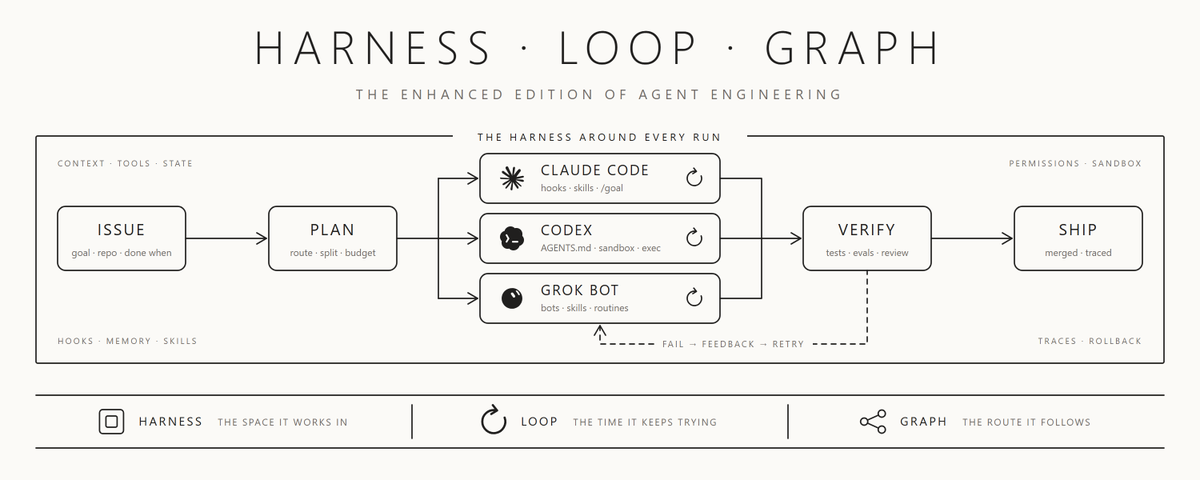
Then read how to put AI to work for you before it takes the work in the harness engineering guide below ↓

Fabio J Fehr retweeted

A working linear probe ≠ a linear representation. We propose 3 tests that tell them apart: reverse predictivity, spectral concentration and OOD transfer.
Code + data: github.com/klindtlab/linear-…
See you at NeurIPS Sydney 🇦🇺 🦘
with @klindt_david and nadirkutluozen.com


Linear Representation or did we just get lucky?
New paper: Is a Linear Probe evidence of a Linear Representation? arxiv.org/abs/2610.22655
🧵
Fabio J Fehr retweeted

We asked GPT-6 Astra to edit Qwen3.5-0.8B weights to improve math.
It directly changed only 0.016% of weights, fixing 0.8B's reasoning loops & improving math up to 6x and even instruction following 3x, without gradients or training.
We call this Weight-Space Programming: frontier LLMs can now natively read/write neural network weights! 🧵
Blog: rikiyat.github.io/blog/weigh…

Readers added context they thought people might want to know
LLM was given weights explicitly as text in prompt and used code/forward passes (per authors' logs) to ablate Qwen looping direction, a known thinking-mode issue per model card. Primarily fixed repetition in that mode, not general 'natively' improving weights/math.
rikiyat.github.io/blog/weight-sp…
github.com/RikiyaT/lm_und…
huggingface.co/Qwen/Qwen3.5-0…
huggingface.co/RikiyaT/Qwen3.…
Fabio J Fehr retweeted

I am delighted to announce the launch of Metis Reasoning, a new AI company I have founded with a team of researchers, mathematicians, robotics experts and entrepreneurs.
We are pursuing a different approach to general and embodied AI reasoning: developing systems that can establish what they know, test conclusions against evidence and learn to reason more effectively through experience.
Alongside today's launch, we are publishing The Age of Reasoning, a white paper setting out the research foundations of our approach and what we believe the next generation of AI could look like.
I will also be discussing these ideas @NVIDIAGTC in Berlin today, alongside researchers exploring new approaches to AI.


Fabio J Fehr retweeted
𝗚𝗲𝗼𝗣𝗵𝘆𝘀 is accepted at NeurIPS 2026! (github.com/ChristianInterno/…). Physical plausibility is written into the geometry of frozen image-encoder features.
When I started working on physical plausibility, almost no shared generated videos/data were available to the community and every experiment began from scratch. That slowed everyone down, so today we release everything we built along the way:
🎬 𝟯,𝟭𝟲𝟴 𝗴𝗲𝗻𝗲𝗿𝗮𝘁𝗲𝗱 𝘃𝗶𝗱𝗲𝗼𝘀 (drive.google.com/drive/folde…): 16 MAGI-1 24B candidates for each of the 198 Physics-IQ scenarios, each with its Physics-IQ score. You can benchmark your method without generating a single video: picking the first candidate scores 53.3, the best possible pick 73.1, and our GeoPhys picks reach 64.6 with the official Physics-IQ code and 59.9 on Physics-IQ Verified ( Robert Geirhos, @sammtmd, @GoogleDeepMind and @Anates_Labs , @TimRaedsch)
📦 𝟮𝟮𝟳 𝗚𝗕 𝗼𝗳 𝗳𝗿𝗮𝗺𝗲-𝘁𝗿𝗮𝗷𝗲𝗰𝘁𝗼𝗿𝘆 𝗳𝗲𝗮𝘁𝘂𝗿𝗲𝘀 (huggingface.co/datasets/CInt…): LikePhys, IntPhys 2 and all 3,168 Physics-IQ candidates, through four frozen encoders (DINOv2, DINOv3, CORnet-S, VOneNet), at every layer. You can explore the geometry of physical plausibility without a GPU.
🧠𝗧𝗵𝗲 𝗻𝗲𝘂𝗿𝗼 𝗘𝗘𝗚 𝗮𝗻𝗮𝗹𝘆𝘀𝗶𝘀: the data and scripts behind the alignment with human EEG responses, and matched video pairs rendered with ADEPT (github.com/JerryLingjieMei/A…) with Habon Issa (@CSHL)
🛠️ 𝗧𝗵𝗲 𝗰𝗼𝗱𝗲 (github.com/ChristianInterno): get the results, calibrate YOUR GeoPhys to your own model and domain with a few labelled pairs, use it on (𝟭) your videos for violation detection, (𝟮) best-of-N selection, or (𝟯) as a per-video plausibility evaluation metric.
A Colab demo introduce you to GeopHy on real LikePhys videos in five minutes: colab.research.google.com/gi…
Odyssey-3 (@odysseyml) and FLUX 3 (@bfl_ai) just took the top of Physics-IQ Verified, congrats! I believe inference-time verification matters, and a training-free verifier you can calibrate to your own model might push that further.
I'm so curious to see what you build with this!
💻Code:github.com/ChristianInterno/…
🎬 Videos: drive.google.com/drive/folde…
🤗 Features: huggingface.co/datasets/CInt…
📄 Paper:arxiv.org/abs/2606.20707 (will be updated soon with new content and results)
🌐 Project page: christianinterno.github.io/G…
With @klindt_david, Barbara Hammer (HammerLab ML), @EeroSimoncelli, @philiptorr, Fabio Pizzati, Francesco Pinto, Habon Issa, @alexpondaven, Ivan Laptev, Markus Olhofer (Honda Research Institute Europe).
#NeurIPS2026 #VideoGeneration #WorldModels #PhysicalReasoning #PhysicalPlausibility #PhysicsIQ #ArtificialIntelligence


Fabio J Fehr retweeted

Students sometimes ask me if it still makes sense, in this accelerating age, to pursue a PhD in AI.
Perhaps counterintuitively, I think it's a great time to do so.
I wrote up some thoughts on this here: web.mit.edu/phillipi/www/wri…
Fabio J Fehr retweeted

My problem with Astra reviews is that they focus almost entirely on intra-paper details: experimental rigor, missing ablations, and whether every local claim is airtight.
But good reviewing also needs an inter-paper view: what can we learn from this work, how does it change how we think about the problem, and what future research can it enable?
Research is more than a checklist.
If ICLR gets flooded with reviews that only see the intra-paper details and miss the bigger picture, we’re pretty cooked.
Fabio J Fehr retweeted
So nice to be involved and work with @Markus50726803 and the rest of the team :)
Surprised to learn how JEPA models drop fast moving features without it even showing in the training loss.
DISReg is an elegant fix: predict an embedding of the frame difference instead of the action.

JEPA-style world models are biased towards learning slow, simple features.
We're releasing MotionJEPA, built for learning a balanced representation of both static and dynamic features.
mkarmann.github.io/motion-je…
New paper 𝗕𝘂𝗶𝗹𝗱𝗶𝗻𝗴 𝗟𝗲𝗴𝗮𝗹 𝗥𝗲𝘄𝗮𝗿𝗱 𝗠𝗼𝗱𝗲𝗹𝘀 𝗳𝗼𝗿 𝗚𝗿𝗼𝘂𝗻𝗱𝗶𝗻𝗴 𝗮𝗻𝗱 𝗔𝗯𝘀𝘁𝗲𝗻𝘁𝗶𝗼𝗻
Models should answer from evidence and know when the evidence is insufficient
We introduce a framework & benchmark for building legal contextual preference data
Fabio J Fehr retweeted

Group meeting
speakers
Jeff Hammerbacher CEO Open Athena
Faris Sbahi(CEO) & Max Aifer – Normal Computing
Professor Christopher Summerfield & Pawan Kumar Directors of AISI (UK AI security Institute)
Jude Kelly CBE
Professor Rui Ponte Costa and Ivan Vasenov
Josefa Stoisser Novo Nordisk
Adrián Bazaga Microsoft

Project page: fjfehr.github.io/when-rubric…
