
Professor at UFRGS, Brazil. Working on statistical physics of complex systems.
- Tweets450
- Following117
- Followers58
- Likes5.3K


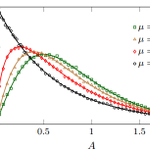


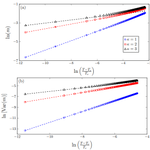
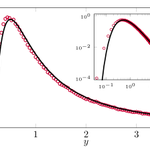


ALT Spontaneous transitions between memories, as observed in internally generated cognition such as mind-wandering and free association, require neural dynamics capable of destabilizing one attractive memory state and moving towards another. We ask what minimal representational structure is required for such transitions to emerge in random associative networks. To address this question, we study Potts associative networks with S active states per unit and slow adaptive thresholds. The S=1 case can model a standard Hopfield-like network of binary units. We employ dynamical mean-field theory in the extensive-load regime, where the number of stored patterns scales linearly with network size and connectivity, and we focus on transitions between two condensed memories, which are singled out in the connectivity matrix. In the finite-load regime, we show that transitions are governed by an effective drive term, whose sign and temporal evolution distinguish high-latching (structured), low-latching


ALT Phase diagram in terms of the mean degree and the standard deviation of pairwise infections rates (coupling strengths).


ALT Vertical axis: mean degree. Horizontal axis: standard deviation of the coupling strengths. Phases I and II: fixed points. Phases III and IV: chaotic.


ALT Time evolution of the standard deviation of microscopic variables for Lotka-Volterra (LV), neural networks (NN) and epidemic spreading (SIS model) on directed networks with average degree c=5, Poisson and geometric distributed degrees, and random couplings (Gaussian and uniform). Solid line: DMFT. Symbols: simulations.


ALT Critical magnetization for different distributions of thermal noise.

ALT Critical dynamics of the magnetization for different distributions of thermal noise.


ALT Spectral density of the configuration model with large mean degree.

ALT Distribution of the self-energy when the mean degree diverges. The function nu is the distribution of rescaled degrees.

ALT Distribution of the local density of states, which captures the spatial fluctuations of the eigenvectors. The power-law tail leads to diverging moments.