






Filip Tosh retweeted

2026 will be insanely bullish for biotech and here's what to build/watch:
• AI drug discovery
• computational biology
• gene therapies
• longevity and anti-aging
• AI biotech workflows
• obesity drugs & bionic biologics
the future is being built right now
bio/acc.


Filip Tosh retweeted

I spent 1.5 years at MIT co-designing a new undergrad program in Genetic Engineering.
The full report is now publicly available. It describes what needs to be built to educate the next generation, and why.
Appendix II includes notes from interviews with 100+ biotech company CEOs and scientists about what they look for in new hires.
Appendix III includes a huge analysis of all existing curricula in biotechnology and genetic engineering globally. It also features dozens of photos from my visits to biotechnology centers across the U.S., Europe, and Asia.
Hopefully this will be a useful resource for educators looking to adapt or expand their curriculums, too.


Filip Tosh retweeted

do math. learn to code. lift weights. read a lot. build things. fail fast and iterate faster. show up daily even when it feels pointless. write online, think clearly, question everything. automate boring stuff, master fundamentals, and keep improving your taste. delete distractions, protect your focus, stay curious. keep your circle sharp and your goals louder. fight procrastination every morning. survive the lonely days without losing direction. turn pain into progress, boredom into discipline, and fear into action. sleep well, eat clean, touch grass, and train your mind harder than your body. choose long-term games over dopamine hits. dream bigger, move quieter, and keep stacking tiny wins. stay broke, stay hungry, stay obsessed and bet on yourself with unreasonable consistency.
Filip Tosh retweeted
9 days to Breakpoint ( @SolanaConf ).
Are you ready for the biggest convergence of science, crypto, and AI this year?
See in you in Abu Dhabi 🫵
We won't take NO for an answer...



Filip Tosh retweeted

List of notations used in Math
Calculus & Analysis
1. Infinity: ∞
2. Summation: ∑
3. Product: ∏
4. Integral: ∫
5. Double Integral: ∬
6. Triple Integral: ∭
7. Contour Integral: ∮
8. Limit: lim
9. Derivative (Prime): ′ (e.g., f'(x))
10. Differential (d): d (e.g., dy/dx)
11. Partial Derivative: ∂
12. Nabla / Gradient: ∇
13. Laplacian Operator: ∇²
14. Infimum / Greatest Lower Bound: inf
15. Supremum / Least Upper Bound: sup
16. Tends To / Approaches: →
Geometry & Trigonometry
1. Pi (Constant): π
2. Angle: ∠
3. Right Angle: ∟
4. Measured Angle: ∡
5. Spherical Angle: ∢
6. Parallel To: ∥
7. Not Parallel To: ∦
8. Perpendicular: ⊥
9. Triangle: Δ
10. Circle: ○
11. Segment: ¯ (e.g., AB with a bar over it)
12. Arc: ⌒ (e.g., AB with an arc over it)
13. Degree: °
14. Sine: sin
15. Cosine: cos
16. Tangent: tan
17. Pi (Product): Π (uppercase)
Basic Arithmetic & Algebra
1. Plus: +
2. Minus: -
3. Multiplication (Times): × or ⋅
4. Division (Obelus): ÷
5. Division (Slash): /
6. Equals: =
7. Not Equals: ≠
8. Approximately Equals: ≈
9. Identically Equals: ≡
10. Less Than: <
11. Greater Than: >
12. Less Than or Equal To: ≤
13. Greater Than or Equal To: ≥
14. Plus-Minus: ±
15. Minus-Plus: ∓
16. Square Root: √
17. Cube Root: ∛
18. Fourth Root: ∜
19. Percent: %
20. Per Mille (Per Thousand): ‰
21. Factorial: !
22. Exponentiation / Power: aⁿ (base and superscript)
23. Decimal Point: .
Set Theory & Logic
1. Element Of: ∈
2. Not An Element Of: ∉
3. Empty Set / Null Set: ∅ or {}
4. Subset Of: ⊂
5. Proper Subset Of: ⊊
6. Superset Of: ⊃
7. Proper Superset Of: ⊋
8. Union: ∪
9. Intersection: ∩
10. Set Minus / Relative Complement: \
11. Complement of Set: Aᶜ or Ā
12. Universal Set: U
13. For All (Universal Quantifier): ∀
14. There Exists (Existential Quantifier): ∃
15. There Does Not Exist: ∄
16. Such That: : or |
17. Therefore: ∴
18. Because: ∵
19. End of Proof / Q.E.D.: ∎ or □
20. Implies: ⇒ or →
21. If and Only If (IFF): ⇔ or ↔
22. And (Logical Conjunction): ∧
23. Or (Logical Disjunction): ∨
24. Not (Logical Negation): ¬
Number Systems & Constants
1. Natural Numbers: ℕ
2. Integers: ℤ
3. Rational Numbers: ℚ
4. Real Numbers: ℝ
5. Complex Numbers: ℂ
6. Quaternions: ℍ
7. Imaginary Unit: i or j
8. Euler's Number: e
Greek Letters (Commonly Used as Symbols)
1. Alpha: α
2. Beta: β
3. Gamma: γ
4. Delta (Change): Δ (uppercase)
5. Delta (Small change): δ (lowercase)
6. Epsilon: ε or ϵ
7. Zeta: ζ
8. Theta: θ or ϑ
9. Lambda: λ
10. Mu: μ
11. Sigma (Summation): Σ (uppercase)
12. Omega: ω (lowercase), Ω (uppercase)

Filip Tosh retweeted

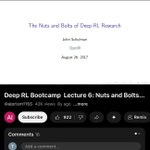
another banger dropped by @jbhuang0604
youtube.com/watch?v=Y-o545eY…


Filip Tosh retweeted

Holy shit… I finally understand the difference between LLMs, RAG, and AI Agents.
After building production AI systems for 2 years...
Here's what actually matters:
They're not competing technologies. They're three layers of the same intelligence stack, and most people are using them completely wrong.
/ The LLM is the brain \
It can reason, write, and understand language. But here's the catch: it's frozen in time. GPT-4 knows nothing past its training cutoff. Ask it about yesterday's news? Hallucination city.
LLMs are brilliant at thinking but blind to the present.
/ RAG is the memory system \
It connects that frozen brain to live knowledge. When you ask a question, RAG searches external databases, pulls relevant documents, and feeds them to the LLM as context.
Suddenly your static model becomes dynamic. Fresh data. Real facts. Zero retraining needed.
The accuracy gains are immediate. Instead of guessing from training data, the model reasons over actual retrieved information. You can audit exactly which documents influenced each answer.
/ AI Agents are the decision-makers \
While LLMs think and RAG informs, neither can act. Agents wrap a control loop around the brain. They perceive goals, plan steps, execute actions, and reflect on results.
An Agent doesn't just answer questions. It researches topics, pulls data, synthesizes reports, and sends emails. All autonomous.
Here's where it gets interesting.
Most AI demos are just LLMs with fancy prompting. Real production systems layer all three: the LLM for reasoning, RAG for accuracy, and the Agent framework for autonomy.
Use an LLM alone when you need pure language tasks: writing, summarizing, explaining.
Add RAG when accuracy matters: answering from internal docs, technical manuals, domain-specific knowledge.
Deploy Agents when you need real autonomy: systems that decide, act, and manage complex workflows.
The future isn't about choosing one. It's about architecting all three together.
LLMs for thinking. RAG for knowing. Agents for doing.
That's the actual intelligence stack.

Filip Tosh retweeted

when i realised nobody knows what they're doing. it's idiots all the way up. you don't need permission, or qualifications, or expertise. you can literally just do things.


Filip Tosh retweeted

I’ll share a small part of pickle.com
Back in med school, I became obsessed with augmenting memory and dreamed of a Notion or Obsidian that completes itself. Today, we’ve built something close.
My self-awareness is sharper and everything feels connected. I genuinely believe AI does not replace humans. It amplifies us.
Huge respect to our engineers and designers who made this crazy thing real.
Bubbles are the episodic units of my life that the system interprets from my raw data. Clouds are the system’s questions, its hypotheses about who I am.
When I answer a cloud, it becomes a bubble again.
There is so much personal data that I cannot fully demo it. Wish I could. This system understands me more deeply than anyone.
Want to try it? Retweet and comment “memory.”
I’ll DM you an access code to skip the waitlist.


Filip Tosh retweeted

Interpretable #MachineLearning reveals the key physical interactions learned by coarse-grained MD models. By @CecClementi and team, led by Klara Bonneau.
nature.com/articles/s41467-0…
