
PhD neuroscientist | Biomedical data scientist Pain, biomarkers, and large-scale human data
Montréal, Québec
Joined December 2011
- Tweets68
- Following236
- Followers134
- Likes261



Pinned Tweet
Super excited to share our paper published in @NatureMedicine! 🌍📊
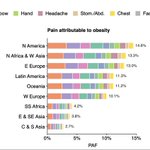
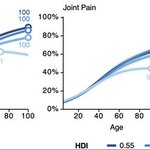
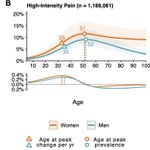
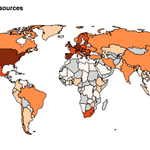
We harmonized 902 population-based data sources from 138 study programs, covering 6.1M people across 118 countries, to map pain from ages 5 to 100+.
nature.com/articles/s41591-0…
A few findings 🧵👇

Matt Fillingim retweeted

New in @NatureMedicine: pain reference curves from 6M+ people in 118 countries. Pain rises steeply before 55, is higher in women, and late-life pain peaks in low-HDI regions, unlike GBD estimates. Led by @MattFillingim
nature.com/articles/s41591-0…
Smoking, obesity, and household income explained an important but incomplete share of pain burden.
Their effects were also site-specific, and they explained much less of the burden in some lower-HDI regions.


We also built an open-access benchmarking tool so researchers can compare their cohorts against the global reference curves:
evppainlab.shinyapps.io/glob…
Huge thanks to our collaborators, data partners, participants, and @evp82 !
Matt Fillingim retweeted

A performance atlas of six commercial high-throughput proteomics platforms across 10 dimensions.
Awesome resource for guiding the selection of the right platform for different research projects.

Matt Fillingim retweeted

In a genome-wide association analysis of fibromyalgia across 2.5M, the top signal was a coding variant in HTT, part of the common Huntington's Disease germline risk haplotype A1 nature.com/articles/s41591-0… @NatureMedicine


Matt Fillingim retweeted

Brain–body-environment interactions must move beyond isolated exposures toward the expotype: the dynamic configuration of physical, social, lifestyle, and internal factors that jointly shape brain–behaviour phenotypes. At @NatRevNeurosci (nature.com/articles/s41583-0…), we propose a future agenda to assess the exposome as a complex, time-varying system that requires nonlinear models to capture interactions, thresholds, synergistic effects, and cross-domain buffering mechanisms. Although predictive machine learning can support individual risk estimation, the next frontier is to move from prediction to mechanism, from association to dynamic synergetic inference. Multivariate learning, causal machine learning, aging clocks, longitudinal designs, and generative biophysical digital twins are beginning to provide this bridge. Brain–body–environment diversity can reveal how ecology becomes biologically embedded. We call for a future exposomic neuroscience that integrates nonlinear temporal modeling, generative mechanisms, and population diversity to understand, simulate, and modify trajectories of brain aging and disease. Congrats Sarah Genon, @MasoudTahmasian & @INM7_ISN

🛠️ We built all of this into an open-access benchmarking tool, where you can compare any external cohort against the global reference:
evppainlab.shinyapps.io/glob…
🙏 Huge thanks to the 100+ co-authors and data partners who made this possible, and to @EtienneVP and the lab at @McGillU.
Working with 894 surveys and cohorts spanning every inhabited continent and ages 5 to 100, we mapped pain at 11 anatomical sites plus high-intensity and generalised pain. A couple findings below:

Matt Fillingim retweeted

New paper w/ @_LeeJaeJoong_ in Nat Neurosci!🧠 We developed personalized fMRI predictive models tracking ongoing spontaneous pain in chronic pain patients, trained on 6+ mo. of densely sampled data. A true team effort. Deeply grateful to our participants! doi.org/10.1038/s41593-026-0…
Matt Fillingim retweeted

Yes, been saying/doing this for years .. publish when you have a complete story that is fully vetted, and preprint along the journey
I constantly get comments “this could’ve been 4-5 papers”; like no, you weren’t gonna read all that. Here is the whole picture in front of you

Matt Fillingim retweeted

Phenotyping is the vast, minimally-explored frontier in genome-wide association studies.
Important thread🧵
Briefly, phenotyping is how you measure people's traits. Measure poorly, get bad results; measure well, get good results.
Example? Janky knees.

Matt Fillingim retweeted

Benchmarking methods for mapping functional connectivity in the brain | doi.org/10.1038/s41592-025-0…
What is the best FC metric?
led by @liuzhenqi0303 in @naturemethods ⤵️
