

ᴡᴇʙ3 ᴍᴀʀᴋᴇᴛɪɴɢ || ɴғᴛ ᴄᴏʟʟᴀʙs || ᴄᴏɴᴛᴇɴᴛ ᴄʀᴇᴀᴛᴏʀ || ᴅᴍ ғᴏʀ ᴄᴏʟʟᴀʙs & ᴘᴀʀᴛɴᴇʀsʜɪᴘs
Joined January 2024
- Tweets75K
- Following4.9K
- Followers5.6K
- Likes49.6K



Pinned Tweet
One thing that stood out to me during the @Appreciators_IO campaign:
The leaderboard never really stopped moving.
Even near the final day, creators kept posting, new ORIGINALS kept getting minted, and the community remained active.
Most campaigns rely on rewards alone.
This one gave creators and holders reasons to participate together.
Top creators are competing for 10,000 $APE
Holders get a 2x multiplier and access to exclusive NFT rewards.
But what kept the momentum alive was the constant flow of new ideas, artwork, memes and community contributions.
That is harder to manufacture than engagement.
And easier to recognize when you see it.
Mint → appreciators.io
BE ORIGINAL.

𝙰𝚜𝚒F retweeted

A token burn tells us what happened to supply. The fee trail tells us why it happened in the first place.
That's the part of @RebateLaunch I wanted to examine more closely.
Rebate Pad has a 0.7% platform fee on trades. According to the project's published mechanism, fees generated on Robinhood Chain and Elysium are used to purchase $REBATE and burn the acquired tokens. Its November 10 update reported 26.5 million $REBATE burned, with 19.2 million attributed to Robinhood Chain and 7.3 million to Elysium. The following update reported 35.3 million burned, representing 3.53% of the original one-billion-token supply.
What makes this structure interesting is the connection between product usage and token supply. The burn mechanism isn't described as a separate discretionary announcement. It is connected to platform fee generation. In theory, more fee-generating activity creates more resources for buybacks, while the purchased tokens are removed from circulation. That creates a measurable relationship between the launchpad's economic activity and its native token mechanics.
However, I wouldn't automatically interpret a larger burn as evidence of a stronger ecosystem. A 0.7% fee generates revenue only when qualifying trading activity takes place. Trading volume can fluctuate, and the amount spent on buybacks doesn't tell us whether the launched tokens have healthy liquidity or whether participants are receiving sustainable value. There is also a difference between a reported burn figure and an independently reconciled on-chain record.
Three things would make this model easier to evaluate: the actual fee revenue collected on each chain, the transaction trail connecting fee collection to $REBATE purchases, and the final burn transactions. I find this more meaningful than simply celebrating a large supply-reduction number.
For me, the interesting question is not how many tokens can be burned during a busy period. It's whether the relationship between real platform activity and token supply remains transparent when activity becomes quieter.
That's the economic connection worth watching.


26.5M $REBATE burned.
Every trade on Rebate Pad pays a 0.7% platform fee. On Robinhood Chain and now on Elysium, those fees buy $REBATE and burn it.
· Robinhood Chain: → 19.2M burned
· Elysium: → 7.3M burned
· Supply: 973.45M of 1B
app.rebatepad.dev


𝙰𝚜𝚒F retweeted

Looking at lily phillips ai twin and its so fucking real even the reviewer was shocked
Very peak
𝙰𝚜𝚒F retweeted

There's more happening with @Injective beyond its blockchain infrastructure
The project has partnered with the University of Tokyo's Endowed Chair for Blockchain Innovation, opening opportunities for research, education and talent development.l
The collaboration will explore:
➤ Joint research around blockchain and financial applications
➤ Educational events and lectures on onchain finance
➤ Talent development for students, researchers and future builders
One thing I like about this is the practical approach
Students won't just be discussing blockchain as a technology. They'll get to examine how it applies to real financial systems, including trading, asset tokenization, stablecoins and settlement
There's also a planned collaborative lecture with a hands-on development component
I think partnerships like this matter because blockchain adoption also needs people who understand the technology and know how to build with it
For @Injective, this is another step towards connecting blockchain infrastructure with academic research and traditional finance.

𝙰𝚜𝚒F retweeted

Today marks the final day of the @onlystreetsfun campaign on @rarelistio.
It's been an interesting opportunity to explore a project taking a different approach to memecoin creation on Solana. Connecting real-life moments with internet culture is a simple idea, but it opens the door to plenty of creativity.
What I find interesting about OnlyStreets is that it encourages people to pay attention to their surroundings. You never know which ordinary moment could become something people across the internet start talking about.
As the campaign comes to an end, I hope everyone who participated gave it their best. It's been a good experience discovering and sharing what OnlyStreets is building.
One last push before the leaderboard closes. Let's finish strong.

𝙰𝚜𝚒F retweeted

To claim $150 million in court, Albert Castellana says you first pay about $1.5 million just to file.
In this clip, @kstellana tells @HenriArslanian about the 1% court fee in Israel, and how a case can take years and cost hundreds of thousands to millions.
Now imagine AI agents making deals all day. No one will pay that to settle a small dispute. That is the gap @GenLayer is built for.
Would you pay 1% of the claim just to open a case?
𝙰𝚜𝚒F retweeted

$SAI = Super Artificial Intelligence. My first thought was “ok, another AI ticker.” Then I read how it works.
AI creates on an AI-only network, people predict which posts will pop, and those predictions train it. Battles between generic AI models and SAI come after that. It’s a Super AI meme coin first, app next.
The fair launch part checks out too: 1B supply, 0% tax, 0% team, 50% in the LP locked or burned with proof. Launching 20 Nov on pump.fun, beta at 1k users already.
Made a rhino meme for it. I’m still not sure humans as training data holds up, so I’m just watching.
@sai_superai @NEXST_AI @thecreatorfi
$SAI #ad

𝙰𝚜𝚒F retweeted
People often mention buyback and burn as if they're one event.
They are actually two separate steps.
Here's how @RebateLaunch describes its $REBATE mechanism:
Step 1: Buyback
→ Platform fees are collected.
→ The collected funds are converted into USDG.
→ The funds are used to purchase $REBATE
Step 2: Burn
→ Purchased $REBATE is permanently removed from circulation.
The platform describes two allocations:
→ 60% for automated dip buying.
→ 40% for market buying and burning.
The important distinction is that buying creates market demand at the time of execution, while burning reduces circulating supply.
Neither action guarantees future price performance.
I think explaining the two steps separately makes tokenomics much easier for newcomers to understand.
Do you usually separate buyback activity from actual supply reduction when reading project updates?


𝙰𝚜𝚒F retweeted

preworkout ritual with @shivst3r and @nicodotfun sipping @rektdrinks right before the session starts.
𝙰𝚜𝚒F retweeted

AI agents can make deals in seconds. But who settles the dispute when they disagree?
In his conversation with @HenriArslanian, @kstellana explains a problem that becomes harder to ignore as AI agents start transacting autonomously.
One agent believes it fulfilled an agreement. The other says it didn't. Neither can simply turn to a traditional court for resolution.
That's where @GenLayer comes in.
It's building an adjudication layer for the agentic economy, where validators running different AI models assess disputes and reach consensus on decisions requiring judgment.
Autonomous transactions need more than execution. They need a credible way to resolve disagreements.
What would an AI dispute resolution system need to prove before you trusted it with a real transaction?


𝙰𝚜𝚒F retweeted

One thing worth thinking about when building financial applications is how much information they actually need to expose.
A lending protocol may need to verify someone’s financial history, but does it really need unrestricted access to every detail behind that history?
A financial application may need to calculate using sensitive data, but that doesn’t mean the data must first be exposed.
This is why privacy by design matters.
With zkTLS, @primus_labs can verify the authenticity of internet data without exposing the underlying information. With FHE, computation can happen directly on encrypted data.
These aren’t just privacy features. They change how applications can be designed around sensitive information.
The better question isn’t how to hide data after collecting it. It’s how to build useful applications without unnecessarily exposing it in the first place.


𝙰𝚜𝚒F retweeted
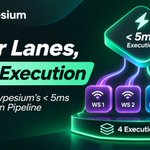
The interesting part of @Hypesium isn't simply that it targets execution under 5ms. It's how much work is completed before the trigger arrives.
On Elysium, blocks are produced every 100ms and there is no public mempool. That changes the usual execution environment because applications cannot rely on observing a public queue of pending transactions.
Here's how Hypesium approaches that problem:
➜ Preparation: The transaction route and calldata are constructed in advance, with gas configuration kept updated.
➜ Trigger: The system monitors the pool creation log instead of waiting to assemble everything after the event.
➜ Validation: A nonce check takes place at the critical stage.
➜ Submission: The prepared transaction is sent through four lanes simultaneously: two persistent WebSocket connections and two keep-alive HTTP connections.
The reason behind this design is straightforward. When blocks arrive every 100ms, reducing the amount of work after the trigger can make a meaningful difference.
But four submission lanes should not be confused with four successful executions or four independent confirmations. The documented under-5ms figure describes the hot path, not a guarantee of final transaction confirmation.
What I'd like to see over time is actual execution data: successful inclusion rates, missed opening blocks, reverted transactions and performance during network congestion.
That's how an interesting architecture becomes measurable infrastructure.
The real engineering question is not how fast a system can work in ideal conditions, but how consistently it performs when conditions become difficult.
Would you prioritize a faster hot path or more transparent execution statistics?

𝙰𝚜𝚒F retweeted

Alright, so let’s break this down who’s really raking in those venue points from the @atoma_fi vaults?
Well, Atoma snags 20% right off the top.
The other 80%?
That gets divvied up based on how much you chip in and how long you stick around.
So, it’s not just about the size of your deposit it’s a commitment thing, too.
But hey, there’s a little twist!
Rewards might shift if the venues decide to wrap things up, and let’s not forget those vaults come with their own set of market risks.
You know, just to keep things interesting.
Oh, and speaking of rewards, are they visible in real-time, or do they pop up after each epoch?
What’s the deal there?
𝙰𝚜𝚒F retweeted

Gm frens
a camera rule sounds small until you think about what it blocks. on @onlystreetsfun, a coin can only come from a photo taken inside the app, at the actual spot so nothing already floating around online can be launched.
that keeps the starting point honest. it doesn't make every coin good and nobody should read it as a promise of anything but it does change who gets to launch.
the campaign on rarelist is in its final hours so if you've been meaning to look, today is the last day.

𝙰𝚜𝚒F retweeted

Me checking my phone for updates on Soudian Node activity like it's the season finale. 😭😂
But seriously, there's more to the ecosystem:
→ Node Licences offer contractual participation in operating revenue.
→ 50% of the holder allocation is in USDT and 50% in $SUD.
→ $SUD is planned for launch in June 2027.
Real-world activity meets blockchain.
Sign up: soudian.ai/
@soudianAi

𝙰𝚜𝚒F retweeted

I've been looking for more ways to grow my X account, meet new creators and improve my content.
So when I saw this opportunity from @Canborsa_DEX, I knew I had to share it!
Canborsa is starting a 30-day Creator Program called Road to 1 Million.
The part I like most is that there are two leagues. This means small creators also get a fair chance to compete without having to fight bigger accounts. 😁
You don't need to be famous to start. Just share your ideas, make good content and keep showing up.
I think this is a nice chance for anyone who loves creating on X.
Who's joining me? 👇
canborsa.com/r/6MVZQ4SN
🤝 Paid partnership · 🤖 Made with AI


Creating content on X? Get paid for it 💵
We’re launching Road to 1 Million, a Creator Program where anyone can create content about Canborsa and earn rewards as their views grow!
The prize pool goes up to $10,000 and grows with every 200K views the community brings in together.
✰ Prizes for 32 top creators in two leagues
✰ Weekly Lucky Drop with 5 x $50
✰ $500 Creative Award for the best work
✰ Ticket to #TOKEN2049 Dubai
No follower minimum and no deposit required. Just create content and compete.
Join now→points.canborsa.com/creators
The interesting part of @Hypesium isn't simply that it targets execution under 5ms. It's how much work is completed before the trigger arrives.
On Elysium, blocks are produced every 100ms and there is no public mempool. That changes the usual execution environment because applications cannot rely on observing a public queue of pending transactions.
Here's how Hypesium approaches that problem:
➜ Preparation: The transaction route and calldata are constructed in advance, with gas configuration kept updated.
➜ Trigger: The system monitors the pool creation log instead of waiting to assemble everything after the event.
➜ Validation: A nonce check takes place at the critical stage.
➜ Submission: The prepared transaction is sent through four lanes simultaneously: two persistent WebSocket connections and two keep-alive HTTP connections.
The reason behind this design is straightforward. When blocks arrive every 100ms, reducing the amount of work after the trigger can make a meaningful difference.
But four submission lanes should not be confused with four successful executions or four independent confirmations. The documented under-5ms figure describes the hot path, not a guarantee of final transaction confirmation.
What I'd like to see over time is actual execution data: successful inclusion rates, missed opening blocks, reverted transactions and performance during network congestion.
That's how an interesting architecture becomes measurable infrastructure.
The real engineering question is not how fast a system can work in ideal conditions, but how consistently it performs when conditions become difficult.
Would you prioritize a faster hot path or more transparent execution statistics?
𝙰𝚜𝚒F retweeted

The final free spin lands The Big House, scoring CA$3,200 on Big Dog House! @Duelbits