

Earn a share of crypto trading fees with ready-made liquidity strategies or build your own. Non-custodial, gas sponsored.
London
Joined June 2026
- Tweets109
- Following18
- Followers51
- Likes113
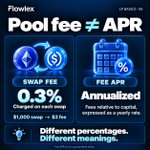








A pool says “0.3%.” Is that what you earn?
That’s the swap fee: a $1,000 swap generates $3 in fees. Eligible LPs share the LP portion according to their active liquidity.
Fee APR measures something else: fees relative to capital, expressed as an annual rate.
A higher swap fee doesn’t automatically mean higher LP earnings. Trading volume, your liquidity share, and time in range also matter.
When exploring strategies in Flowlex, keep these numbers separate: the swap fee describes the trade; estimated APR helps you compare scenarios.
Next lesson: how to read APR without mistaking it for a promise.

Same pool. Same position. Different fees each day.
Why does that happen?
Trading fees come from swaps, so your position’s daily earnings depend on what happens in the pool.
Three things to watch:
💧 Trading volume
The amount traded matters—not just the number of swaps. At an unchanged fee rate, more volume generates more pool fees.
👥 Your share of active liquidity
If other LPs add liquidity in your range, your share can shrink even though you haven’t changed your position.
📍 The price range
In concentrated liquidity, your position earns fees while its liquidity is active. Trading outside your range doesn’t generate fees for that position.
A simple example: if eligible LP fees double and your active share stays the same throughout, your fees double too. If your share halves at the same time, you could earn the same amount as before.
That’s why a busy day for the pool isn’t automatically a record day for every LP.
Flowlex helps you review your position, its range, and accrued fees. Compare several days to understand the activity behind the number.
Next: a pool’s fee percentage vs. APR—what’s the difference?

You’ve added tokens to a pool. So why does the app now show a “position”?
Your wallet
Lets you access your onchain assets and authorize actions, such as supplying tokens or withdrawing liquidity.
The pool
The shared liquidity that traders use for swaps. Many people can supply tokens to the same pool.
Your position
The record of your contribution. In concentrated liquidity, it has its own amount of liquidity, price range, and accrued fees.
For example: you and a friend both provide liquidity to an ETH/USDC pool. You choose different ranges and supply different amounts.
Same pool. Separate positions. Different fee results.
Once supplied, those tokens are committed to the pool’s contracts. They’re no longer an available wallet balance you can spend at the same time.
Flowlex helps you open and manage your position, check its range, and track its fees.
Next: why do trading fees change from day to day?

Where do liquidity providers’ trading fees come from?
From the people making swaps.
Imagine someone swaps $1,000 worth of tokens through a pool with a 0.3% swap fee.
$1,000 × 0.3% = $3 in swap fees.
That doesn’t mean every LP receives $3—or that the pool divides it equally between everyone.
The portion allocated to LPs is shared according to their contribution to the active liquidity serving the trade. Depending on the pool’s rules, some fees may also go to the protocol.
A simplified example:
If $2.50 is available for LPs and your share of the active liquidity stays at 10% throughout that swap, your position earns $0.25.
That’s why two people in the same pool can earn different amounts.
Flowlex helps you explore strategies, manage your position, and track accrued fees. The fees originate from swaps on the underlying DEX.
The 0.3% label describes the swap fee—not your investment return.
Next: what’s the difference between a pool, a position, and a wallet?

A brutal day for crypto security. An extraordinary stretch for trading activity.
The Binance and Polymarket incidents are terrible news for everyone affected. Meanwhile, some Uniswap pools are seeing unusually heavy volume—and substantial trading fees.
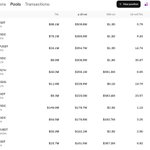
The snapshot below shows:
• ETH/USDT 0.3%: $509.8M in 24h volume
• ETH/USDC 0.05%: $389.5M
• WBTC/USDT 0.05%: $354.3M
For context, that ETH/USDT pool’s daily volume is roughly 39% of its displayed 30-day total.
For LPs whose liquidity remained active, this has meant exceptional fee opportunities. It also shows why LP earnings vary: fees follow trading activity.
One distinction matters when reading this screen: the 528% pool APR annualizes a single day’s fees. It isn’t a forecast, an individual LP’s return, or net profit.
At Flowlex, we’re making these mechanics easier to understand—from choosing a range to tracking a position and its fees.
Were your positions in range during the surge?

Just published Tokenized Assets Need More Than Tokens. They Need Liquidity. medium.com/@flowlexliq/token…
Who puts the tokens into a liquidity pool? People like you.
Last time, we explained how a pool makes an ETH → USDC swap possible. But those tokens have to come from somewhere.
Liquidity providers — LPs — supply them. An LP can be an individual, a team, or a professional market maker.
Here’s a simple example:
1️⃣ You add tokens to an ETH/USDC pool.
2️⃣ Your contribution creates a liquidity position.
3️⃣ Traders use the pool to exchange tokens.
4️⃣ When swaps use your active liquidity, you can earn a share of the trading fees.
You don’t need to find traders or handle their swaps yourself. The pool’s smart contract handles the exchange.
The fees come from trading activity. They aren’t fixed interest paid by Flowlex, and the mix and value of your tokens can change.
Flowlex brings pool exploration, ready-made strategies, and position management into one app — helping you take part as a liquidity provider.
Next: who pays the trading fees, and how are they shared?

You swap ETH for USDC. Where does the USDC come from?
On a decentralized exchange, it can come from a liquidity pool—a shared supply of tokens available for trading.
Imagine a pool containing ETH and USDC:
You send ETH into the pool.
The pool sends USDC back to you.
A smart contract—the software running the pool—handles the exchange and its pricing rules.
After your swap, the pool holds more ETH and less USDC. You don’t need to wait for another person who wants to make the exact opposite trade.
But who supplied those tokens?
People called liquidity providers. They make tokens available for swaps and can earn a share of the trading fees.
Flowlex helps you explore these pools and manage your own liquidity positions. You’re supplying tokens that other people can trade against.
Next: what does becoming a liquidity provider actually involve?
#flowlex

Your position is “out of range.” What does that actually mean?
When you provide concentrated liquidity, you choose a lower and an upper price limit. Your liquidity can earn trading fees while the pool price stays between them.
If the price moves outside that range:
• Your position stops earning new trading fees.
• Previously earned fees aren’t erased.
• The position’s liquidity is held in one of the two tokens.
• Its value can still change.
Going out of range doesn’t automatically mean losing your entire deposit. It also doesn’t mean your funds are protected from losses.
If you leave the position unchanged and the price returns to your range, it becomes active again and can earn fees from swaps.
You can also choose to change the range—but repositioning may involve token swaps and transaction costs. A new range doesn’t guarantee better results.
In Flowlex PRO, you can explore price ranges and scenarios before opening a position.
Already have one? Start with three checks: the current pool price, your range boundaries, and the token your position now holds.
Understand the status before deciding what to do next.

Flowlex PRO is now open to everyone.
One switch in the header unlocks:
→ Pick your pool
→ Draw your own range right on the price chart, with live estimated APR
→ PRO calculator: see what happens if the price moves, before you deposit
Your range. Your rules.
Flip PRO on at app.flowlex.com
Before opening a liquidity position, explore how it could work.
The Flowlex calculator lets you choose a strategy, adjust the amount and duration, and explore different price ranges.
But how should you read the estimate?
• Start with the tokens. Understand what your position will hold.
• Check the range. Your liquidity earns trading fees while the market price is within it.
• Look at the assumptions. An “always in range” scenario can look very different from one based on recent market activity.
Changing the inputs helps you compare scenarios. It doesn’t tell the calculator what happens next.
Trading activity changes. Prices move. Your position can leave its range and stop earning fees until the price returns. The tokens themselves can also lose value.
That’s why estimated fees aren’t the same as expected net profit.
Use the Flowlex calculator to understand the choices before opening a position—and look beyond the headline percentage.
Which would you like us to explain next: APR or price ranges?

Fees earned ≠ profit made.
Seeing $24.80 in claimable fees feels good. But it doesn’t tell you whether your position is profitable.
Two numbers matter:
• Position value: what the tokens in your liquidity position are worth now.
• Claimable fees: trading fees that have accumulated and are available to collect.
Here’s a simple example:
You start with $1,000.
Your tokens are now worth $950.
You have $24.80 in unclaimed fees.
Combined value: $974.80.
Overall result: −$25.20 before costs.
You earned fees, but the drop in your tokens’ value was larger.
This example assumes fees are shown separately, with no other deposits, withdrawals or previously collected fees. Always check the labels—some totals already include fees.
Flowlex shows your position and its trading fees so you can follow both. When reviewing your results, account for money added, money withdrawn, fees collected and transaction costs.
Look at the whole position, not just the fees.
Illustrative example, not an actual user result.

A liquidity pool, without the jargon
When someone swaps ETH for USDC, where does the USDC come from?
On a decentralized exchange, it can come from a liquidity pool: a shared supply of tokens that people make available for trading.
Here’s how it works.
A trader sends ETH into the pool and receives USDC in return. Software called a smart contract handles the exchange. There’s no need to find another person willing to make the opposite trade at that moment.
Where do the trading fees go?
The people supplying tokens are called liquidity providers. When a swap uses their liquidity, they can earn a share of the fee the trader pays.
That share depends on the pool’s rules and how much of their liquidity participates in the trade. Simply adding tokens doesn’t mean earning fees on every swap.
And what’s the catch?
As trading happens and prices move, you may end up holding more of one token and less of the other. Your position can lose value—even while earning fees.
Trading fees are income. They are not a guarantee of profit.
Where does Flowlex fit in?
Flowlex brings liquidity pools, ready-made strategies and position management into one simple app. It helps you access and manage this activity; it doesn’t pay you a fixed interest rate.
Understand where the fees come from before focusing on the percentage.

Where do the fees come from?
When people swap crypto on Uniswap, they pay a trading fee. By supplying tokens to a shared pool used for those swaps, you can earn a share of those fees.
Flowlex is a crypto fintech app for decentralized finance (DeFi). We make it simpler to add tokens to Uniswap pools, manage your position and collect fees.
We’re not an investment company paying you interest. We provide the tools; the fees come from trading activity.
What would you like us to explain next?
#flowlex #uniswap

Flowlex fees are now 0% for a limited time.
With Flowlex, you can earn a share of the fees people pay when swapping crypto and manage your positions in one app.
Try it for yourself: flowlex.com
Swap and bridging costs may apply.