

Protecting humanity’s first footsteps on the Moon & heritage across outer space. Building responsible governance through preservation | @hanlonesq @tdhanlon
Oxford, Mississippi
Joined March 2017
- Tweets5.3K
- Following932
- Followers2.1K
- Likes4.7K






Pinned Tweet
Thrilled to provide updates to the For All Moonkind Moon Registry, a living testament to humanity’s journey beyond Earth. We’ve added two remarkable missions—@fireflyspace Blue Ghost and @Int_Machines IM-2—to our catalog of human heritage on the lunar surface. These additions mark exciting milestones in our collective story as a spacefaring species, and we’re proud to document them for generations to come.
At For All Moonkind, our mission is to ensure that these sites—and the stories they tell—are recognized and protected as part of our shared human heritage. The Moon Registry, freely accessible to all, is more than a catalog; it’s a celebration of what we’ve achieved and a call to safeguard these irreplaceable footprints in the cosmos. As we update this dynamic resource, we’re reminded of the words of Apollo 16 astronaut Charlie Duke: “It’s one small way to share this accomplishment of humanity with humanity.”
We invite you to explore the updated Moon Registry at moonregistry.forallmoonkind.…
#ProtectTheBootprints!

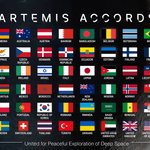
#ICYMI SEVENTY-SEVEN! Welcome to Republic of Uzbekistan to the Artemis Accords! Remember: You do not need a lunar mission today to have a stake in how the Moon is governed tomorrow. Humanity’s future on the Moon will reach far beyond the countries capable of getting there first, and every country should have a voice now in shaping the rules that will govern our shared future there.
Oh -- and that's 77 countries that now formally recognize there is cultural heritage that needs protection on the Moon!
#ProtectTheBootprints #Section9 #ArtemisAccords
lnkd.in/eWVt7s9R

For All Moonkind retweeted

Congratulations to the State of Arizona Space Commission for a forward-thinking initiative that connects space ambition with economic opportunity. I was pleased to contribute to a strategic planning hearing, and honored to testify alongside space luminaries and advocates @KKedisOgborn (who dashed out before the picture) @JustinWilmethAZ, Maj. Gen. Roger Teague and Brad Morrison. I, of course, focused on the opportunities provided by the international space law framework and highlighted how Articles IX and VI of the Outer Space Treaty can inform practical steps to support commercial growth and help Arizona shape emerging space practices.
It was especially meaningful to contribute to a Commission chaired by @brettmecum, a very distinguished graduate of our @Ctr4AirSpaceLaw @OleMiss Graduate Certificate program. And I came away with a new title: Arizona Space Marshal! I will serve proudly!
Arizona is thinking deliberately about how to attract companies, develop talent and help shape the future of commercial space. Excited to see this vision take flight! 🚀
#SpaceNeedsLawyers


For All Moonkind retweeted

Very enjoyable to deliver lectures alongside Michelle Hanlon of @OleMiss & @ForAllMoonkind, and many thanks to the @usunvie and @UNOOSA staff for bringing us all together.

For All Moonkind retweeted
The Outer Space Treaty is not so much a set of rules as a set of tools, with a modest set of built-in safeguards. At the second annual U.S. Space Forum in Vienna, I had the opportunity to explore how we can use those tools to build the next era of space governance.
I was proud to represent the University of Mississippi's Center for Air and Space Law at Ole Miss and contribute, alongside Christopher Johnson, to the academic programming through which participants earned an Executive Certificate. #OleMiss supported my participation, extending our work to equip professionals and policymakers around the world to engage with the legal foundations of space activities.
In my first presentation, we opened the toolbox. In the second, we put it to work on the Moon, starting with the plume effects of a landing spacecraft. When landing can send lunar dust and debris toward nearby equipment or historic sites, coordinating activities becomes a very practical concern. Safety zones offer one approach, fashioned from the interaction of Articles I, II, IX and XII: freedom of access, nonappropriation, due regard and reciprocal access to installations. The challenge is to protect operations while preserving the freedoms that make those operations possible.
These are questions every country has an interest in shaping, whether or not it currently operates in space. How we coordinate the first lunar activities will influence the opportunities available to those who follow, and the ability to reach the Moon should not be the price of admission to that conversation.
Tremendous kudos and my thanks to David A. Epstein. the U.S. Mission to International Organizations in Vienna and everyone who brought commercial innovators, international delegations and academics together for such thoughtful exchanges. The launch of #ProjectConstellation, connecting U.S. commercial innovators and university expertise with emerging space nations, offers an exciting opportunity to carry that engagement forward.
The tools are already in our hands. Building with them will take technical understanding, legal imagination and voices from around the world.
Always great to catch up with Mike Gold, Robin Dickey, Colleen Graffy, David Schuman, Fredrick A. Jenet, Ph.D.. M.C. Sungaila and so many others!
#USSpaceForum #SpaceLaw #ProjectConstellation #SpaceDiplomacy #UNVIE #SpaceNeedsLawyers


For All Moonkind retweeted

Commercial Space: Law in the New Space Economy 🚀
We’ve set the time! Join the Center for Air and Space Law @OleMiss for our exec course, Jan. 11–15, 11 am–1 pm Central US, $800 | No prerequisites | 10 hours | Fully online. Register today! olemiss.edu/airandspacelaw/c… #HottyToddy

For All Moonkind retweeted
I have had the honor of meeting @Astro_Cady a couple of times over the past few years, but until today I had never had the opportunity to hear her present. She is amazing. She makes extraordinary experiences feel accessible and invites everyone to see themselves as part of the story. I could have listened to her for hours.
Buy her book: Sharing Space: An Astronaut’s Guide to Mission, Wonder, and Making Change. You will NOT regret it. Thank you, Cady, for sharing your perspective so generously, for making us feel we could have been there with you, and for the shout-out to space law! It was really wonderful and heartwarming to see the line of people waiting to talk to you. Your words and your actions are truly inspiring.
More from the really fabulous @RadInstitute Institute Symposium on "Living Beyond Earth: Our Next Giant Leap" to come!

The first footprints on the Moon are still there. As lunar activity grows, how do we make sure they stay there?
Our co-founder @hanlonesq joined @purduegloballaw Dean Martin Pritikin to discuss lunar commerce, space law and the places that tell the story of humanity’s first steps on another world.
In the conversation, Michelle makes a distinction: the Moon is more than a source of resources. It is a place with meaning across cultures and generations, and a proving ground for how we will live and work in space. Protecting its historic sites belongs in the plans we make before the next wave of missions arrives.
Thank you to Purdue Global Law School for hosting this conversation.
Watch it here: youtube.com/watch?v=JVkj5MIk…
#ForAllMoonkind #LunarHeritage #SpaceLaw #ProtectTheBootprints

For All Moonkind retweeted
100%


As our Co-founder @hanlonesq would say, WOOOHOOO!
Albania does not need a lunar lander to have a stake in how humanity explores the Moon. By becoming the 73rd signatory of the Artemis Accords, Albania joins a growing community committed to peaceful exploration, transparency, scientific cooperation and the preservation of humanity’s historic sites in space.
The future of the Moon -- and of human history on the Moon -- should not be shaped only by the nations with the largest rockets or the earliest missions. Countries of every size have a role in establishing the values that will guide human activity as lunar exploration becomes sustained human presence.
Welcome Albania! The Moon belongs to no nation, but its history belongs to us all.
#ProtectTheBootprints #HumanHeritageInSpace #Section9 #ArtemisAccords @NASA
nasa.gov/organizations/oiir/…

For All Moonkind retweeted
Unfiltered theoughts in space weapons and the US Space Academy. spacelawandethics.substack.c…

For All Moonkind retweeted
As I have said repeatedly, the OST due regard provision creates a tremendous first mover advantage. In summary, the message from @NASAAdmin was clear: the next space race will be won by whoever can secure the Moon’s most valuable terrain, build permanent infrastructure there and use it as the springboard to Mars and beyond

JUST IN FROM THE ALL-IN SUMMIT: NASA Administrator Jared Isaacman just laid out his vision for America’s next phase in space.
Among his most notable remarks:
• NASA expects “dozens of landers” and “dozens of rovers” to head to the Moon over the next four years, alongside major robotics and lunar resource experiments.
• Isaacman said the lunar south pole has only a limited number of viable landing areas near permanently shadowed craters containing water ice, creating what he described as a race for a small number of strategic “parking spots.”
• He warned China is targeting the same region, intends to build a lunar base with Russia and “will get to the Moon.” Isaacman said China is now an “incredible rival” and that “the Chinese are extremely good in space right now.”
• Isaacman called SpaceX NASA’s “most important launch partner” and said the U.S. would be “seriously challenged in the high ground of space” without its capabilities.
• On Mars, he argued the hardest problem is not getting astronauts there, but getting them home - and said NASA should develop nuclear-powered transfer vehicles that reduce the need to manufacture return propellant on Mars.
• He said NASA’s SR-1 Freedom nuclear mission will be followed by “SR-2, SR-3, SR-4,” with technology ultimately aimed at destinations including Enceladus, Europa and Titan.
In summary, the message from @NASAAdmin was clear: the next space race will be won by whoever can secure the Moon’s most valuable terrain, build permanent infrastructure there and use it as the springboard to Mars and beyond.

71 States. One Moon. A Growing Consensus on How We Explore It.
Seventy-one States have now signed the Artemis Accords, with Türkiye becoming the newest signatory.
Why is that number important?
The Artemis Accords are not a treaty, nor are they a substitute for the work of the United Nations Committee on the Peaceful Uses of Outer Space. Their significance lies in the growing breadth of international support for practical principles that translate the Outer Space Treaty into conduct: transparency, interoperability, emergency assistance, sharing scientific data, avoiding harmful interference and (of course) preserving humanity’s historic sites on celestial bodies.
Seventy-one signatories also means that this conversation is no longer confined to the earliest space powers. States from every region, with very different levels of space capability and very different national priorities, are asserting an interest in shaping how humanity explores and uses the Moon.
Numbers alone do not create international law. Implementation is what will give the Accords lasting significance. As signatories coordinate missions, exchange information and develop shared practices, their conduct can help establish clearer expectations for responsible behavior where treaty language remains broad.
For All Moonkind is particularly encouraged that preservation of historic sites and artifacts is embedded in this growing framework. Protecting the places that record humanity’s first steps into another world is not peripheral to exploration. It is part of demonstrating that progress and preservation can advance together.
Seventy-one is not the finish line. It is evidence that a broad international community is forming around the proposition that lunar exploration should be peaceful, transparent, coordinated and attentive to the heritage that belongs to us all.
#ArtemisAccords #SpaceLaw #LunarGovernance #SpaceHeritage #ForAllMoonkind #ProtectTheBootprints

For All Moonkind retweeted
@AmericanAir you cannot start that flight to VIE soon enough!

✈️ @AmericanAir will add Vienna and Reykjavik to its European network in spring 2027 as it expands transatlantic flying from Philadelphia and deploys its growing @Airbus A321XLR fleet on five routes.
aviationweek.com/air-transpo…
#AmericanAirlines #Airbus

For All Moonkind retweeted
As the first week of the academic year @OleMiss draws to a close, we celebrate the talented student editors of the Journal of Space Law and the Journal of Drone Law and Policy -- already helping shape humanity's future!
🤖 Made with AI

For All Moonkind retweeted
A US Space Academy! This is an extraordinary and visionary step for the United States, and I could not support it more emphatically.
whitehouse.gov/presidential-…

China has postponed the launch of Chang’e 7 by approximately one month (or more depending on your news source), but the mission remains one of the most consequential steps yet toward humanity’s sustained presence on the Moon. Its lander, rover and hopping probe will search for water ice near the lunar south pole, where extraordinary scientific promise and growing operational pressures are beginning to converge.
Our Co-founder @hanlonesq spoke with @Astro_Jonny Jonathan O'Callaghan about the legal implications. The Outer Space Treaty prohibits national appropriation, but Article IX also requires States to act with due regard for the activities of others. Another mission could not land so close that its plume, dust or operations endangered China’s spacecraft or compromised its scientific measurements.
Due regard protects legitimate operations. It does not confer ownership of the lunar surface or allow any nation to reserve an entire resource-rich region.
The lunar south pole will test whether humanity can protect exploration, preserve access and manage shared spaces. We believe the perfect place to begin is with the sites of human history already on the Moon. If we can agree to protect humanity’s first steps, we can begin building the trust and cooperation needed to govern everything that follows.
Read the article: yahoo.com/news/science/artic…
#ForAllMoonkind #ChangE7 #LunarGovernance #SpaceLaw #Moon #ProtectTheBootprints

For All Moonkind retweeted
Our Executive Director @hanlonesq and our Adjunct Professor Ruth Pritchard-Kelly noth had something to say about the Earth's crowded orbit in this article by @Astro_Jonny @sciam. 1,000,000 satellites is ridiculous! Or is it?
#SpaceNeedsLawyers
scientificamerican.com/artic…

What goes up does not always come down. Sometimes it reaches the Moon.
Our co-founder @hanlonesq joined @TheDelWalters @scrippsnews to discuss the rocket body that struck the lunar surface and the growing quantity of human-made material throughout space.
This impact may offer scientists useful information about the Moon. It also offers another reminder that humanity’s activities leave lasting traces, whether in Earth orbit or on another celestial body. As lunar activity accelerates, we must become more deliberate about what we send, where it lands and what we intend to leave behind.
#ProtectTheBootprints #LiveLongAndProsper
vimeo.com/1215936950?share=c…

Fifty-five years ago today, #Apollo15 landed on the Moon. It marked a new chapter in lunar exploration. With the introduction of the Lunar Roving Vehicle, astronauts traveled farther from their landing site than ever before, conducting field geology on a scale previously impossible. The mission demonstrated that the Moon was not simply a destination, but a place where humans could work, explore and make discoveries.
One of Apollo 15's most memorable stories concerns what has become known as the Seatbelt Rock.
While driving the rover, Commander David Scott noticed an unusual basalt. The crew was behind schedule and an unscheduled stop was unlikely to be approved. Scott radioed that he needed to adjust his seatbelt. Instead, he quickly collected the sample before continuing on. The story is amusing, but it also illustrates something fundamental about exploration.
No mission plan anticipated that discovery. It resulted from a trained human observer recognizing significance in an unexpected moment and exercising judgment in real time. Exploration has always depended upon that uniquely human capacity.
As we prepare to return to the Moon, artificial intelligence and robotic systems will play an increasingly important role. They will make missions safer, more efficient and more capable. But they cannot fully replace the value of human presence. Humans ask new questions, recognize the unexpected and make intuitive decisions that often lead to the most important discoveries.
As humanity returns to the lunar surface, we should remember that exploration is not measured only by the distance we travel or the data we collect. It is also measured by our ability to observe, question and understand. The future of lunar exploration will be strongest when human ingenuity and machine intelligence work together, each contributing what the other cannot.
Apollo 15 reminds us that some discoveries begin not with a carefully scripted plan, but with the curiosity to stop and look a little closer.
#SpaceExploration #SpaceLaw #AI #Moon #HumanSpaceflight #ProtectTheBootprints

Fifty-five years ago today, #Apollo 15 launched for the #Moon. As we celebrate that extraordinary mission, we are reminded that the lunar surface already holds a rich record of human exploration, from scientific instruments and operational equipment to commemorative objects, bootprints and sites of enduring historical significance.
As activities expand beyond Earth orbit and onto the lunar surface, a new informational challenge is emerging. The Moon is no longer an unexplored environment. The need for practical information-sharing is becoming increasingly urgent as governmental and commercial lunar missions grow in number, geographic concentration and operational complexity. Future operators may conduct landing, surface mobility, communications, scientific and infrastructure activities in areas where previous missions have left operational equipment, scientific experiments, commemorative objects and sites of enduring historical significance.
Earlier this month, we were honored to submit a written consultation to the (take a deep breath, it's a long title) @UN Working Group on the Status and Application of the Five United Nations Treaties on Outer Space of the Legal Subcommittee of the Committee on the Peaceful Uses of Outer Space on the Topic of Information Sharing on Space Activities and Implementation of Article XI of the Outer Space Treaty.
You can read our full submission, prepared on our behalf by Michelle L.D. Hanlon, Marlène M. Losier, PhD, JD, Anne-Sophie MARTIN, Ph.D and Gregory Radisic, LLM here: forallmoonkind.org/wp-conten…
