

Posting pictures of the Korean War
Joined February 2026
- Tweets1.4K
- Following10
- Followers10.3K
- Likes387




In 1950, Greece had just come out of a brutal civil war of its own against communist forces. The country was exhausted and poor.
It sent troops to Korea anyway.
First came a squadron of Greek Air Force C-47 transport planes. During the Chosin Reservoir campaign in December 1950, Greek pilots were among those flying into a tiny, frozen airstrip at Hagaru-ri, surrounded by Chinese troops, to fly out wounded Marines and soldiers.
Then came a Greek infantry battalion, attached to the US 1st Cavalry Division and later the 3rd Infantry Division. Many of its men were veterans of the Greek Civil War who knew exactly what fighting communist guerrillas in mountains looked like.
They fought on some of the toughest hills in Korea. In June 1953, the Greeks were holding Outpost Harry, one of the most fought-over positions in the final weeks of the war, when the Chinese threw everything at it. The Greeks held.
Over the course of the war, more than 180 Greek soldiers were killed in Korea.
Greece had barely survived its own war. It still sent its sons to fight in someone else's.

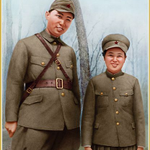
Kim Il Sung stands with his future wife Kim Jong Suk when they were anti-Japanese guerrillas in the 1930s

In December 1950, the UN was evacuating the port of Hungnam in North Korea. Chinese armies were closing in. Tens of thousands of terrified North Korean civilians crowded the docks, begging to get out.
One of the last ships there was the SS Meredith Victory, a merchant cargo ship. It was built to carry only 12 passengers.
Its captain, Leonard LaRue, looked at the crowd and made a decision. He ordered his crew to throw out cargo and load people.
They packed refugees into every space on the ship: cargo holds, decks, anywhere a person could fit. When they were done, there were about 14,000 people on board.
There wasn't enough food, water, toilets, heat, or medicine. The ship sailed through waters that might have been mined, with no escort.
It took three days to reach safety in South Korea. They arrived on Christmas Day.
Not one person died on the voyage. Five babies were born on the way. The crew nicknamed them Kimchi 1 through 5.
It went into the record books as the largest rescue from land by a single ship.
Among the refugees was a couple whose son would grow up to become the President of South Korea, Moon Jae-in.
And Captain LaRue? A few years later, he left the sea and became a Benedictine monk.

Richard Wilson grew up in Cape Girardeau, Missouri. He played right guard on his high school football team, then left school after his junior year and enlisted on his 17th birthday.
The Army made him a combat medic, then a paratrooper. Nine days before shipping out to Korea, he married his high school classmate.
On October 21, 1950, the day after the 187th Airborne's combat jump north of Pyongyang, Wilson was the medic with Company I on a patrol near Opa-ri.
The company walked into a valley surrounded on three sides by hills. The North Koreans opened up with mortars, machine guns, and rifles. Men went down everywhere.
Wilson went from one wounded man to the next, treating them in the open, completely exposed.
The company was ordered to pull back before it was surrounded. Wilson helped carry and drag the wounded out and made sure no one was left behind.
Then, after they'd escaped, he heard that a soldier they'd thought was dead had been seen moving, trying to crawl to safety.
Wilson's buddies told him not to go. He was unarmed. The enemy was still there.
He went back anyway.
Two days later, a patrol found him lying beside the wounded man. He had been shot several times while trying to shield and treat him.
Richard Wilson was 19. He was awarded the Medal of Honor posthumously.

Every child in North Korea grows up learning the story of Kim Il Sung, the "Great Leader" and founder of the country. Some of it is history. A lot of it is legend.
Here's what North Koreans are taught.
He liberated Korea from Japan. Schools teach that Kim's guerrillas defeated the Japanese Empire and freed the country in 1945. In reality, Kim spent the last years of World War II in the Soviet Union, and it was the Soviet army that drove the Japanese out of northern Korea. Kim came home on a Soviet ship.
He could "shrink distance." North Korean legend said Kim had mastered an ancient art that let him travel huge distances in an instant, appearing in one place and then another to confuse the Japanese. It became so widely believed that in 2020, North Korea's own state newspaper published an article explaining that he couldn't literally do it.
He worked miracles in the mountains. Stories passed down in North Korea say his guerrillas made bullets and grenades out of pine cones, crossed rivers on fallen leaves, and turned sand into rice.
America started the Korean War. North Koreans are taught that the US and South Korea invaded on June 25, 1950, and that Kim heroically defeated them. In reality, North Korea invaded the South with Stalin's approval, and Kim's army was saved from total destruction only when China sent hundreds of thousands of troops.
He is still the president. Kim died in 1994. North Korea later made him "Eternal President." His body lies preserved in a giant mausoleum in Pyongyang that North Koreans visit in silence.
Time itself starts with him. North Korea used a calendar that counted years from 1912, the year Kim was born. His birthday, April 15, is the "Day of the Sun," the biggest holiday in the country.
Even nature mourned him. When he died, North Korean state media reported that birds and animals grieved too.
And his son's legends got even bigger. North Korea says Kim Jong Il was born on sacred Mount Paektu under a double rainbow and a new star. He was actually born in the Soviet Union. State media also reportedly claimed he shot 11 holes-in-one the first time he played golf.
It's the longest-running personality cult in modern history. Three generations of one family, built on a story where the founder never lost, never fled, and never needed anyone's help.

The Forgotten War retweeted
In the summer of 1950, Gen. Walton Walker saved South Korea.
He commanded the US Eighth Army during the desperate defense of the Pusan Perimeter. He shifted his few reserves from crisis to crisis and famously told his troops there would be no more retreating. Stand or die.
He was a tough little Texan who'd been one of Patton's best corps commanders in World War II. The troops called him "Johnnie Walker," like the whiskey.
His son, Sam Walker, was also in Korea, serving as a young captain.
On December 23, 1950, in the middle of the UN retreat from North Korea, Walker was riding in his jeep north of Seoul, heading out to visit troops.
A South Korean army truck pulled out into the road. The jeep crashed into it. Walker was thrown out and killed.
The commander of an entire army, a man who'd survived World War II and the worst days of Korea, was killed in a traffic accident.
His son escorted his body home.
Walker's death brought in his replacement: Gen. Matthew Ridgway. Within weeks, Ridgway would turn the beaten Eighth Army around and start pushing the Chinese back north.
Sam Walker stayed in the Army too. He eventually became a four-star general, just like his father.

The Forgotten War retweeted
In mid-October 1950, as UN forces closed in on Pyongyang, the North Koreans loaded American prisoners of war onto trains and moved them north.
Many were already starving and sick after months in captivity. They traveled only at night, hiding in tunnels during the day so UN planes wouldn't see the train.
On October 20, the same day American paratroopers were jumping just a few miles away, the train stopped in a tunnel near Sunchon.
The guards tried to kill the prisoners with smoke first, stoking the engine inside the tunnel. When that didn't work fast enough, they began taking the Americans off the train in groups and shooting them.
More than a hundred American POWs were murdered.
Some survived by playing dead among the bodies. A few slipped away in the darkness.
Over the next days, troops of the 187th Airborne found the bodies scattered in ravines and fields near the tracks. Around 20 survivors were found alive, many barely, and flown out for medical care.
The paratroopers had jumped to rescue them. They arrived only hours too late.
It became known as the Sunchon tunnel massacre, one of the darkest moments of the war for American prisoners.

The Forgotten War retweeted
Woodrow Keeble was a Dakota Sioux from North Dakota. He was already a war hero before Korea. In World War II he fought on Guadalcanal, where fellow soldiers remembered him as a man who could throw a grenade like a baseball. Before the war, he'd been scouted by the Chicago White Sox.
By October 1951, he was a master sergeant with Company G, 19th Infantry, 24th Infantry Division.
On October 20, near Sangsan-ri, his company was stalled below a hill held by Chinese troops in three machine gun bunkers. Attack after attack had failed. Keeble was already wounded.
He went up alone.
Crawling up the slope under fire, he took out the first machine gun nest with grenades. Then the second. He was hit again and again by grenade fragments. He kept going and destroyed the third.
His company took the hill.
His officers recommended him for the Medal of Honor. The paperwork was lost. They submitted it again. It was lost again. He received the Distinguished Service Cross instead.
Back home, he suffered strokes that left him unable to speak. He even had to pawn his medals at one point. He died in 1982.
His family and supporters never gave up. On March 3, 2008, President George W. Bush awarded Woodrow Keeble the Medal of Honor, more than 56 years after he earned it.
He was the first full-blooded Sioux to receive it.

A paratrooper with the 187th Regimental Combat Team pauses momentarily while the man below clears the area over Korea in September 1951


Do NOT do any landscaping along the DMZ today

#BREAKING: North Korea orders border troops to take prompt action if South Korean forces threaten their safety.
The day after the 187th Airborne jumped north of Pyongyang, the North Koreans came for them.
On October 21, 1950, a North Korean regiment retreating north ran straight into the paratroopers' positions near Opari and Yongju. The North Koreans were desperate. The paratroopers were blocking their only way out.
The fighting was brutal and close. Companies of the 187th were hit by waves of attacking North Koreans. Positions were overrun and retaken. Medics crawled through the fire to reach the wounded.
The paratroopers held.
By the end of the fighting, the North Korean regiment had been shattered. The 187th killed and captured large numbers of enemy soldiers in the area over the following days.
The next morning, British and Australian troops of the 27th Commonwealth Brigade pushed north to link up with the paratroopers, and walked straight into another fight in an apple orchard near Yongju.
On the map, the jump looked like a clean success. On the ground, it was some of the hardest fighting the 187th would see in Korea.

Hmmm 🤔

North Korea has told its border troops to take "prompt and resolute action" if South Korean forces threaten their safety, state media said on Wednesday, raising the risk of a clash along the heavily armed frontier.
The report came a day after Seoul pledged to punish "resolutely" any further provocation by Pyongyang if North Korea acted on threats to strengthen its military posture along the border. cnn.it/4hZXGHx

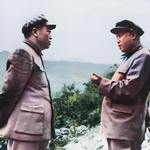
On October 21, 1950, two men met for the first time in a tiny mining village in the mountains of North Korea, near the Chinese border.
One was Kim Il Sung. Four months earlier, he had launched a war he was sure he'd win in weeks. Now his capital had fallen, his army had collapsed, and he was hiding near the edge of his own country.
The other was Peng Dehuai, commander of the Chinese People's Volunteers. Two nights earlier, his troops had started crossing the Yalu.
Peng had arrived almost alone. His army was still marching in the dark behind him, and his headquarters barely existed. He'd crossed the border ahead of his own troops with only a few aides and guards.
The meeting was awkward. Kim had lost almost everything and now depended on a foreign general to save his country. Peng quickly found out how little Kim actually knew about where his own forces were or what was left of them.
From that moment on, the real decisions in the war on the communist side were made by China, not North Korea.
Kim had started the Korean War. After October 21, 1950, it was Peng Dehuai's war to fight.


A member of the South Korean National Police holds the severed head of a North Korean communist guerrilla during the Korean War, 1952.


