

@FormulaPace
🇬🇧Account based in
About this account
- Account based in
- United Kingdom
- Connected via
- United Kingdom App Store
Account-level information from X, not a live location or the device used for a specific post.
F1 📊
Joined August 2023
- Tweets4.8K
- Following205
- Followers6.3K
- Likes7.4K




A very random observation I have made this year:
In the past we’re used to hearing that 10kg of fuel is worth around 0.3s per lap.
This year though, I’m finding that at every race it’s more like 0.5s per lap with these cars and engines.
I’m not really sure why that’s the case though, perhaps it’s energy related
Was completely spot on as per

Here’s the full explanation:
All year, HAM has done a phenomenal job with the early turn in and his tight lines.
With these cars, and these tyres, it’s the way forward. On traction, the cars have far less power at lower speeds out of corners, that minimising distance seems to pay off.
This weekend in COTA, it was a recipe for that to continue but for some reason HAM is doing the complete opposite of what he did on tracks like China and Hungary - as well as his peak years at Mercedes.
Images show - his lap in Q3 today at Turn 8 and Turn 15 vs his mighty pole lap from 2018. Shows exactly what I noticed from lap 1 this weekend.
He’s driving half a car width wider than he usually should, and it’s killing the fronts through the lap.
Requires a lot more steering lock to get it to the apex, and by the last corner the fronts are screaming for dear life and he’s struggled there a lot.
China, conversely, he was phenomenal at protecting the left front at turn 1 so it’s a surprise to see the inverse happening now.
Leclerc is following the lines HAM took in 2018 to a greater degree, especially through turn 15 and he seeks more comfortable in hooking up the last sector (I believe he had the outright purple S3 from his Q3 first run).
Images below


Udi retweeted

Here’s the full explanation:
All year, HAM has done a phenomenal job with the early turn in and his tight lines.
With these cars, and these tyres, it’s the way forward. On traction, the cars have far less power at lower speeds out of corners, that minimising distance seems to pay off.
This weekend in COTA, it was a recipe for that to continue but for some reason HAM is doing the complete opposite of what he did on tracks like China and Hungary - as well as his peak years at Mercedes.
Images show - his lap in Q3 today at Turn 8 and Turn 15 vs his mighty pole lap from 2018. Shows exactly what I noticed from lap 1 this weekend.
He’s driving half a car width wider than he usually should, and it’s killing the fronts through the lap.
Requires a lot more steering lock to get it to the apex, and by the last corner the fronts are screaming for dear life and he’s struggled there a lot.
China, conversely, he was phenomenal at protecting the left front at turn 1 so it’s a surprise to see the inverse happening now.
Leclerc is following the lines HAM took in 2018 to a greater degree, especially through turn 15 and he seeks more comfortable in hooking up the last sector (I believe he had the outright purple S3 from his Q3 first run).
Images below
I remember a few year back Rosberg mentioned something interesting about bumpy surfaces and how that negatively affects Hamilton due to how much emphasis he puts on having stable braking performance for his lap time.
This weekend it’s quite evident at T1, he’s not quite nailing it as he should.
It’s something that seems quite minor, but can make a big difference at times when it comes to having the confidence to throw the car around.
I don’t think it’s right to label it as a weakness, but rather just something that neutralises him and gives others a good chance of being faster.
I’d also say it’s something Leclerc excels with himself, hence his prowess on street tracks.
Since 2017 with the larger cars it’s hurt Lewis a lot more than it used to from 2007-16

Values from Singapore:
VER -1.067% HAD*
ANT -0.778% RUS*
LEC -0.136% HAM
NOR -0.173% PIA
ALO -0.457% STR
SAI -0.442% ALB
BEA -0.250% OCO
LAW -0.872% LIN
GAS -0.355% COL
PER -1.180% BOT*
Note - These values indicate the pace I’ve calculated following my criteria which is for the laps on the same tyre strategy only. This does NOT necessarily represent the pace over the full race distance, but rather to build a representative sample over the season.
*Hadjar & Russell spent entire race in traffic due to engine penalties. Bottas had brake overheating issue costing 1s per lap. All of which are not included in season averages.
V8s coming back

🚨 | BREAKING!
FIA president Ben Sulayem confirms F1 will return to V8 engines in 2030.
The new engines will be around 80kg lighter, with at least 50% lower R&D and engine costs.
Rwanda’s debut African GP is also expected to feature the new V8s.
📰 @Racingnews365c


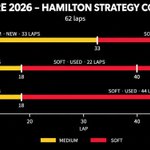
A deep-dive into Hamilton’s strategy calls in Singapore - What was the optimal decision to make?
I’ve had a chance to look at the observed data from the race and found:
- a new Soft would be 0.45s faster than a new Medium.
- Softs degraded non-linearly (average 0.06s per lap but not constant)
- Mediums degraded linearly by 0.035s per lap.
- The fuel penalty is 0.04s per lap.
Based on all this information, given Hamilton started on the Mediums the optimal strategy was to pit on Lap 33 for the Softs and run to the end. Of course there was a VSC but the decisions are during the race before it happened.
Pitting on Lap 19 gave them either the option to go to the end on Softs or do a two-stop.
Going Medium-Soft by pitting on Lap 19 for a used tyre is estimated to be 13.5s slower over the race than the predicted optimal.
Going Medium-Soft-Soft with two even Soft stints is estimated to be 3.5s slower over the race than the optimal.
So if we want to trace back the errors, it would be deviating from their original plan to go long on the Mediums.
Over the course of the race, the Mediums was the slower tyre so Hamilton dropping back from the front two on Softs was a facade. He would’ve gained it back later on with the compound offset.
Ferrari reacting to a ghost cost them, essentially and it left the driver and team in a pickle strategy wise.
So is Lewis right to take all the blame? I don’t believe so. Yes for not pitting when the VSC came out, but also Ferrari calling him in early was ultimately their undoing.
And this is exactly what I mean when I talk about incompetence and accountability. The Ferrari pit wall should know better than to deviate from their plan with the payoff later on.

Proof that F1 fans don’t actually know what drivers do

You definitely have to credit Mekies for turning it around this season at Red Bull. I doubt they’d be anywhere near race wins if they continued with Horner into 2026 looking at where they were in mid-2025.
They’ve had the best engine since Baku, aside from already having the best ICE confirmed.
Their car still lacks a bit in the corners but it’s not on a knife-edge so the performance is accessible.
What I’ll add though is that given the performance mainly comes from the engine, it may be slightly premature. If others catch up enough on the engine side then they may lose ground. Given the ADUO rules it’s possible going into 2027.
For now though, the package is working. Mercedes have not yet unlocked performance with their new upgrades and the Ferrari is way too slow on the straights to be a serious contender. McLaren seemed to be in a similar boat to Ferrari despite having a Merc engine.
Lewis doesn’t want to upset the team morale which in a way is good, but taking accountability for things that aren’t your doing also does nobody any favours.
The only way to fix incompetence is by constructively pointing it out.
Fact is, it shouldn’t be Lewis’ call to make whether he stays out or not if it’s clear and obvious it’s the wrong option.

